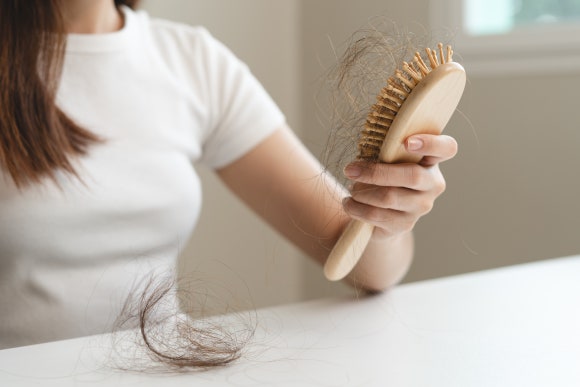
Many women experience sudden hair loss after childbirth.
The questions, “Can I take medicine for this?” and “Will it affect breastfeeding?” are among the most common concerns I hear in the clinic as well.

A recent review article published in an international dermatology journal analyzed the safety of hair loss treatments during breastfeeding from multiple angles¹.
I’ll explain its contents by focusing on the questions patients ask most often.
Q1. Why does hair loss happen after childbirth?
Hair loss that appears right after delivery is mostly due to hormonal changes.
During pregnancy, estrogen levels are high, so hair does not shed as easily. But after delivery, hormone levels drop rapidly, and telogen hairs fall out all at once.
This is called postpartum hair loss, and it usually recovers within 6 to 12 months.
However, some women experience delayed recovery, or existing female pattern hair loss worsens and requires treatment.
Q2. Are there treatments that can be used safely during breastfeeding?
Yes, there are.
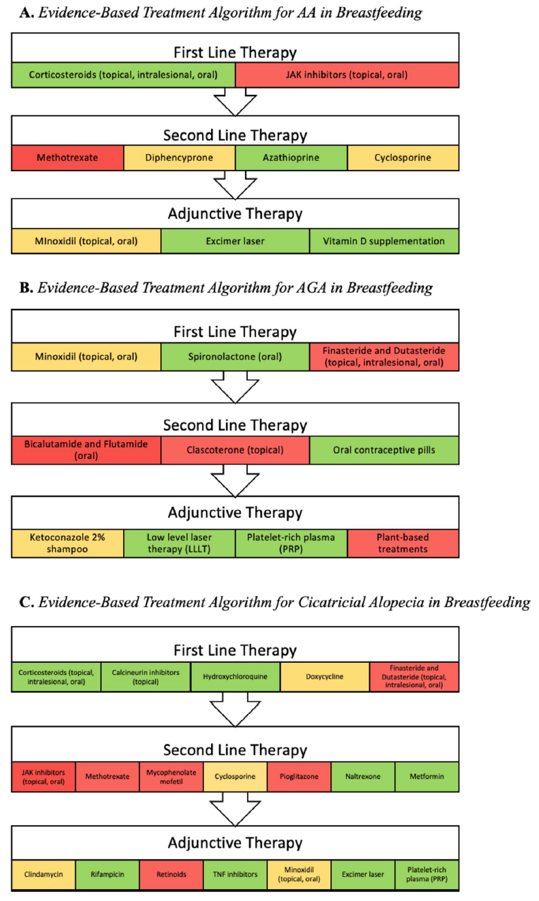
Topical steroids, oral prednisolone, injectable scalp steroids, PRP, and low-level laser therapy (LLLT) have all been reported as safe¹.
The important thing is to follow basic principles such as avoiding application to the nipple area and washing before breastfeeding.
| Treatment | Form | Safety assessment | Precautions |
|---|
| Prednisolone | Oral | Safe | High doses are recommended to be taken 4 hours before breastfeeding |
| Topical steroids | Ointment/lotion | Safe | Avoid the nipple area |
| Injectable scalp steroids | Injection | Safe | Use on areas other than the breasts |
| Spironolactone | Oral | Safe (low dose) | Use caution with high doses |
| PRP | Injection | Safe | Based on the patient’s own blood |
| Low-level laser therapy (LLLT) | Physical therapy | Safe | No systemic absorption |
Q3. Can minoxidil be used while breastfeeding?
It is a commonly used medication, but caution is needed.
There has been a reported case of temporary facial hypertrichosis in a child whose mother used high-concentration minoxidil¹.
Fortunately, it disappeared after the medication was stopped, but application around the nipples should definitely be avoided, and the principle is to use low-concentration products in the smallest amount possible.
Q4. Which medications must be avoided?
JAK inhibitors (such as tofacitinib and baricitinib), methotrexate, and finasteride/dutasteride formulations are contraindicated during breastfeeding¹.
This is because they have high transfer into breast milk or carry risks of teratogenicity and tissue retention.
| Treatment | Form | Recommended? | Reason |
|---|
| JAK inhibitors | Oral/topical | Contraindicated | High concentration transferred into breast milk |
| Methotrexate | Oral | Contraindicated | Accumulation in neonatal tissue |
| Finasteride/dutasteride | Oral/topical | Contraindicated | Possible risk of fetal malformations |
| Anti-androgens (such as flutamide) | Oral | Contraindicated | Hepatotoxicity, insufficient safety data |
Q5. Are there options other than medication?
Yes, non-drug treatments are also an option.
Low-level laser therapy (LLLT), excimer laser, and PRP do not significantly interfere with breastfeeding.
However, excimer laser may be associated with possible folate deficiency, so postpartum women are advised to take folic acid supplements together¹.
Q6. In the end, what should guide treatment decisions?
The most important thing is balancing the baby’s safety with the mother’s quality of life.
Even while breastfeeding, managing hair loss within a safe range can help avoid unnecessary anxiety.
Clinicians recommend a personalized approach that takes each patient’s situation into account, including the pattern of hair loss, feeding method, and medications being taken.
Postpartum Hair Loss: Can You Use Medication While Breastfeeding?
Summary
Postpartum hair loss is not just a hair issue; it is a life issue directly tied to self-esteem and the experience of motherhood.
Fortunately, recent research is making safety guidelines for treatment increasingly clear.
It is time to move beyond the old belief that medication must always be avoided and instead choose a treatment strategy that balances safety and effectiveness.
Now it’s time for Hairhair, Kim Jin-oh.
필생신모(必生新毛).
Written by: Kim Jin-oh, New Hair Plastic Surgery Clinic (Public Relations Director, Korean Society of Plastic and Reconstructive Surgeons / Academic Director, Korean Society of Laser Dermatology and Hair)
References
Needle, C.D., Brinks, A.L., Kearney, C.A., et al. (2025). Alopecia Treatments in Breastfeeding: Safety and Clinical Considerations. International Journal of Dermatology, 0(0), 1–20.
[This post was written directly by a board-certified plastic surgeon for informational purposes in accordance with Article 56, Paragraph 1 of the Medical Service Act. Hair transplant surgery and treatment may have side effects, and decisions should be made carefully through consultation with a specialist.]