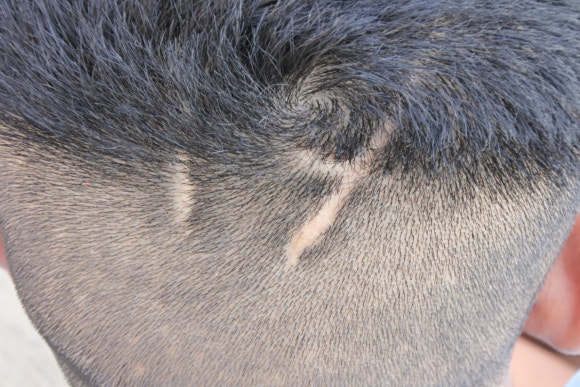
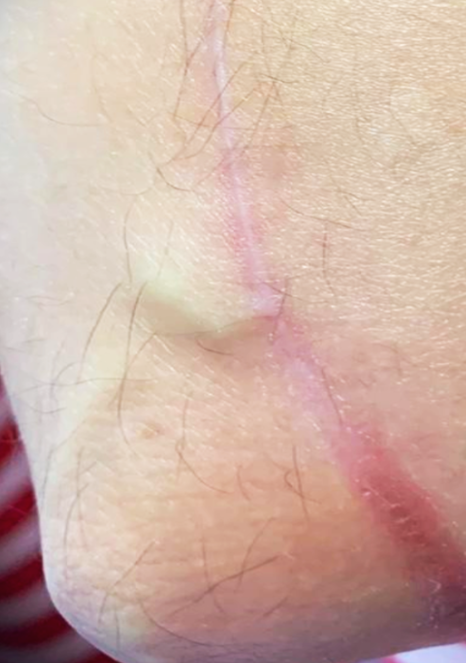
A photo of body hair growing at a surgical site
We usually think that when a wound occurs, a scar forms there and hair does not grow back.
However, recent regenerative medicine research is shaking up that common sense.
A phenomenon in which new hair follicles are created during the wound-healing process,
namely “wound-induced hair follicle neogenesis (WIHN),” is exactly that¹.
This discovery has opened up the possibility of creating new hair beyond simple scar healing.
In this article, I have summarized how WIHN works, its key signals, and its clinical implications.
Can wound healing lead to hair loss treatment?
Summary table of the new possibilities of “hair follicle regeneration”
| Category | Key Points | Clinical Significance |
|---|
| WIHN | New hair follicle formation during wound healing¹ | Potential to regenerate hair instead of forming scars |
| Key signals | Wnt·Shh·FGF9·TLR3·PGE2 | Regenerative pathways may be regulated |
| Microbial influence | Activated in the presence of normal bacteria⁴ | Skin microbiome environment is important |
| Treatment relevance | MTS, Microneedling, etc. | Greater potential for clinical application |
Q1. Can hair grow back when a wound occurs?
In general, when the skin is damaged, collagen is produced excessively, leaving a “scar,” and hair does not grow back in that area.
However, recent animal studies have reported a phenomenon in which new hair follicles are formed during wound healing, namely WIHN¹.
What is surprising is that these follicles were not derived from existing follicle cells, but were newly formed as epidermal cells in the skin redifferentiated¹.
In other words, this showed the possibility that “new hair can be created in adult skin if the conditions are right.”
Q2. Under what conditions are hair follicles newly formed?
Not every wound regenerates into hair follicles.
According to research, the following conditions are needed.
| Condition | Influencing Factor | Result |
|---|
| Age | Younger age has higher regenerative ability² | Larger wounds are needed with aging |
| Wound size | Must be above a certain size² | Too small = not possible |
| Elasticity of the wound area | Optimal in the 5–15 kPa range³ | Too hard or too soft suppresses regeneration |
| Skin microbiota | Activated in the presence of normal bacteria⁴ | Almost impossible in a sterile state |
In other words, new hair follicles can form only when an appropriate wound environment + immune response + microbial signals come together in harmony.
Q3. What signals induce hair follicle regeneration?
During wound healing, various signaling pathways are activated.
The five key ones are as follows.
| Major Pathway | Role | Features |
|---|
| Wnt/β-catenin | Essential for hair follicle formation¹ | Follicle formation is not possible when inhibited; doubles when activated |
| Sonic Hedgehog (Shh) | Converts fibrosis to regeneration⁵ | Guides wound tissue toward regeneration |
| γδT cells / FGF9 | Connects immunity and regeneration⁶ | Amplifies WIHN by strengthening Wnt signaling |
| TLR3 / dsRNA pathway | After damage detection, stimulates RA and IL-6/STAT3⁷ | Signal for new hair follicle formation |
| Prostaglandins (PGE2 / PGD2) | Inflammatory mediators | PGE2↑ promotes regeneration, PGD2↑ inhibits it⁸ |
These signals interact with one another and ultimately lead the skin to reorganize into follicular tissue instead of scar tissue.
Q4. Could this happen in humans too?
So far, WIHN has mainly been observed in mouse models.
However, because activation of the Wnt and Shh pathways in human skin
increases the expression of hair follicle-related genes, there is enough potential for future clinical application⁹.
In particular, Wnt activators (KY19382), PGD2 inhibitors (Ramatroban), and TLR3 agonists currently under development are being studied based on these regenerative principles.
Q5. Is this also related to the hair loss treatments we receive now?
Yes.
Microneedling, MTS, PRP, and similar treatments used in current clinical practice all use the principle of “regeneration stimulation through micro-injury.”
At this time, various growth factors, cytokines, and Wnt signals are activated during the wound-healing process, which follows the same biological direction as WIHN.
In other words, the field is opening up the possibility of advancing from stimulating existing hair follicles → to forming new hair follicles.
If regenerative medicine technologies become more sophisticated in the future, we may see a transition from an era of simply “transplanting” hair to an era of “creating” it.
It is now time for hairhair, Kim Jin-oh.
Pilsaengsinmo (必生新毛).
Written by: Kim Jin-oh, New Hair Plastic Surgery (Public Relations Director of the Korean Association of Plastic Surgeons / Academic Director of the Korean Society for Laser, Dermatology and Hair)
References
-
Ito, M., Yang, Z., Andl, T., et al., 2007. Wnt-dependent de novo hair follicle regeneration in adult mouse skin after wounding. Nature, 447, pp.316–320.
-
Xue, Y., Lim, C.H., Plikus, M.V., Ito, M., Cotsarelis, G. and Garza, L.A., 2022. Wound-induced hair neogenesis model. Journal of Investigative Dermatology, 142(10), pp.2565–2569.
-
Harn, H.I., Wang, S.P., Lai, Y.C., et al., 2021. Symmetry breaking of tissue mechanics in wound-induced hair follicle regeneration of laboratory and spiny mice. Nature Communications, 12, 2595.
-
Wang, G., Sweren, E., Liu, H., et al., 2021. Bacteria induce skin regeneration via IL-1β signaling. Cell Host & Microbe, 29(5), pp.777–791.
-
Lim, C.H., Sun, Q., Ratti, K., et al., 2018. Hedgehog stimulates hair follicle neogenesis by creating inductive dermis during murine skin wound healing. Nature Communications, 9, 4903.
-
Gay, D., Kwon, O., Zhang, Z., et al., 2013. Fgf9 from dermal γδ T cells induces hair follicle neogenesis after wounding. Nature Medicine, 19, pp.916–923.
-
Chen, D., Jarrell, A., Guo, C., Lang, R. and Atit, R., 2012. Dermal β-catenin activity in response to epidermal Wnt ligands is required for fibroblast proliferation and hair follicle initiation. Development, 139(8), pp.1522–1533.
-
Garza, L.A., Liu, Y., Yang, Z., et al., 2012. Prostaglandin D2 inhibits hair growth and is elevated in bald scalp of men with androgenetic alopecia. Science Translational Medicine, 4(126), 126ra34.
-
Ryu, Y.C., Lee, D.H., Shim, J., et al., 2021. KY19382, a novel activator of Wnt/β-catenin signalling, promotes hair regrowth and hair follicle neogenesis. British Journal of Pharmacology, 178(12), pp.2533–2546.
[In accordance with Article 56, Paragraph 1 of the Medical Service Act, this post is written directly by a board-certified plastic surgeon for informational purposes. Hair loss surgery and treatment may have side effects, and you should make a careful decision through consultation with a specialist.]