Female pattern hair loss is not just a cosmetic issue; it is a condition that can greatly affect quality of life and self-esteem.
Unlike male pattern hair loss, treatment options for women of childbearing age are limited,
so treatment options with fewer side effects and the ability to be used continuously have been steadily researched.
Among them, the drug that has recently been attracting attention is spironolactone.
Although it was originally a diuretic used to treat hypertension and edema, its action of suppressing male hormones (androgens) has led to its use as an adjunct medication in the treatment of female pattern hair loss¹.
Can spironolactone really help treat female pattern hair loss?
Summary table
| Item | Main content |
|---|
| Study design | Randomized, double-blind, placebo-controlled, 24 weeks¹ |
| Participants | 48 women aged 21–45 |
| Intervention | Spironolactone 100 mg/day + topical 3% minoxidil vs placebo + minoxidil |
| Effect | Increased hair density and thickness, improvement rate 38% vs 9%¹ |
| Side effects | Menstrual irregularity 37.5%, mild hyperkalemia 9.5%¹ |
| Safety | Overall favorable, electrolyte monitoring needed with long-term use⁴ |
| Clinical significance | High potential as an adjunct therapy that enhances the effect of minoxidil |
Q1. By what mechanism does spironolactone alleviate female pattern hair loss?
Spironolactone blocks androgen receptors in the body and inhibits the binding of DHT (dihydrotestosterone).
DHT is known to be a major cause of the gradual miniaturization of hair follicles and thinning of hair².
Therefore, spironolactone may help slow hair loss progression and restore the hair growth cycle.
It is also used together for androgen-dependent conditions such as acne and hirsutism,
and it has been reported to show relatively stable tolerability with long-term use³.
Q2. What results were found in actual studies?
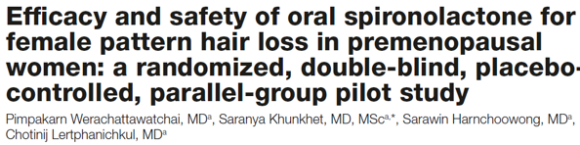
A study published in 2025 in the international journal Int J Women’s Dermatology analyzed the combined effect of spironolactone (100 mg/day) and
3% minoxidil in 48 women aged 21–45¹.
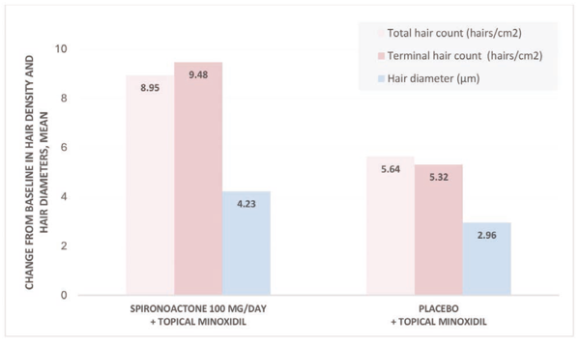
After 24 weeks, both groups showed improvements in hair density and thickness, but the group that
used spironolactone had a greater degree of improvement.
In particular, the proportion rated as having “moderate or greater improvement” on photo assessment was 38% in the spironolactone group and 9% in the placebo group.
This suggests that follicle activation effects may appear even in the short term.
Q3. What side effects should be considered when taking spironolactone?
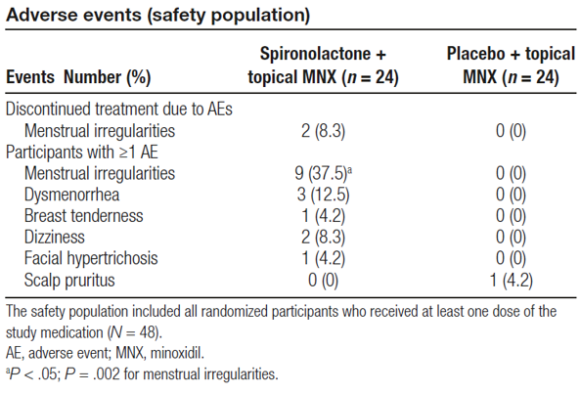
The most common side effect is menstrual irregularity (about 37.5%), and most cases were mild and recovered within 3 months after stopping the medication¹.
In addition, mild hyperkalemia (9.5%) was rarely reported, but it did not cause any special symptoms.
Therefore, for young women with normal kidney function, the risk is not significant, but electrolyte (especially potassium) monitoring is recommended with long-term use⁴.
For women who may become pregnant, it is important that use during pregnancy is prohibited, and using contraception
along with the medication is safer.
Q4. Can it be effective even at a low dose?
Recent studies have reported that even at low doses (25–50 mg/day), it can suppress hair loss progression and improve hair
thickness⁵.
In particular, lower doses may have a lower frequency of side effects, making them potentially suitable for long-term maintenance therapy.
In clinical practice, starting at 25–50 mg and gradually increasing the dose while observing symptoms and side effects is the most realistic approach.
This requires individualized adjustment based on the patient’s body weight, hormonal status, and menstrual cycle.
Q5. Should it be used together with minoxidil?
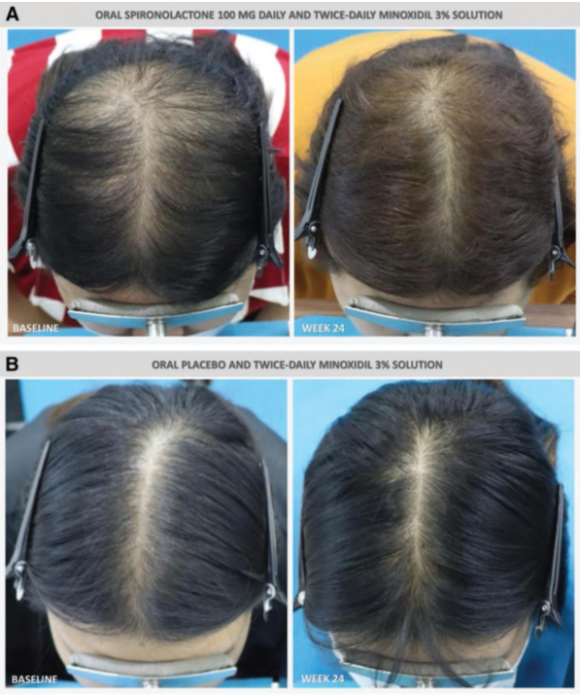
In studies as well, it was mostly used together with minoxidil¹.
This is because the two drugs have different mechanisms of action and therefore show complementary effects.
While spironolactone blocks hormonal pathways, minoxidil directly stimulates blood flow and growth factors in hair follicles.
Therefore, combination therapy may lead to a higher treatment response rate, but additional long-term studies are needed to prove the effect of monotherapy.
Spironolactone is not yet a standard treatment for female pattern hair loss, but it is becoming established as a clinically meaningful adjunct option.
In particular, for patients who do not achieve sufficient results with minoxidil, it can offer a new approach of “hormone-based hair loss suppression.”
However, for women of childbearing age, it is important to set an individualized dose through sufficient consultation with a medical professional while also managing contraception and menstrual cycles.
It is now time for hairhair, Kim Jino.
Pilsaengsinmo (必生新毛).

Written by: Kim Jino, New Hair Plastic Surgery Clinic (Public Relations Director, Korean Society of Plastic and Reconstructive Surgeons / Academic Director, Korean Society for Laser, Dermatology and Hair)
References
-
Werachattawatchai P, Khunkhet D, Harnchoowong S, Lertphanichkul C. Efficacy and safety of oral spironolactone for female pattern hair loss in premenopausal women: a randomized, double-blind, placebo-controlled, parallel-group pilot study. Int J Womens Dermatol. 2025;11:e227. doi:10.1097/JW9.0000000000000227.
-
Vargas-Mora P, Morgado-Carrasco D. Spironolactone in Dermatology: Uses in Acne, Hidradenitis Suppurativa, Female Pattern Hair Loss, and Hirsutism. Actas Dermosifiliogr. 2020;111(8):639-649. doi:10.1016/j.adengl.2020.03.015.
-
Burns LJ, De Souza B, Flynn E, Hagigeorges D, Senna MM. Spironolactone for treatment of female pattern hair loss. J Am Acad Dermatol. 2020;83(2):276-278. doi:10.1016/j.jaad.2020.03.087.
-
Wang C, Du Y, Bi L, Lin X, Zhao M, Fan W, et al. The efficacy and safety of oral and topical spironolactone in androgenetic alopecia treatment: a systematic review. Clin Cosmet Investig Dermatol. 2023;16:603-612. doi:10.2147/CCID.S398950.
-
Devjani S, Ezemma O, Jothishankar B, Saberi S, Kelley K, Senna MM. Efficacy of Low-Dose Spironolactone for Hair Loss in Women. J Drugs Dermatol. 2024;23(3):e91. doi:10.36849/JDD-D-23-00025.
[This post is being written directly by a board-certified plastic surgeon for information-sharing purposes in accordance with Article 56, Paragraph 1 of the Medical Service Act. Hair loss surgery and treatment may have side effects, so please make a careful decision after consulting with a specialist.]