Recently, the number of people receiving weight-loss injections such as Wegovy, Saxenda, and Mounjaro has increased sharply.
As they have become part of daily life, almost like a weight-loss routine, the issue arises when surgery or a procedure is coming up.
Surprisingly, many people ask whether it is okay to receive this injection and then undergo sedation or a procedure.
It is easy to think that simply fasting is enough, but these medications slow stomach movement, which can leave food in the stomach for longer and create unexpected risks.
Let’s go through the post below to look at how to prepare in detail.

Can You Have Surgery or a Procedure After Getting a Weight-Loss Injection? Facts You Should Know
Summary
GLP-1 weight-loss injections slow gastric emptying, so food may remain in the stomach.
Even with fasting, the stomach contents may not be fully emptied, which can increase the risk of aspiration during surgery.
In most cases, it is safe to continue the medication, but if you have symptoms such as bloating, vomiting, or nausea, or if your dose is being increased, you may need to temporarily stop the medication or reschedule the surgery.
Fasting before surgery, dietary adjustments, and advance consultation with the medical team are the keys to a safe procedure.
Q1. Why should you be careful before surgery if you are getting a weight-loss injection?
GLP-1 agonists have the effect of slowing stomach movement, causing food to stay in the stomach for a long time.
As a result, if sedatives or general anesthesia are used during surgery, remaining food can reflux into the airway and cause aspiration pneumonia¹²³.
In particular, once-weekly formulations such as Wegovy and Mounjaro last for a long time, so
the risk of stomach contents remaining is relatively higher even if you have fasted.
Q2. Are there actually such cases?
In real-world reports, there have been cases where aspiration occurred during surgery in patients who had received semaglutide (the active ingredient in Wegovy) even though they had fasted sufficiently³.
There have also been cases in which some patients who had received GLP-1 medication before an endoscopy still had food remaining in the stomach, leading to cancellation of the procedure¹².
For this reason, the American Society of Anesthesiologists once recommended stopping once-weekly formulations one week before surgery and daily formulations on the day of surgery⁴, but the guidance was later revised.
Q3. So do you no longer need to stop the medication now?
In new guidelines jointly announced by several medical societies after 2024, it was stated that most patients can continue taking the medication⁵⁶.
The following are exceptions.
| Category | Recommended medication stop or surgery delay |
|---|
| Symptomatic | Vomiting, bloating, nausea, feeling overly full |
| Dose adjustment period | When first starting the medication or increasing the dose |
| Conditions with reduced gastrointestinal motility | Diseases with slow digestion, such as diabetic gastroparesis |
| Long surgery planned | Procedures requiring general anesthesia or sedation |
Q4. How should fasting be done before surgery?
Before surgery, it is safest to follow the guidelines below⁷⁸.
| Food type | Stop time |
|---|
| Solid food | Fast until 8 hours before surgery |
| Clear liquids (water, black coffee, etc.) | Allowed until 2 hours before surgery |
| On the day of the GLP-1 injection | Continue if there are no symptoms; consider stopping the day before if sedation will be used |
If you have symptoms, adjusting your diet to a low-residue diet (foods that are easy to digest) starting the day before surgery can also be helpful.
Q5. What should be checked on the day of surgery?
On the day of surgery, it is important for the medical team to directly check the condition of the stomach.
Recently, gastric ultrasound has been used to check whether food remains in the stomach⁹¹⁰.
If food remains, the surgery may be postponed or changed to local anesthesia without sedation.
Q6. What are the differences between Wegovy, Saxenda, and Mounjaro?
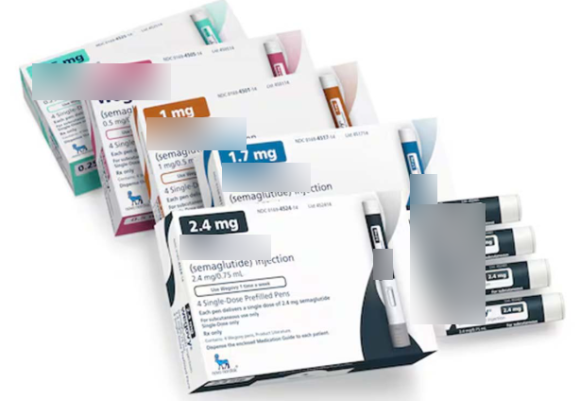
Diet medication
Source - Health Chosun
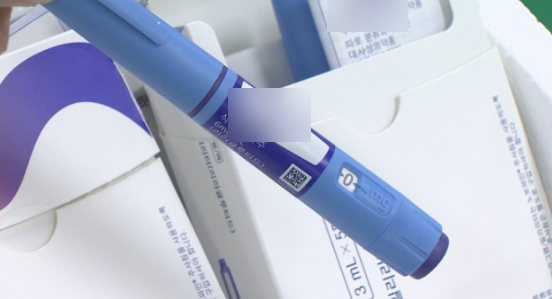
Diet medication
Source - Kukmin Ilbo
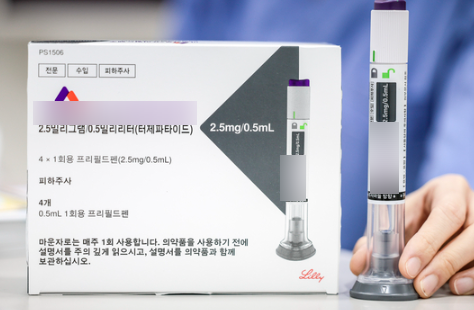
Diet medication
Source - JoongAng Ilbo
| Medication | Dosing schedule | Effect on gastric motility | Recommended pre-surgery adjustment |
|---|
| Wegovy (Semaglutide) | Once a week | Strongly slows | Consider stopping 1 week before surgery |
| Saxenda (Liraglutide) | Daily | Moderately slows | May stop on the day of surgery |
| Mounjaro (Tirzepatide) | Once a week | Slows even more strongly | Consider stopping during dose escalation |
Mounjaro stimulates both GLP-1 and GIP hormones at the same time, so the delay in gastric emptying may be stronger⁵⁶.
Q7. Does this also apply to procedures like hair transplantation?
Of course. Most hair transplants are performed under local anesthesia, but if sedation is used together, the same principles apply.
Before surgery, it is a good idea to discuss the medication dosing schedule, dosage, and whether you have gastrointestinal symptoms with the attending physician in advance,
and, if necessary, temporarily stop the medication or adjust the timing of the surgery.
Q8. In the end, how should you prepare?
If you are facing surgery or a procedure, it can be summarized in the following three steps.
| Step | Checkpoint |
|---|
| ① 1–2 weeks before surgery | Inform the medical team whether you are taking the medication and whether you have symptoms |
| ② The day before surgery | Stop solid food 8 hours before; consume only clear liquids |
| ③ On the day | Consider gastric ultrasound and adjust the schedule if symptoms are present |
In the end, the important thing is not a blanket stop, but individualized adjustment.
Most patients receiving weight-loss injections can safely undergo surgery,
but if symptoms or dosing patterns are ignored, unexpected complications can occur.
Sufficient consultation and checking before surgery are the first steps in ensuring safety.
Now it is time for hairhair to leave, this was Kim Jin-oh.
Pilsaengsinmo (必生新毛).

Written by: Kim Jin-oh of New Hair Plastic Surgery (Public Relations Director, Korean Society of Plastic and Reconstructive Surgeons / Academic Director, Korean Society of Laser Dermatology and Hair)
References
- Bai JQA et al. The Role of Psychological Stress in Hair Loss: A Review. JAAD Reviews. 2025. DOI: [10.1016/j.jdrv.2025.10.002].
quoted in the article: “Psychological stress has long been implicated in the pathogenesis and exacerbation of a multitude of hair loss disorders including telogen effluvium, androgenetic alopecia, and alopecia areata.”
- Choi S et al. Corticosterone inhibits GAS6 to govern hair follicle stem-cell quiescence. Nature. 2021;592(7854):428–432.
quoted in the article: “Chronic stress prolongs hair follicle quiescence by elevating corticosterone levels, which suppresses growth arrest-specific 6 (Gas6) expression in dermal papillae, thereby inhibiting activation of follicular stem cells and delaying regeneration.”
- Ma YQ et al. Oxidative stress and alopecia areata. Front Med. 2023;10:1181572.
quoted in the article: “In parallel, stress-induced neuropeptides including substance P and calcitonin gene-related peptide can promote neurogenic inflammation, a process characterized by peripheral nervous system activation and mast cell degranulation, leading to a pro-inflammatory milieu around the hair follicle.”
- Maloh J et al. Systematic Review of Psychological Interventions for Quality of Life, Mental Health, and Hair Growth in Alopecia Areata and Scarring Alopecia. J Clin Med. 2023;12(3):964.
quoted in the article: “Stress-induced neuropeptides including substance P and CRH contribute to alopecia areata pathogenesis by inducing apoptosis in follicular keratinocytes, stimulating mast cell degranulation, and disrupting hair follicle immune privilege.”
- Lee EY et al. The local hypothalamic–pituitary–adrenal axis in cultured human dermal papilla cells. BMC Mol Cell Biol. 2020;21(1).
quoted in the article: “Central to this process is the hypothalamic–pituitary–adrenal (HPA) axis, which when activated by stress, triggers the release of corticotropin releasing hormone (CRH), adrenocorticotropic hormone (ACTH), and ultimately glucocorticoids such as cortisol.”
- Manolache L & Benea V. Stress in patients with alopecia areata and vitiligo. J Eur Acad Dermatol Venereol. 2007;21(7):921–928.
quoted in the article: “Psychological stress may precipitate a premature shift of hair follicles from the anagen phase to the telogen phase of the hair cycle, mediated by increased cortisol secretion and downstream inflammatory signaling.”
-
Cipriani R et al. Paroxetine in alopecia areata. Int J Dermatol. 2001;40(9):600-601.
-
Wright KP et al. Influence of sleep deprivation and circadian misalignment on cortisol, inflammatory markers, and cytokine balance. Brain Behav Immun. 2015;47:24-34.
-
Kavadya Y & Mysore V. Role of Smoking in Androgenetic Alopecia: A Systematic Review. Int J Trichology. 2022;14(2):41-48.
-
Nam YJ et al. CRH receptor antagonists from Pulsatilla chinensis prevent CRH-induced premature catagen transition in human hair follicles. J Cosmet Dermatol. 2020;19(11):3058-3066.
-
Wikramanayake TC et al. Prevention and treatment of alopecia areata with quercetin in the C3H/HeJ mouse model. Cell Stress Chaperones. 2012;17(2):267-274.
[This post is written directly by a plastic surgery specialist for informational purposes in accordance with Article 56, Paragraph 1 of the Medical Service Act. Hair loss surgery and treatment may have side effects, and you should make a careful decision after consulting with a specialist.]