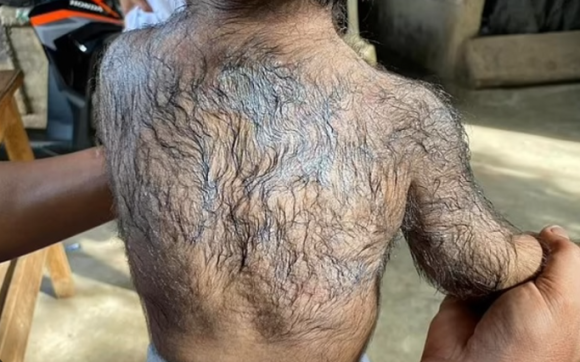
Hypertrichosis
Source - Health Chosun
Recently, the question of whether hair loss topical products applied by parents can also affect children has been asked much more often.
In particular, as reports¹² were published one after another in overseas cases showing that minoxidil applied by a parent came into contact with an infant’s skin and temporarily caused generalized hypertrichosis, interest in safety has increased.
Amid this trend, the Ministry of Food and Drug Safety decided to add the warning phrase, ‘Avoid contact between children and the application site,’ to domestic minoxidil products as well.
Why Does the Ministry of Food and Drug Safety Tell You to Keep Children Away from Minoxidil Application Sites? Summary
There have been cases in which minoxidil applied by a parent came into contact with an infant’s skin and caused temporary
hypertrichosis.¹²
Infants have a thinner skin barrier and higher drug absorption rates³, so
they are more reactive than adults.
In all reported cases, normal recovery occurred naturally within 2 to 6 months after exposure was stopped.¹²⁵
Accordingly, the Ministry of Food and Drug Safety added a warning
phrase to domestic products: ‘Avoid contact between children and the application site.’
Prevention is possible with simple changes in daily habits.
Q1. Can minoxidil applied by a parent affect a child too?
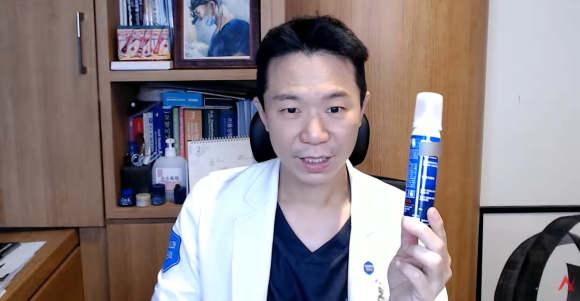

Looking at the cases that have actually been reported, there have been instances¹² where minoxidil applied to a parent’s scalp came into contact with an infant’s skin, causing hair to become thicker on the face, arms, and back.
This is because infants have a very thin stratum corneum and a high body surface area-to-weight ratio, making drug absorption more likely³.
In clinical practice as well, it is not uncommon for parents to visit because they notice their child’s fine facial hair has suddenly become thicker, and when the application timing and daily routine are checked, there are often cases where contact may have occurred.
Q2. Is it dangerous if this kind of change appears?
No long-term side effects have been reported in the cases published so far.¹²⁵
In a report from Spain¹, an 18-month-old infant almost completely recovered about 4 months after exposure was prevented, and three infants who were repeatedly exposed showed a pattern of hair becoming finer and naturally shedding² over 2 to 6 months.
Rather than being a dangerous toxic reaction, this can be understood as a temporary physiological response in which the drug acts in the infant’s body as it is.
Q3. Why does this change happen when minoxidil touches a child?
Minoxidil opens ATP-sensitive potassium channels, prolongs the hair growth phase, and causes vasodilation⁴.
If this mechanism is absorbed in a small amount through an infant’s skin, it can stimulate the hair growth phase like it does in adults, resulting in hair becoming thicker or more abundant.
Clinically, it is common for the fine hair on the arms, back, and face of minoxidil users to become darker, and infants may be especially likely to show this reaction more quickly and more broadly.
Q4. Why did the Ministry of Food and Drug Safety add a warning phrase?
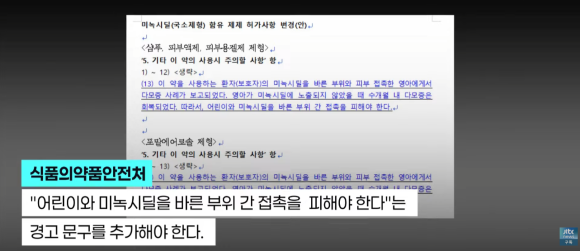

Source - JTBC News
Because overseas cases were confirmed one after another, it was verified that skin contact with infants and children can actually have an effect.
Accordingly, the Ministry of Food and Drug Safety announced that it would require the warning phrase ‘Avoid contact between children and the application site’ to be added to 47 domestic minoxidil products.
This can be seen as less about the drug being dangerous and more as a safety measure to prevent inadvertent close contact in daily life.
Q5. How can this be prevented at home?
The following measures alone are enough to prevent it.
| Situation | Recommended habit |
|---|
| Immediately after application | Wash hands thoroughly with soap |
| Times when you are close to the child | Avoid holding or sleeping together for 1–2 hours after application |
| Use before bedtime | Avoid if possible, or switch to daytime use |
| Prevent indirect contact | If needed, cover the application site with a cap or sleep cap |
| If unexpected contact occurs | Wash immediately + observe hair changes over the next few weeks |
Even if thicker hair has already appeared, most cases follow a pattern¹²⁵ of naturally disappearing once exposure is stopped, so there is no need for excessive worry.
Why Does the Ministry of Food and Drug Safety Tell You to Keep Children Away from Minoxidil Application Sites? Key Summary Table
| Item | Content |
|---|
| Main issue | Minoxidil application sites come into contact with infant skin, causing hypertrichosis |
| Why it happens | Infants have a higher drug absorption rate³ |
| Minoxidil mechanism | Prolongs the growth phase and causes vasodilation⁴ |
| Possibility of recovery | Natural recovery within 2–6 months¹²⁵ |
| Ministry of Food and Drug Safety action | Added the warning phrase “Avoid contact between children and the application site” |
| Prevention method | Manage application timing, wash hands, minimize contact |
Now it’s time for hairhair, Kim Jin-oh was here.
Pilsaengsinmo (必生新毛).

Written by: Kim Jin-oh of New Hair Plastic Surgery Clinic (Public Relations Director, Korean Society of Plastic and Reconstructive Surgeons / Academic Director, Korean Society of Laser Dermatology and Hair)
References
-
Rampon G, Henkin C, de Souza PRM, Almeida Jr HL. Infantile generalized hypertrichosis caused by topical minoxidil. An Bras Dermatol. 2016;91(1):87–88. cited “Infant developed generalized hypertrichosis after exposure to topical minoxidil from parent.”
-
Herskovitz I, Freedman J, Tosti A. Minoxidil induced hypertrichosis in a 2-year-old child. F1000Research. 2013;2:226. cited “Three infants developed hypertrichosis after repeated contact with minoxidil used by caregivers.”
-
Martínez-Rodríguez MSD, et al. Cutaneous and systemic side effects in paediatric patients exposed to systemic minoxidil. J Clin Med. 2021;10(18):4257. cited “Children have higher absorption due to thinner stratum corneum and higher surface area to body weight ratio.”
-
Tosti A, et al. Mechanisms of action of minoxidil. cited “Minoxidil acts by opening ATP-sensitive potassium channels, promoting vasodilation and prolonging anagen.”
-
Rai AK. Minoxidil-induced hypertrichosis in a child with alopecia areata. Indian Dermatol Online J. 2017;8(2):147–148. cited “Three-year-old child developed facial hypertrichosis after exposure to 5% minoxidil.”
[In accordance with Article 56, Paragraph 1 of the Medical Service Act, this post is being written directly by a board-certified plastic surgeon for informational purposes. Hair loss surgery and treatment may have side effects, and they should be decided carefully through consultation with a specialist.]