Could simply changing the time you wash your hair change the condition of your scalp?
Many people ask, “Should I wash it in the morning or at night?”
But the scalp changes throughout the day, and many factors accumulate, including sebum, moisture, the microbial environment, and exposure to pollutants.
Recent studies have shown that the scalp becomes easier to redden during the day, sebum increases, and barrier function declines².
Based on the questions patients ask most often, we have organized the differences between morning shampooing and evening shampooing,
scalp circadian rhythm, changes in sebum and microorganisms, and their relationship with hair loss.
Hair Loss Shampoo Method: Is It Better for the Scalp to Wash Your Hair in the Morning or at Night? Summary
There is no evidence that the timing of shampooing itself directly causes hair loss¹.
The scalp tends to show increased redness, moisture, pH, and sebum during the day, while barrier function declines² → the chance of pollutant accumulation during the day increases.
Increased sebum and microbial changes (Malassezia) are associated with dandruff and seborrheic dermatitis³⁴.
Changes in sebum, microorganisms, and pollutants can cause microinflammation and may be linked to the progression of hair loss⁵⁶.
For oily scalp, dandruff, seborrheic dermatitis, and occupations with heavy external exposure → evening shampooing is recommended.
For indoor lifestyles and dry scalp → morning shampooing is also fine.
Above all, the quality and consistency of cleansing are more important than the time.
Q1. Between morning shampooing and evening shampooing, when is the better time to help prevent hair loss?
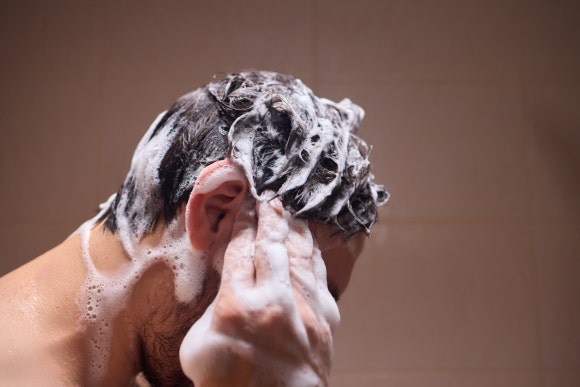
There is no single “correct time” that directly reduces hair loss¹.
However, the scalp tends to show increased sebum, moisture, and pH during the day, while barrier function declines². If the sebum, dust, fine particles, sweat, and product residue that accumulate during this time remain for too long,
it can easily lead to microinflammation on the scalp.
Washing in the evening has the advantage of removing these pollutants and keeping the scalp clean for the longest continuous period, which is sleep time.
Q2. Why do people often say washing at night is better for the scalp?
According to research, during the day,
-
scalp redness increases
-
moisture levels change
-
pH rises
-
sebum increases
-
barrier function weakens
all occur at the same time².
This time of day is when fine dust, pollutant exposure, ultraviolet rays, and sebum oxidation overlap, and scalp stress accumulates.
Sebum is good food for microorganisms such as Malassezia³⁴, and excessive activity can cause dandruff and seborrheic dermatitis. There are reports that these inflammatory responses are also associated with androgenetic alopecia⁵.
Therefore, cleansing in the evening to remove the day’s accumulated pollutants becomes a way to manage the overall scalp environment more stably.
Q3. If washing at night is better, what precautions must be followed?
There is one key point: complete drying
A wet scalp, as temperature and humidity rise, becomes an environment optimized for microbial growth.
For people with dandruff or seborrheic dermatitis, in particular,
-
falling asleep with the scalp still wet
-
sleeping while covered with a thick hat or blanket
-
a sweaty sleeping environment
can worsen these symptoms.
If you choose evening shampooing,
the rule is simply: completely dry the scalp → then go to sleep. If you follow this strictly, there are almost no downsides.
Q4. What scalp types can wash their hair in the morning?
If you meet the following conditions, morning shampooing is natural and fine.
If you have an oily scalp, dandruff, or seborrheic dermatitis, morning shampooing alone may not properly clear away the buildup that accumulates during the day, so it is better to change to a routine that includes cleansing once a day in the evening.
Q5. Is it true that washing your hair more often makes it fall out more?
Several studies have confirmed that this common belief lacks scientific evidence¹.
The hairs that come out during shampooing are the hairs that were already scheduled to shed that day.
In fact, adequate cleansing, removal of sebum and pollutants, and maintaining an appropriate microbial balance help reduce scalp stress and maintain a healthy condition.
Hair Loss Shampoo Method: Is It Better for the Scalp to Wash Your Hair in the Morning or at Night? Summary Table
| Category | Morning Shampooing | Evening Shampooing |
|---|
| Effectiveness in removing scalp buildup | Low (removes only sebum accumulated overnight) | High (removes pollutants accumulated during the day) |
| Convenience for styling | High | Medium |
| Oily scalp, dandruff, seborrheic dermatitis | Not recommended | Recommended |
| Occupations with heavy exposure to fine dust and outdoor activity | Not recommended | Strongly recommended |
| Dry scalp | Suitable | Suitable |
| Precautions | None | Complete drying is essential |
| From a hair loss prevention perspective | Moderate | Slightly better |
From now on, this has been Hairhair time, Kim Jino.
Pilsaengsinmo (必生新毛).

Written by: Kim Jino of New Hair Plastic Surgery (Public Relations Director, Korean Society of Plastic and Reconstructive Surgeons / Academic Director, Korean Society of Laser Dermatology and Hair)
References
-
Punyani S., Tosti A., Hordinsky M., Yeomans D., Schwartz J. (2021). The Impact of Shampoo Wash Frequency on Scalp and Hair Conditions. Skin Appendage Disorders, 7(3), 183–193. cited: “A daily shampoo regimen was found NOT to affect hair and scalp conditions adversely.”
-
Piérard-Franchimont C., Henry F., Loussouarn G., Saint-Léger D., Piérard G-E. (2007). Circadian chronophysiology of the scalp. Pathologie Biologie (Paris), 55(6), 283–287. cited: “The early afternoon was the time of maximum increase in redness, hydration, pH and sebum output, combined with decreased skin barrier function.”
-
Ro B.I., Dawson T.L. (2005). The role of sebaceous gland activity and scalp microfloral metabolism in the etiology of seborrheic dermatitis and dandruff. Journal of Investigative Dermatology Symposium Proceedings, 10(3), 194–197. cited: “Most common scalp flaking disorders show a strong correlation with sebaceous gland (SG) activity.”
-
Salamanca-Córdoba M.A. et al. (2021). Seborrheic dermatitis and its relationship with Malassezia spp. Infectio, 25(2), 120–129. cited: “Seborrheic dermatitis (SD) is a chronic inflammatory disease that typically occurs as an inflammatory response to Malassezia species.”
-
Suzuki K. et al. (2021). Scalp Microbiome and Sebum Composition in Japanese Male Individuals with and without Androgenetic Alopecia. Microorganisms, 9(10), 2132. cited: “Changes in sebum composition and/or the scalp microbiome may be involved in AGA development and progression.”
-
Samra T., Lin R.R., Maderal A.D. (2024). The Effects of Environmental Pollutants and Exposures on Hair Follicle Pathophysiology. Skin Appendage Disorders, 10(4), 262–272. cited: “Some pollutants, such as particulate matter, trigger inflammatory responses and have been associated with alopecia areata.”
[In accordance with Article 56, Paragraph 1 of the Medical Service Act, this post is written directly by a board-certified plastic surgeon for informational purposes. Hair loss surgery and treatment may have side effects, and you should make a careful decision after consulting with a specialist.]