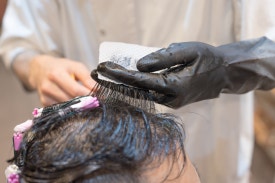
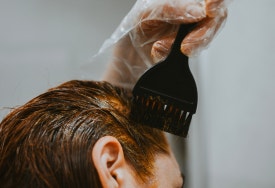
Hairstyling is more than just beauty; it is a means of self-expression.
But when you repeat perming, dyeing, and bleaching, it is natural to start wondering, “Is this really causing hair loss?”
In reality, damage to the hair shaft and changes in the hair follicle are two different concepts, and if you do not understand this difference, unnecessary anxiety can easily grow.
This is a summary based on the latest research and clinical experience, focusing on the questions most often asked in the clinic.
Why Does Hair Perming, Dyeing, and Bleaching Sometimes Feel Like It Makes Hair Loss Worse?
Summary
| Category | Key points |
|---|
| Direct effects of perming, dyeing, and bleaching | Damage to the hair shaft, not the follicle → increased breakage and snapping¹² |
| Why it seems like hair is “falling out” | When broken hairs without roots increase, it can be mistaken for a visible reduction in hair volume |
| When scalp irritation is present | Burning or stinging is a sign of inflammation → repeated episodes can increase follicles in the resting phase¹ |
| Combination of traction (pulling) + chemical procedures | The most risky scenario: traction alopecia and chemical damage working together⁶⁷ |
| When there is a tendency toward hair loss | The follicles are already weaker, so adjusting the interval and strength of procedures is essential⁵ |
Q1. Can dyeing or perming actually cause hair loss?
In most cases, it is damage from breakage, not hair loss where the root is pulled out.
Perming, dyeing, and bleaching act on the hair shaft that has already grown out.
While the chemicals open the cuticle and change the structure, the hair protein is easily damaged, and as a result, the hair may break without strength or fall off as if the middle section has been cut away¹².
Even electron microscopy studies have shown that healthy hair has an even, smooth surface, whereas hair that has undergone repeated strong bleaching shows a torn cuticle-like appearance³.
The feeling that “hair is falling out” likely reflects damaged hair breaking and dropping out in large amounts.
Q2. Does that mean it has nothing to do with permanent hair loss?
If the scalp is safe, it is usually not directly linked to permanent hair loss.
The hair follicle is located in relatively deeper tissue, and chemical procedures rarely destroy the follicle directly.
The problem arises when the scalp is severely irritated.
If you felt burning or stinging during the procedure, an inflammatory reaction in the form of contact dermatitis has already occurred, and if it is repeated, follicles may shift into the resting phase, causing a temporary increase in shedding¹.
Most cases recover, but if strong irritation continues, the follicles may lose their ability to recover, which can lead to reduced density.
Q3. How can you tell broken hair from actual hair loss?
Whether the root is present is the key.
Breakage → hair snaps in the middle without a root
Hair loss → hair with a white root at the end
If, after brushing or showering, there are many short hairs with sharply cut ends on the floor, the effect of chemical procedures is likely greater.
On the other hand, if a large number of normal-length hairs with roots attached are falling out, scalp conditions
(inflammation, hormones, other diseases) should be considered.
Q4. Why does the crown seem to have less hair when bleaching or dyeing is done frequently?
Because long, healthy shafts that maintain volume decrease.
Damaged hair loses elasticity and strength, so it looks less full.
The crown is the area that receives the most light, so the more severe the shaft damage, the easier it is for it to look sparse due to an optical illusion.
Many people mistake this for progressing hair loss.
Q5. What happens if you keep perming and dyeing when your scalp is sensitive?
If inflammation accumulates, follicle recovery may decrease.
When scalp inflammation, flaking, and stinging keep recurring, follicles are pushed into the resting phase and shedding increases¹.
In particular, if you already have male-pattern or female-pattern hair loss, the follicles are already vulnerable to stress, so when chemical irritation is added, the progression may appear faster⁵.
Therefore, the criteria for procedure intervals, chemical strength, and scalp protectants should be adjusted for each individual.
Q6. What is the most dangerous combination?
It is when chemical damage and traction (pulling) occur at the same time.
Traction alopecia occurs from sustained tension, such as tight tied-up hair, hair extensions, or braids.
If this is combined with hair that has already been weakened by bleaching or dyeing, the follicles have a harder time holding up, increasing the risk of even scarring changes (scarring hair loss)⁶⁷.
Areas with naturally lower density, such as the hairline and temples, are especially vulnerable.
Q7. How should someone who already has hair loss manage it?
The important question is not whether to do the procedure, but how to do it.
For people with a tendency toward hair loss, the follicles are already less resilient, so it is necessary to lengthen the interval between procedures, apply products in a way that avoids direct contact with the scalp, adjust the strength of the chemicals, and minimize the intensity of procedures on vulnerable areas such as the crown and front hairline.
If the stimulation from procedures becomes stronger than the rate at which treatment can protect the follicles, the perceived speed of hair loss may increase.
Q8. Do I have to stop dyeing completely?
No. The key is the interval, strength, and scalp response.
People with a healthy scalp can continue procedures without major problems if they maintain appropriate intervals.
On the other hand, if your scalp is weak or hair loss is already progressing, it is better to closely observe the scalp’s response each time and develop personalized criteria.
If stinging is severe during the procedure, it is safest to stop immediately.
That moment is a clear signal from the scalp.
Now it is time to hairhair, Kim Jin-o.
필생신모(必生新毛).
Written by: Kim Jin-o, New Hair Plastic Surgery Clinic (Public Relations Director, Korean Society of Plastic and Reconstructive Surgeons / Academic Director, Korean Society for Laser, Dermatology and Hair)
References
- Dias, M.F.R.G. (2015) Hair cosmetics: an overview. International Journal of Trichology, 7(1), 2–15.
cited: Hair cosmetics are also an important tool for increasing patient’s adhesion to scalp treatments, according to the diversity of hair types and ethnicity.
- He, Y., Liu, X., Song, S. et al. (2023) Mechanisms of impairment in hair and scalp induced by hair cosmetic products. Clinical, Cosmetic and Investigational Dermatology, 16, 1205–1217.
cited: Hair dyes and perms alter hair color and/or shape by mechanically changing the physical structure and chemical substances of the hair shaft.
- Kim, D.H., Park, Y., Lee, J. (2024) Effects of excessive bleaching
on hair: comparative analysis of external morphology and internal microstructure. Applied Microscopy, 54, 12.
cited: SEM analysis of normal hair revealed a relatively clean surface with intact cuticle scales, while bleached hair showed brittle, torn scales with a rough appearance.
- Lee, Y., Huh, C.H., Kim, B.J. (2014) Comparison of hair shaft damage after chemical treatment in different ethnic hair types. International Journal of Dermatology, 53(5), 601–607.
cited: The goal of this study was to investigate differences in patterns of serial damage in Asian, White European, and African hair after repeated chemical treatments.
- Cedirian, S., Tasset, C., Saint-Martory, C. et al. (2025) The exposome impact on hair health: etiology, mechanisms, and strategies for protection. International Journal of Cosmetic Science, 47(2), 89–104.
cited: Chemical treatments encompass bleaching, coloring, perming, and chemical straightening, and extended and repeated exposure can alter hair texture and increase fragility.
- Billero, V., Miteva, M. (2018) Traction alopecia: the root of the problem. Clinical, Cosmetic and Investigational Dermatology, 11, 149–159.
cited: The prevalence of traction alopecia remains high in communities that practice tight braiding of the hair and especially when relaxer use is combined with these styles.
- Geisler, A.N., Taylor, S.C., Lim, H.W. (2022) Hairstyling practices to prevent hair damage and alopecia in women of color. Cutis, 109(2), 98–102.
cited: Patients are advised to apply these styles with as little traction as possible and to avoid leaving extensions or weaves in place for longer than two or three months.
[This post was written directly by a board-certified plastic surgeon for informational purposes in accordance with Article 56, Paragraph 1 of the Medical Service Act. Hair loss surgery and treatment may have side effects, and you should make a careful decision after consulting with a specialist.]