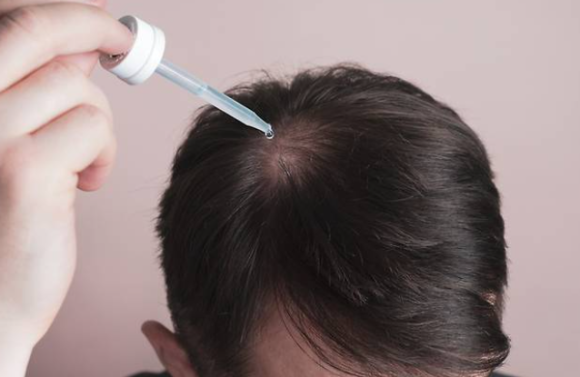
Source - Kormedi.com
Recently, there has been an ingredient drawing attention in both hair loss communities and the investment market.
It is the topical formulation called clascoterone.
While most existing hair loss treatments are oral medications or topical minoxidil-based products,
this ingredient has a unique mechanism that locally weakens androgen signals in the scalp, and it is being evaluated as a new treatment candidate.
In particular, after the release of large-scale clinical results involving more than 1,000 participants, questions have been pouring in about whether it could become an alternative to existing treatments.
Today’s post organizes only the key questions patients are asking, based on actual papers and presentation materials.
Clascoterone Hair Loss Treatment: How Is It Different from Existing Medications?
Summary
Clascoterone is an ingredient that was first approved as an acne treatment,
and it works by suppressing androgen effects only in the skin¹².
In hair loss clinical trials, significant hair growth compared with placebo was confirmed³⁴, and a statistically meaningful
result was reaffirmed in a recent study of 1,465 participants⁴.
However, the absolute increase is limited, and expressions of seemingly large
relative improvement percentages can be misleading.
Safety is relatively favorable¹²⁵. However, more long-term data are needed.
There are also results showing that its effect was somewhat weaker than minoxidil⁶.
It is a promising new option, but it is still too early to call it a replacement for existing treatments.
Q1. How does clascoterone work for hair loss?
How is it different from existing medications?
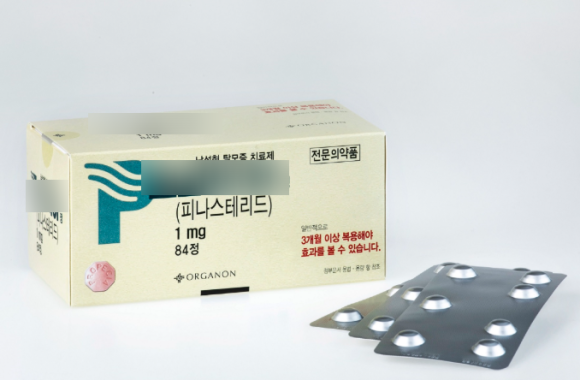
Finasteride
Source - Health JoongAng
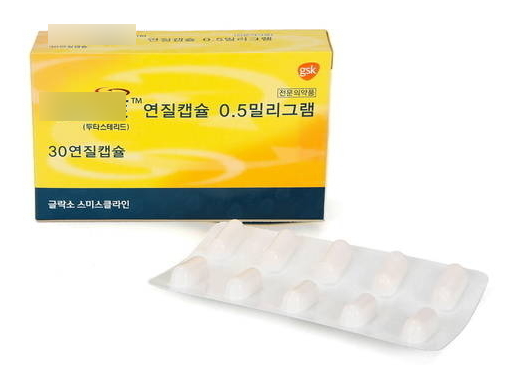
Dutasteride
Source - eMD Medical News
Clascoterone uses a mechanism that weakens androgen signals only in the scalp¹².
Rather than changing systemic hormone levels, it acts locally around hair follicles to restore stalled growth signals.
Unlike oral DHT-blocking agents, this means the risk of systemic sexual side effects is lower,
and it has attracted attention because it may also be applicable to female patients⁷.
Q2. How effective was it in clinical trials, really?
In early studies, a clearly greater increase in hair count than placebo was observed³.
In the recent phase 3 study involving 1,465 participants, both trials reported statistically significant increases⁴.
However, expressions such as “539% improvement” and “168% improvement” mentioned in the media are
relative increases rather than absolute values, so they can distort the real meaning.
Example
Placebo group +2 hairs
Clascoterone group +12 hairs → actual difference +10 hairs, but relative improvement = +500%
The difference between present and absent is clear, but the absolute level is limited.
Q3. Is it effective enough to replace minoxidil or oral hair loss medications?
Based on the data available so far, it seems more like an adjunctive option than a replacement.
In one comparative study, minoxidil showed a stronger response⁶.
Even so, the reasons it is drawing attention are as follows:
-
Patients who find oral treatment burdensome
-
Cases where systemic side effects are a concern, such as female pattern hair loss
-
Cases where there were side effects from existing medications
This is because it may expand as a lower-burden option for these patient groups.
Q4. How severe are the side effects? Is it safe to use long term?
It was first used as an acne treatment, so safety data have already accumulated over several years¹²⁵.
Most reported adverse reactions are mild irritation at the application site or temporary redness, and systemic effects have been shown to be very limited¹².
Although HPA axis changes were reported in some extensive, long-term use cases, many studies found that they recovered without symptoms⁵.
Because hair loss treatment uses it locally on the scalp, the risk is expected to be even lower.
However, it should be kept in mind that long-term data for hair loss purposes are still insufficient.
Q5. How much hair growth is there numerically?
Across multiple clinical studies, increases of 10–14 hairs/cm² have been reported, which is
similar to the range seen in existing minoxidil studies⁸.
Some studies still have not released photo-based evaluations or detailed mechanism analyses, so
clearer comparisons may become possible once additional data are available.
Clascoterone Hair Loss Treatment: How Is It Different from Existing Medications?
Summary table
| Item | Details |
|---|
| Mechanism of action | Local scalp androgen receptor antagonist¹² |
| Already approved use | Acne treatment¹ |
| Hair loss clinical trial scale | Early studies + phase 3 study with 1,465 participants³⁴ |
| Effect | Significant hair count increase vs placebo³⁴, absolute increase around 10–14 hairs/cm²⁸ |
| Relative improvement issue | Numbers may appear exaggerated regardless of the absolute increase |
| Side effects | Mostly skin irritation, with little systemic effect¹²⁵ |
| Comparative effect | Some studies reported a weaker response than minoxidil⁶ |
| Clinical position | More of a “lower-burden adjunctive option” than a replacement for existing medications |
Clascoterone is one of the hair loss treatment candidates with the most concrete clinical data so far.
The fact that it blocks hormone signaling only in the scalp is certainly appealing, and its effect versus placebo has been confirmed.
However, it is still premature to say that it outperforms existing treatments or is revolutionary on its own, because more long-term data and additional comparative studies are needed.
The appropriate assessment right now is this:
It is a promising new option, but it is not yet at the stage of fully replacing existing treatments.
Now it is time for hairhair, this was Kim Jin-oh.
Pilsaeng Shinmo (必生新毛).

Written by: Kim Jin-oh of New Hair Plastic Surgery (Public Relations Director, Korean Association of Plastic Surgeons / Academic Director, Korean Society of Laser Dermatology and Hair)
References
- Hebert, A.A., Thiboutot, D., Stein Gold, L. and others (2020) ‘Efficacy and safety of topical clascoterone cream, 1%, for treatment in patients with facial acne’, JAMA Dermatology, 156(10), pp. 1–11.
cited:"Clascoterone cream 1% demonstrated statistically significant improvements in acne lesions with an overall safety profile comparable to vehicle."
- Sánchez, C., Eichenfield, L.F., Stein Gold, L. and others (2022) ‘Efficacy and safety profiles of clascoterone 1% cream in acne vulgaris: An evidence-based review’, Journal of Clinical Medicine, 11(14), 4081.
cited:"Treatment-emergent adverse events with clascoterone 1% cream were mostly mild and similar in frequency to vehicle."
- Cassiopea SpA (2019) ‘Cassiopea announces very positive Phase II twelve-month results for Breezula (clascoterone) in treating androgenetic alopecia’. Press release, 16 April 2019.
cited:"All clascoterone solution dose groups achieved clinically meaningful and statistically significant improvements in target area hair count compared with vehicle at twelve months."
- Cosmo Pharmaceuticals NV (2025) ‘Cosmo announces breakthrough Phase III topline results from SCALP-1 and SCALP-2 for clascoterone 5% solution in male hair loss’. Press release, 3 December 2025.
cited:"Clascoterone 5% solution showed up to a 539% relative improvement in target area hair count versus placebo."
- Sun Pharmaceutical Industries Ltd. (2024) WINLEVI (clascoterone) cream 1% prescribing information.
cited:"Reversible suppression of the hypothalamic-pituitary-adrenal axis was observed under maximal use conditions, with all subjects returning to normal after discontinuation."
- Trindade, G. and Tosti, A. (2023) ‘Topical antiandrogens for androgenetic alopecia’, International Journal of Trichology, 15(2), pp. 45–52.
cited:"Clascoterone solution did not outperform 5% minoxidil under identical clinical conditions in an early trial."
- Carey, K. (2025) ‘Cosmo data positive for first new hair-loss approach in decades’, BioWorld, 3 December.
cited:"Clascoterone is designed to locally block androgen receptor activity in scalp follicles without measurable systemic androgen suppression."
- Rossi, A., Anzalone, A., Fortuna, M.C. and others (2020) ‘Current pharmacologic treatment of androgenetic alopecia’, Journal of Dermatological Treatment, 31(7), pp. 613–622.
cited:"Classical 5% minoxidil trials generally report an increase of approximately 10 to 18 terminal hairs per square centimetre compared with placebo."
[This post is written directly by a plastic surgery specialist for informational purposes in accordance with Article 56, Paragraph 1 of the Medical Service Act. Hair loss surgery and treatment may have side effects, and you should make a careful decision after consulting with a specialist.]