If you have hair loss, is it okay to get a perm or dye your hair?
When I see patients in the clinic for hair loss, I often get this question.
Even if you are worried about hair loss, styling can make it less noticeable and can also help you look better.
In theory, it seems like it would not be good for the hair, but since hair loss is a problem of the scalp, it also seems like it may not be directly related.
For those who are unsure what is correct, let’s take some time to organize the information.
If You Have Hair Loss, Is It Okay to Dye or Perm Your Hair? Summary
| There is no clear evidence that perming or dyeing directly worsens hair loss. |
|---|
| Chemical procedures can cause problems depending on the condition of the hair and scalp. |
| In particular, scalp irritation or allergies can increase temporary hair shedding. |
| The important question is not whether it is possible, but whether it is the right time given your current condition. |
| A way to minimize damage is needed. |
Hair loss and perms or dyeing may seem like the same issue, but in reality they are different.
Androgenetic alopecia is a condition in which hair follicles gradually shrink,
while perms and dyeing are procedures that affect the already growing hair and the scalp environment.
So it is hard to say, “If you have hair loss, you should absolutely never do it,” and it is also hard to conclude, “There is no problem at all.”
Understanding this difference is important.
Q. If you have hair loss, do perms or dyeing worsen hair loss?
Based on current research, there is no clear evidence that perms or dyeing directly worsen the progression of androgenetic alopecia itself.
Hair loss mainly progresses as hair follicles shrink under the influence of hormones (DHT).
However, thioglycolate-based ingredients used in the perm process break bonds inside the hair, weaken the hair, and damage the cuticle¹.
In other words, the problem may be that the hair itself cannot withstand it before the follicles are affected.
Q. Why does my hair feel like it is shedding more after the procedure?
In many cases, it is actually more “breakage” than “shedding.”
Hair damaged after dyeing or perming tends to break in the middle or fall out weakly, and from the outside it can look like more hair is being lost¹.
From the patient’s perspective, the result feels the same, so
many people feel that “the hair loss suddenly got much worse.”
Q. Why is it a problem when hair dye touches the scalp?
Hair dye is a representative substance that can cause contact dermatitis.
In particular, para-phenylenediamine (PPD) has been reported to cause sensitization in 0.1–2.3% of the general population².
If you experienced itching, stinging, redness, or oozing after dyeing, it may not be something to dismiss as simply having a “sensitive scalp.”
Such inflammatory reactions can cause telogen effluvium and temporarily increase hair shedding²³.
Q. If this kind of inflammation occurs, does hair loss become permanent?
In most cases, no.
Inflammation itself rarely destroys hair follicles permanently.
However, once a strong irritant has passed,
shedding can remain unstable for several weeks to months afterward²³.
This is why some people feel that a lot of hair suddenly falls out after dyeing or perming.
Q. Then when is it okay, and when is it better to avoid it?
If there are no wounds or eczema on the scalp, if you have not had severe itching or swelling after previous dyeing, and if discomfort does not linger for long after the procedure,
then perms or dyeing are not likely to lead to major problems¹.
On the other hand, if you are in one of the situations below, it is safer to avoid chemical procedures if possible.
Periods when the scalp is often itchy and red
Periods when flaking and stinging are present
Periods when shedding has increased after stress or weight change
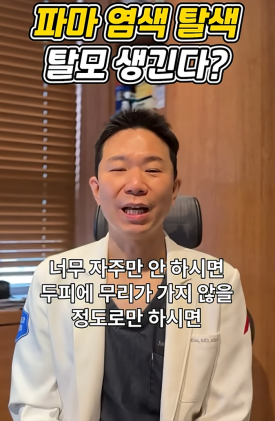
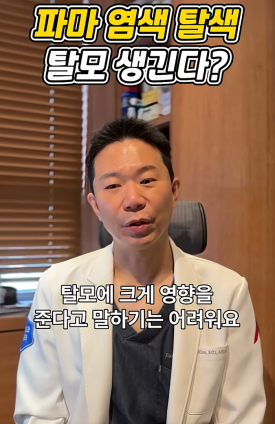
Q. If I absolutely have to do it, what is the better way?
In reality, there are times when a procedure is needed because of an important schedule.
At times like this, rather than avoiding it completely, it is better to reduce the damage.
For dyeing, it helps to keep it from touching the scalp directly and to shorten the application time².
If you had itching or swelling after dyeing in the past, considering a patch test is also necessary³.
Also, it is better to avoid doing a perm and dyeing on the same day.
That is because hair damage is more often something that builds up quietly rather than something that appears all at once.
To summarize again, perms or dyeing do not commonly cause permanent worsening of hair loss.
However, chemical procedures performed when the scalp is sensitive can leave you with more shedding instability than you might expect.
So the important question is this:
“Can I do it?” is not the real question. “Is my scalp in a condition where it is okay to do it now?” is.
It is natural to want to take care of your hair even if you have hair loss.
But if that choice ignores the current condition of your scalp, the consequences often come back more strongly than expected.
It is not too late to look a little more closely and then decide.
This has been Kim Jin-oh, and now it is time for hairhair.
Pilsaengsinmo (必生新毛).

Written by: Kim Jin-oh of New Hair Plastic Surgery (Public Relations Director, Korean Association of Plastic Surgeons / Academic Director, Korean Society for Laser Dermatology and Hair)
References
-
He, Y. et al. (2023) ‘Hair Dye & Perming Impairment: Mechanisms and Interventions’, Frontiers in Medicine. cited:"The majority of the damage mentioned above is due to mercaptoacetic acid/ammonium thioglycolate, the main element of a perm."
-
Palaniappan, V. et al. (2024) ‘Dermatological adverse effects of hair dye use: A narrative review’, Indian Journal of Dermatology, Venereology and Leprology. cited:"Contact allergy to para-phenylenediamine can occur in 0.1–2.3% of the general population."
-
Gupta, M. and Mahajan, V. (2015) ‘Hair dye dermatitis and p-phenylenediamine contact sensitivity’, Indian Dermatology Online Journal. cited:"p-Phenylenediamine is a potent contact sensitizer even in low concentration and considered a useful patch test screening allergen for hair dye dermatitis."
[This post is written directly by a board-certified plastic surgeon for informational purposes in accordance with Article 56, Paragraph 1 of the Medical Service Act. Hair loss surgery and treatment may have side effects, and you should make a careful decision through consultation with a specialist.]
Recommended related posts