Hello.
I am Kim Jino, a hair loss treatment doctor with 24 years of experience.

As the number of hair loss patients continues to increase steadily, to the point that hair loss is often described as affecting 10 million people, more and more people are becoming aware of hair loss earlier than before and starting care or treatment from the early stages.
Many people first notice hair loss when they look in the mirror or check the bathroom drain, but surprisingly, it is often people around them who point it out first. In particular, crown hair loss affects an area that is hard to see on your own, so it is common for people to start paying attention only after others say, “Your crown looks a little thin,” when the scalp has already become quite visible.
After that, people may take photos of the crown or touch it with their hands, but unless hair loss is progressing rapidly, it is not easy to judge whether it is really hair loss or whether it is in the early stage.
So today, I will organize what the early symptoms of suspected crown hair loss are, how to try self-diagnosis, and what kinds of things you can do on your own.
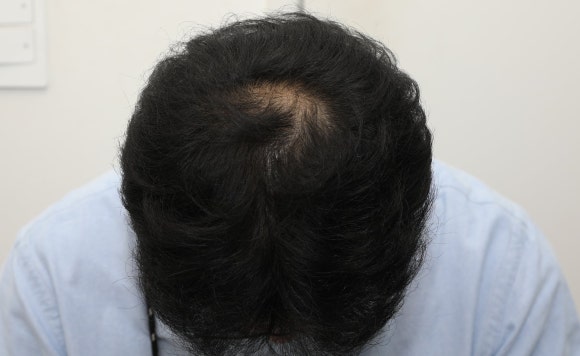
Early symptoms of crown hair loss? If you notice this, it is worth suspecting.
The easiest thing to check is how much the hair appears sparse from an aesthetic standpoint, in other words, how much of the scalp is visible. Healthy hair does not show much scalp and looks relatively dense.
If the number of hairs coming from the follicles decreases, or if more follicles stop producing hair altogether, hair density decreases and the white scalp becomes more visible. If this change gradually spreads, crown hair loss can be suspected.
In the early stage, many people do not feel that they are “losing a lot of hair,” but rather that “their hair has become thinner.” At that time, if the hair has lost strength or the newly growing hair is short and thin, it may indicate that hair loss is progressing.
It is not only the condition of the hair that matters. If the scalp itches frequently, develops flakes (dandruff), becomes oily, smells bad, or has frequent inflammation, this can also be considered a suspicious sign of hair loss.
In summary, you can use the following 7 items for a self-check.
| The crown scalp is more visible than before |
|---|
| The crown looks especially sparse when washing and drying your hair |
| The crown hair is thinner than the hair at the front or sides |
| A lot of short, thin hairs are falling out |
| The crown volume is no longer bouncing back |
| There is crown hair loss in the family |
| Empty spaces repeatedly appear in photos |
If you have around 0 to 2 of these, it is likely within the normal range. If you have 3 to 4, it would be a good idea to consider care or a consultation, as early crown hair loss may be suspected. If you have 5 or more, it is highly likely that it is already progressing.
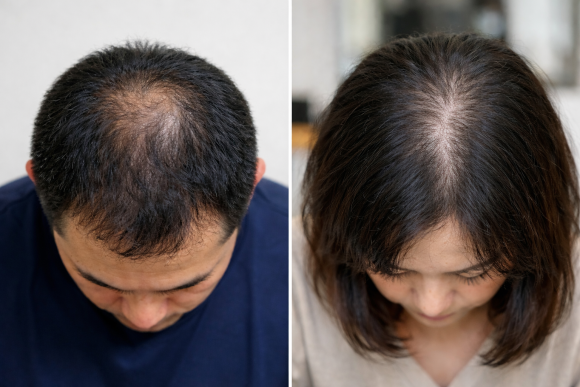
What is the cause?
Once people begin to realize that they are losing hair, they naturally start looking for the cause. It is understandable to want to know why this happened.
In men, hormonal changes and genetic factors account for the largest share. Even if it feels like it appeared suddenly, due to the nature of male pattern hair loss, it likely progressed gradually and only became noticeable at some point. Also, in men, crown hair loss often progresses together with M-shaped hair loss, so it is important to check both areas.
In women, hormonal changes such as childbirth, stress, and nutritional imbalance can have an effect. In particular, many women become aware of symptoms during menopause, because this period overlaps with a rapid decrease in female hormones.
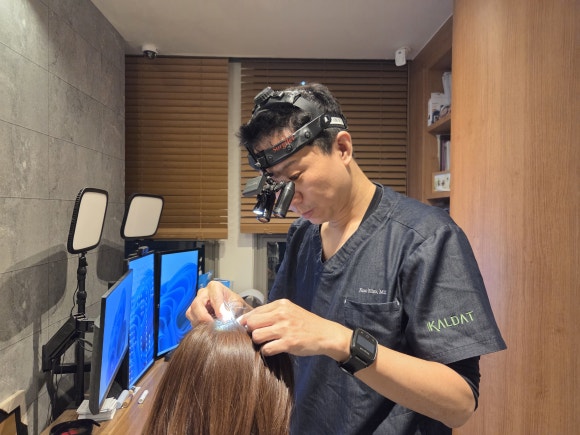
Crown hair loss: how is it treated?
Hair loss symptoms, causes, and treatment responses differ from person to person. That is why treatment is not simply decided by saying, “Do this,” but is carried out by establishing an individualized plan after a careful examination.
The direction of treatment changes depending on lifestyle habits and whether the patient can continue treatment.
For those who can take medication and receive treatment consistently, we prescribe hair loss medication along with machine-based treatment that helps stimulate the hair roots and expand blood vessels, as well as injection therapy that promotes hair growth.
On the other hand, if taking medication is difficult or regular visits are not realistically possible, hair transplantation or scalp micropigmentation may also be considered.
Hair transplantation involves removing a strip of skin from the back of the head, separating the follicles from the strip under a microscope, and then implanting them into the desired area. For those concerned about scars, a non-incisional method is also available.
If surgery feels too burdensome financially or physically, scalp micropigmentation can also be an option. This method adds tattooing in a natural hair pattern to the empty white scalp so that the sparse areas are less noticeable.
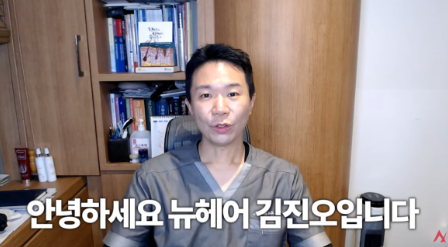
As you can see, there are various ways to treat hair loss, and it is difficult to say that any one treatment is absolutely the right answer. It is important to make a practical choice based on the patient’s situation and circumstances.
In hair loss treatment, simply “feeling that hair is falling out” is not enough. For many people, it takes time to accept hair loss, and in the meantime, they miss the right timing for treatment.
Even if you only respond in the early stage, it can help slow the progression and prevent it from becoming severe. If you are reading this, it is not too late, so I recommend getting your condition diagnosed by a medical professional and finding the treatment method that suits you best.
At New Hair Plastic Surgery Clinic, you will be seen by a hair loss treatment doctor with 24 years of experience and a board-certified plastic surgeon. As we have continued to strive for sincere and honest care, we will continue to provide only treatment that stays true to the fundamentals.
Thank you.