When people talk about hair loss, most think of hormones like DHT (dihydrotestosterone).
But recent research has raised a new question.
Why does the same genetic background lead to faster progression in some people?
One answer is the scalp microbiome (the microbial ecosystem).
Studies have reported that certain microbes increase on the scalp of hair loss patients, and that these changes may worsen the follicular environment.¹
Can Oily Scalp Cause Hair Loss? What’s the Truth? Summary
| Hair loss is mainly driven by genetics and hormones, but an imbalance in the scalp microbiome may accelerate progression. |
|---|
| In particular, an increase in Cutibacterium acnes (C. acnes) breaks down sebum and triggers microinflammation. |
| This inflammation leads to follicular stem cell damage → thinner hair → accelerated hair loss. |
| Ketoconazole and similar agents are adjunctive treatment strategies that suppress both microbes and sebum-related pathways. |
| Microbiome management is not a standalone treatment, but “environmental management” that enhances the effect of medication. |
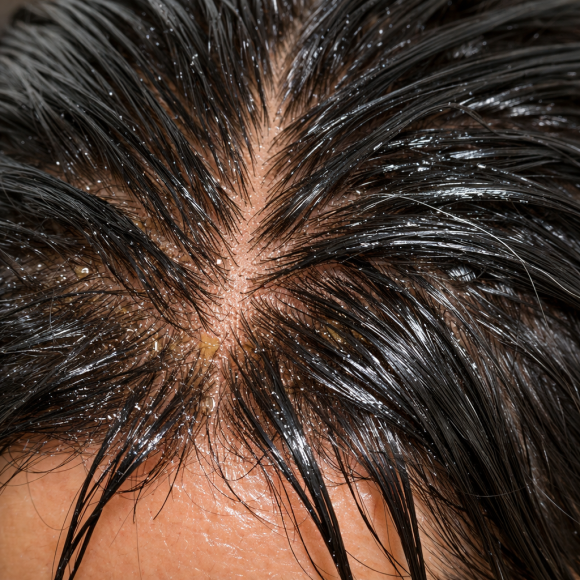
Increased sebum and growth of specific bacteria
As hair loss progresses, the sebaceous glands tend to enlarge and sebum secretion on the scalp increases.
At this point, the increased sebum creates a very favorable environment for certain bacteria.
A representative example is Cutibacterium acnes (C. acnes), which has been reported to increase significantly on the scalps of hair loss patients.²
This bacterium produces free fatty acids while breaking down sebum, and these substances stimulate the scalp immune response and induce inflammation.
In other words, the key issue is not simply having too much oil, but the inflammation that occurs during the breakdown of that oil.
Microinflammation and follicular damage
The inflammation that arises in this process is not the kind of red, painful inflammation we usually imagine, but microinflammation at a level that is invisible to the eye.
However, if this microinflammation continues for a long time, it affects follicular stem cells.
Cytokines released during the inflammatory response send cell-death signals to follicular cells and shorten the anagen phase, the growth period of hair.
As a result, hair gradually becomes thinner, eventually leading to a stage where hair loss becomes noticeably more advanced.³
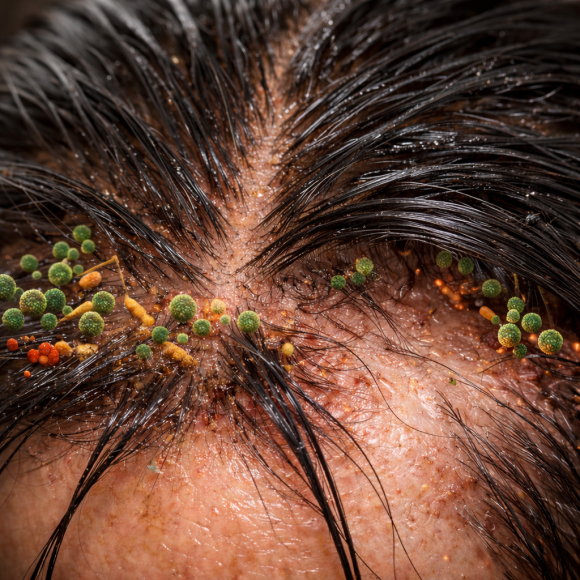
Microbial management and treatment strategies
Based on this mechanism, the role of scalp care products becomes easier to understand.
For example, ketoconazole does more than simply reduce dandruff: it inhibits fungi such as Malassezia, affects the activity of C. acnes, and also reduces sebum breakdown itself.
More recently, ingredients such as clascoterone have also been used to directly reduce sebum secretion and limit the food source available to microbes.
This can be seen as a strategy that regulates the environment rather than directly reducing the number of microbes.
However, the important point is that this kind of care does not treat the underlying cause of hair loss.
Microbiome management should be understood only as a supportive role that complements medication and helps stabilize the scalp environment.
Hair loss is still a condition that should be understood within the broader framework of genetics and hormones.
However, it is also true that the microbial environment and sebum status of the scalp act as important variables that influence the speed of progression.
Therefore, an effective hair loss management strategy should not rely on a single method, but rather combine treatment that addresses the cause with care that improves the environment.
Making the scalp excessively dry or placing too much expectation on a single product can actually disrupt the balance.
In the end, what matters is maintaining a stable scalp ecosystem while taking a long-term approach together with medical treatment.
This balanced strategy helps slow the progression of hair loss and maintain a healthier hair condition.
Now it’s time for Hairhair, Kim Jin-oh.
Pilsaengsinmo (必生新毛).
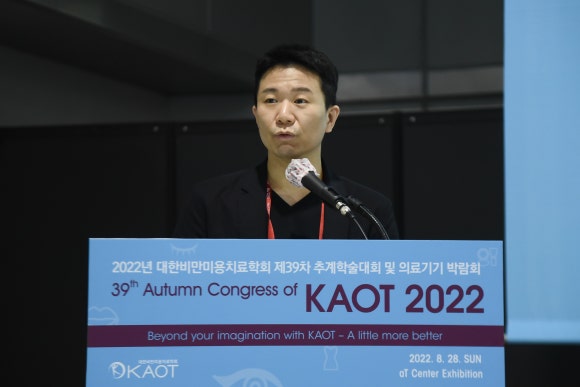
Written by: Kim Jin-oh, New Hair Plastic Surgery (Public Relations Director, Korean Society of Plastic and Reconstructive Surgeons / Academic Director, Korean Hair Research Society)
[References]
-
Gupta, A.K., Teasell, E.M., Liddy, A. and Economopoulos, V. (2026). 'Scalp Microbiome Alterations in Androgenetic Alopecia: Patterns and Emerging Mechanistic Insights', International Journal of Dermatology, 0(0), pp. 1-10. cited: "Emerging evidence implicates the scalp microbiome as a potential modifier of this process."
-
Suzuki, K., Inoue, M., Cho, O., et al. (2021). 'Scalp Microbiome and Sebum Composition in Japanese Male Individuals With and Without Androgenetic Alopecia', Microorganisms, 9(10), p. 2132. cited: "Cutibacterium acnes is frequently reported as enriched in the scalp and follicle of male patients with AGA."
-
Ho, B.S.Y., Ho, E.X.P., Chu, C.W., et al. (2019). 'Microbiome in the Hair Follicle of Androgenetic Alopecia Patients', PLoS One, 14(5), e0216330. cited: "Microbial shifts observed in AGA... contribute to progressive hair-follicle miniaturization."
Related posts you may like