After taking hair loss medication, it feels like I’m growing more body hair.
This is a question I really hear very often in the clinic.
In particular, people who are starting finasteride or dutasteride for the first time tend to be very sensitive to this kind of change.
To put it first: it is difficult to explain, both theoretically and clinically, that this medication causes increased body hair.
So let’s look at why this feeling happens, along with the actual hormonal changes, in a Q&A format.
I started taking hair loss medication and my body hair increased. Summary
| 5-alpha reductase inhibitors (5ARIs) strongly reduce DHT |
|---|
| Testosterone is maintained or slightly increases, but the change is not significant |
| DHT promotes hair loss on the scalp, but promotes growth in body hair |
| When taking the medication, scalp hair improves, while body hair tends to decrease |
| The feeling that “body hair increased” is often an illusion or due to individual differences |

Q1. If I take hair loss medication, does testosterone go up and make me hairier?
A. No.
5ARIs inhibit the enzyme that converts testosterone into dihydrotestosterone (DHT).
As a result, DHT drops significantly, but testosterone mostly stays the same or rises only slightly².
This degree of increase is not enough to affect the entire hormonal axis, and it is not a strong enough change to induce increased body hair.
Key points:
Q2. Then why does it feel like body hair is increasing?
A. There are several reasons.
Visual contrast effect
As scalp hair improves, body hair may stand out more by comparison.
Increased self-observation
When you start hair loss treatment, you tend to pay closer attention to changes in your body.
Individual differences in hormonal sensitivity
Even with the same hormone levels, follicle responses differ from person to person.
In other words, it is often more of a “perception change” or a “relative change” than a real increase.
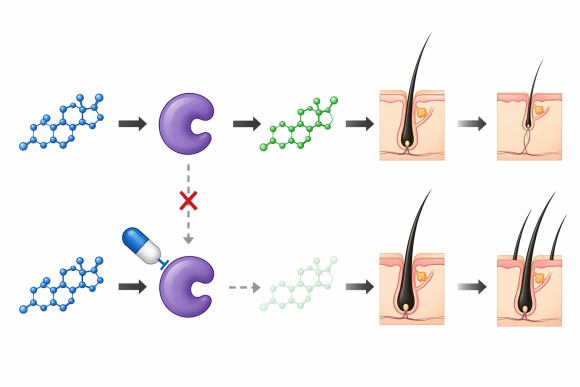
Q3. What does DHT do in the body?
A. It acts completely differently depending on the area.
Dihydrotestosterone is a powerful androgen,
These are opposite roles³.
That is the key point.
Q4. So what happens to body hair when taking hair loss medication?
A. It should actually decrease.
When DHT decreases, the stimulus for body hair growth also decreases, so
Changes like these may appear.
In fact, reports that “beard growth is reduced” are commonly observed in patients with benign prostatic hyperplasia.
Q5. Are there any cases where increased body hair is actually possible?
A. Very rarely.
Theoretically, it is difficult to explain, and in actual clinical practice there are far more cases of decreased body hair than increased body hair.
If body hair increase is obvious, it is more important to check for other hormonal issues or non-medication-related factors as well.
| Category | Role of DHT | Change after taking 5ARI |
|---|
| Scalp hair | Promotes hair loss | Promotes growth, reduces hair loss |
| Body hair | Promotes growth | Suppresses growth, decreases |
| Testosterone | Maintained normally | No change or slight increase |
The claim that “hair loss medication makes body hair increase” is closer to a misconception with little scientific basis.
5-alpha reductase inhibitors work in a way that blocks hair loss on the scalp and, in fact, reduces the growth stimulus for body hair.
Therefore, rather than hesitating to take the medication out of concern about increased body hair, it is important to continue treatment based on a correct understanding of its mechanism.
Now it’s time for hair to grow, from Kim Jin-oh.
Pilsaengsinmo (必生新毛).
Written by: Kim Jin-oh, New Hair Plastic Surgery Clinic (Public Relations Director, Korean Society of Plastic and Reconstructive Surgeons / Academic Director, Korean Laser Dermatology and Hair Society)
References
-
Clark RV, Hermann DJ, Cunningham GR, Wilson TH, Morrill BB, Hobbs S. (2004). Marked suppression of dihydrotestosterone in men with benign prostatic hyperplasia by dutasteride, a dual 5α-reductase inhibitor. J Clin Endocrinol Metab, 89(5), 2179–2184.
-
Gormley GJ, Stoner E, Bruskewitz RC, Imperato-McGinley J, Walsh PC, McConnell JD, Andriole GL, Geller J, Bracken BR, Tenover JS, et al. (1992). The effect of finasteride in men with benign prostatic hyperplasia. N Engl J Med, 327(17), 1185–1191.
-
Kaufman KD. (2002). Androgens and alopecia. Mol Cell Endocrinol, 198(1-2), 89–95.