Will the hair plucked for a hair transplant grow back?
There is a question that people considering hair transplants ask very often.
“Does the hair taken from the back grow back?”
“If they keep taking hair from the donor area, won’t it end up looking thin later?”
“If a follicle is pulled out once, isn’t that the end of it?”
In fact, this is one of the most confusing parts for people who are new to hair transplants.
That’s because ordinary hair shedding and the ‘follicle harvesting’ used in hair transplants are a little different in concept.
Today, I’ll explain in simple terms what it really means to “pluck” hair in a hair transplant, and whether the hair in the harvested area truly grows back.
Hair transplants move ‘follicles,’ not just ‘hair strands’
First, we need to sort out the most important concept.
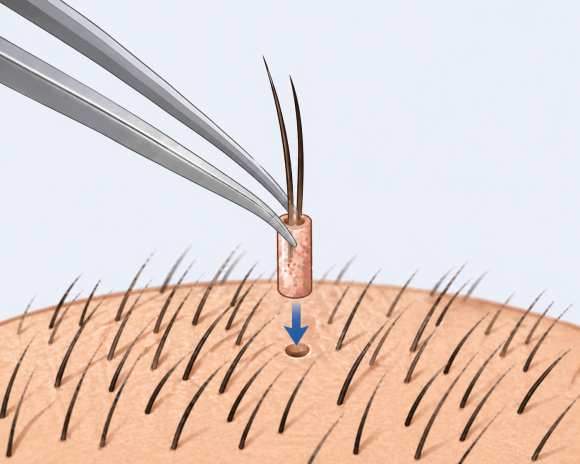
A hair transplant is not a procedure that simply moves a single hair strand.
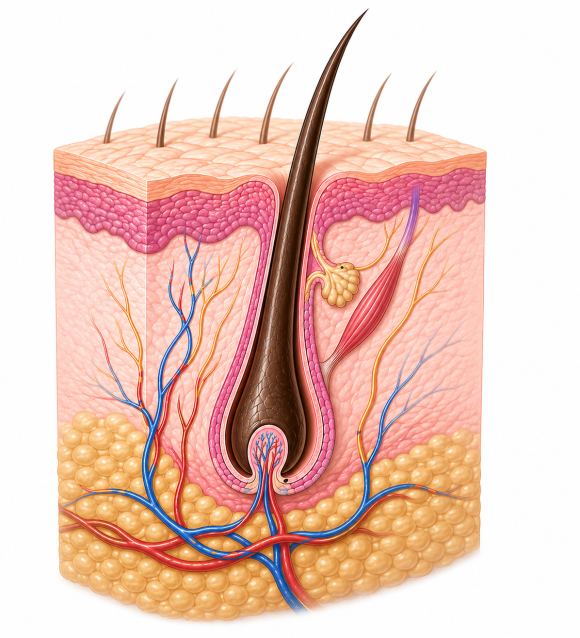
It is a surgery that moves the ‘hair follicle,’ the tissue that produces hair, along with it.
Simply put, it is closer to moving the structure that acts like a hair factory, rather than the hair itself.
That is why hair transplants usually harvest follicles from areas relatively less affected by hair loss, such as the back of the head or the sides.
This area is commonly called the ‘donor area.’
The harvested follicles are then transplanted into areas where hair loss has progressed, such as the hairline or crown.
So does the area where hair was taken from grow back?
To answer first: “The harvested follicles themselves do not reappear.”
In other words, follicles that have already been removed and moved elsewhere are not newly created again in their original spot.
Many people are surprised to hear this.
“What? Then won’t the back of my head just become empty?”
But in reality, it is not that simple.
That’s because the back of the head naturally has a very large number of follicles packed closely together.
And in a hair transplant, only some of them are selected and harvested in a distributed pattern.
For example, it may be easier to think of it like moving a few trees from a forest and replanting them at suitable intervals.
If the overall density is sufficient, the difference may not be noticeable from the outside.
In other words, it is closer to the idea of dividing and using some of the hair that was already abundant, rather than “growing back and fully restoring itself.”
Then why does it look like it grew back?
After a hair transplant, the donor area often appears to recover quite naturally over time.
Because of this, some people think, “It was plucked, but it grew back?”
But in reality, there are a few reasons for that.
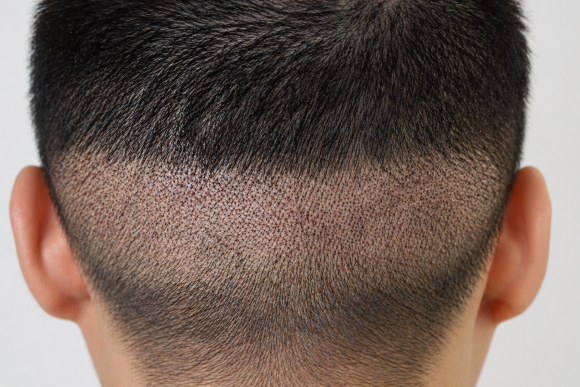
Because the surrounding hair covers it
As time passes after harvesting, the surrounding hair grows and naturally covers the empty spaces.
In particular, people who originally have a lot of hair often do not show obvious signs even after harvesting.
The donor area is not infinite, either
Here is a very important point.
The hair at the back of the head is known to be strong, but that does not mean it can be used without limit.
The donor area is a limited resource.
So if too many follicles are harvested at once, or if harvesting is repeated many times:
-
reduced density at the back of the head
-
a more see-through appearance
-
more noticeable scarring
-
limitations on short hairstyles
Problems like these can occur.
In particular, people whose hair is naturally fine or whose density is low need a more careful plan.
That is why clinics with more experience often focus not only on “how many grafts can be transplanted,” but also on how safely the donor area can be preserved.
Follicles harvested in a hair transplant do not completely regenerate in their original location.
However, because the back of the head naturally has sufficient hair density, if harvesting is done in a properly distributed way, it often remains natural-looking from the outside.
That said, the donor area is also a limited resource, so excessive harvesting can lead to reduced density and scarring issues over the long term.
In the end, a good hair transplant may be less about “how much was transplanted” and more about how well the balance between the hairline and the back of the head was designed.