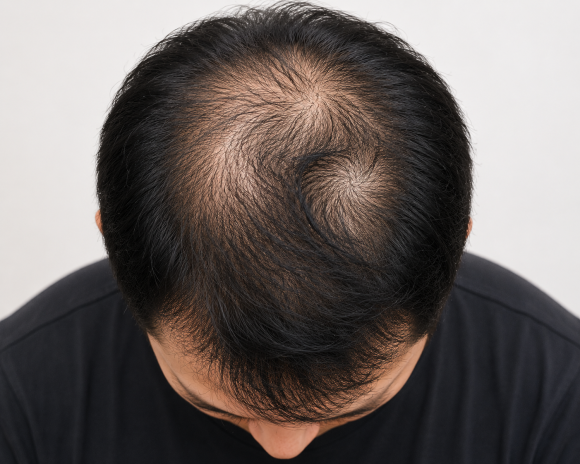
Two Whorls Mean a Hair Loss Risk? The Myth of Double Whorls and Genetics
Many people find out for the first time by washing their hair or taking a photo and thinking, “Huh? I have two whorls?”
In particular, when the crown area looks parted or the scalp seems visible, it is common to worry, “Could this be hair loss?”
Online, you may come across various sayings such as “People with double whorls are stubborn,” “If you have two whorls, you get married twice,” “It’s genetic,” and “The risk of hair loss is high.”
So what does it really mean to have two whorls?
Today, let’s take a simple look at the causes and characteristics of double whorls, their genetic possibility, and their relationship with hair loss.
What is a whorl?
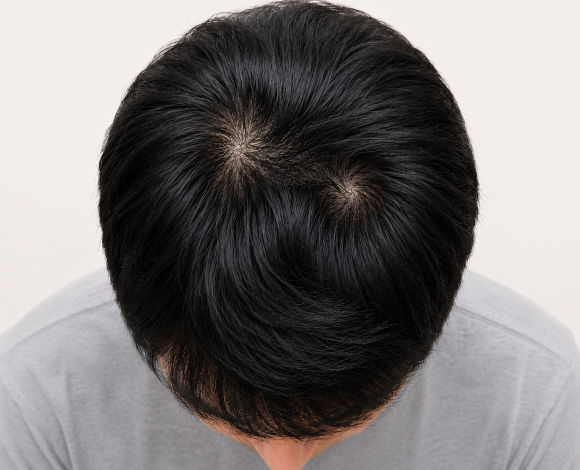
A whorl is the area where hair grows in a spiral pattern in a specific direction.
Usually, the most common case is one whorl near the crown, but some people have two or more.
This is because the direction in which hair grows is already determined within the skin, and it is naturally decided during the process of hair follicle formation in the fetal stage.
Simply put, a whorl can be seen as a kind of “center point where the flow of hair gathers.”
Why do double whorls occur?
In most cases, the cause is a congenital characteristic.
In other words, it means that the hair direction was formed in two separate areas from birth.
In particular, if there are also double whorls in the family, there may be a genetic influence.
In fact, the shape of a whorl, like hair thickness, whether it is curly, and the direction of hair growth, can also be influenced to some extent by genetics.
However, it is not something that clearly passes along at the level of “if a parent has double whorls, the child will definitely have them too.”
It is better to understand that genetics can have an influence, but it does not determine the outcome like an absolute rule.
Is it true that if you have two whorls, you get married twice?
One of the persistent myths that always comes up when talking about double whorls is the saying, “If you have two whorls, you get married twice.”
Of course, this is not something with any medical basis. However, the background behind this saying is connected to an interesting old cultural tradition.
In the past, when people got married, there was a custom of traveling in a “flower palanquin,” and because the word “whorl” here and the “whorl” of the head are pronounced the same, some believe the two became linked.
In other words, because there are two whorls, a folk belief arose that “you may have to ride a palanquin twice.”
From today’s perspective, it is best seen as a story passed down for fun, and it is difficult to say that it has any direct connection to the number of marriages or to one’s life.
There are also stories that people with double whorls have strong leadership, are stubborn, or have unique personalities, but these are not scientifically proven either.
Does having double whorls increase the risk of hair loss?
This is the part many people are most curious about.
To put it first, “you cannot say someone has hair loss just because they have two whorls.”
Double whorls are a normal type of scalp structure. The issue is that around the whorl, the hair direction naturally splits, so the scalp can look more visible.
In particular, it is easy to mistake this for hair loss in the following cases:
-
When the lighting is strong
-
When the hair is wet
-
When the hair is fine
-
When the crown hair is flattened down
-
When the hairstyle is short
In other words, there are quite a few cases where the scalp already tends to show clearly, and it gets mistaken for hair loss.
On the other hand, actual hair loss can also occur.
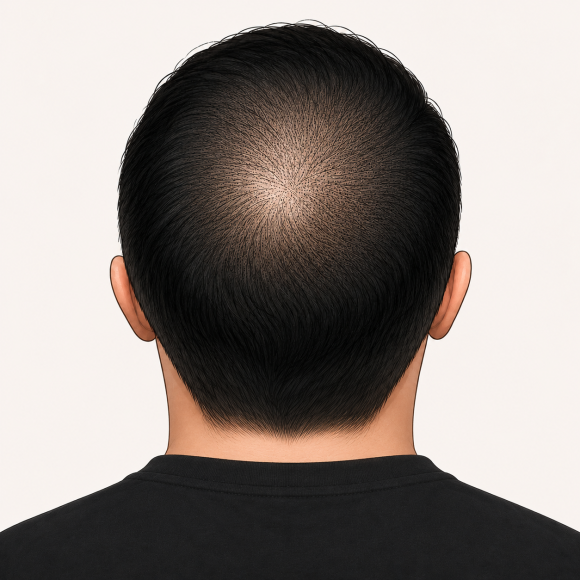
For example, if the whorl area gradually becomes wider than before, the hair becomes thinner, and the density around it also decreases, it is necessary to check whether it is not just a double whorl but possibly crown hair loss.
How can you tell the difference between double whorls and crown hair loss?
The two can look similar at first glance, but there are differences.
A double whorl usually stays almost the same in shape from childhood.
It is characterized by hair directions splitting into two, and in many cases there is no major change over time.
By contrast, crown hair loss tends to spread gradually over time.
Since male pattern hair loss often starts at the crown, it is important not to dismiss it by simply saying, “It’s because I naturally have two whorls,” and instead observe whether there are changes.
A double whorl is one of the more common scalp structures, and in most cases it is a congenital characteristic.
It can be influenced to some extent by family history or genetics, but a double whorl itself is not a disease and does not necessarily mean hair loss.
Also, stories like “If you have two whorls, you get married twice” are closer to a fun old myth from traditional culture and do not have real medical meaning.
However, because the whorl area is a location where the scalp naturally tends to be visible, it is often confused with hair loss.
What matters is not whether you have two whorls, but whether there have been changes compared to before.
If the area is gradually widening or the hair is getting thinner, it may not be a simple double whorl but an early sign of hair loss, so it is better to get an accurate diagnosis.
On the other hand, if it has looked similar since childhood and there has been no major change, there are many cases where there is no need to worry too much.