Treatment for male pattern hair loss has seen surprisingly little change for a long time.
The structure has remained the same for decades: finasteride and dutasteride slow the progression of hair loss, while minoxidil supports hair growth.
The problem was the limitations of topical minoxidil.
It had to be applied consistently twice a day, and many patients gave up midway because of stickiness or scalp irritation.
In actual clinics, it is common to hear reactions like, “I understand it works, but it’s too much of a hassle.”
That is why, over the past few years, oral minoxidil has started drawing attention in the hair loss treatment field.
However, because oral minoxidil was originally developed as a blood pressure medication, it has been used very cautiously at extremely low doses due to concerns about side effects such as palpitations, edema, and low blood pressure.
But the recent phase 2/3 results for Veradermics’ VDPHL01 were data that challenged that very assumption.
Has the Era of 17 mg High-Dose Minoxidil Arrived? Veradermics Clinical Trial Summary
| Veradermics’ extended-release oral minoxidil, VDPHL01, showed significant hair growth efficacy in a phase 2/3 clinical trial.¹ |
|---|
| Even at a high dose of up to 17 mg per day, no serious cardiovascular adverse events were reported.¹ |
| After 6 months of treatment, an increase of up to 37.7 terminal hairs per cm² was confirmed.² |
| The key point is the extended-release technology, which reduced sudden spikes in blood concentration and improved safety. |
| Depending on future FDA approval and domestic introduction, the potential for a shift in the hair loss treatment paradigm is drawing attention. |

The dose of oral minoxidil commonly used for hair loss treatment is very low.
In clinical practice, it is often used cautiously at around 1.25 mg to 2.5 mg.
But in this trial, Veradermics used a substantially higher dose of up to 17 mg per day.
By conventional standards, that is a level that would be difficult to try easily.
The key is the extended-release formulation.
An extended-release formulation is a technology designed to release the drug slowly in the body.
Instead of blood levels rising all at once like with a regular immediate-release drug, it is designed to maintain a more stable concentration.
This difference is very important.

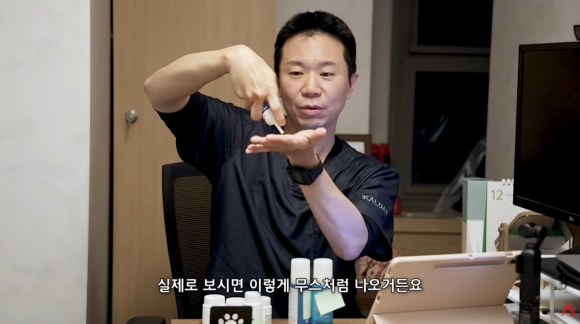
Many of minoxidil’s side effects often occur when blood concentration rises sharply.
However, using an extended-release formulation can reduce those concentration spikes and, as a result, make it possible to use higher doses with relatively greater stability.
In other words, the essence of this trial is not simply that “the dose was increased.”
The key is that it “brought high-dose minoxidil into a realistic safety range.”
What were the actual clinical results like?
The basic formulation used in this trial was an 8.5 mg tablet.
The 6-month follow-up results were quite impressive.²
In particular, in the 17 mg per day group:
An average increase of 37.7 terminal hairs per cm²
The placebo group increased by 7.3 hairs
These were the results reported.²
What matters here is that these were not simply fine vellus hairs.
Terminal hair refers to actual thick hair with a diameter of at least 60 μm.
In other words, this is a level of change that patients may perceive as “looking like they have more hair.”
Another point worth noting is the speed of response.
Hair loss medications are generally described as taking at least 4 to 6 months before effects are felt, but in this dataset, meaningful improvement was reported as being observed as early as 2 months.¹
This is highly meaningful in terms of early treatment satisfaction and adherence as well.

How would it be combined with existing hair loss medications?
Many patients often misunderstand this point.
If oral minoxidil is powerful, doesn’t that mean finasteride or dutasteride are unnecessary?
But the two drug classes serve different purposes.
| Drug class | Role | Main purpose |
|---|
| Finasteride / Dutasteride | DHT suppression | Prevent hair loss progression |
| Minoxidil | Growth promotion | Increase hair thickness and density |
In other words, one is a medicine that “prevents shedding,” while the other is a medicine that “helps hair grow.”
In actual clinical practice, combination strategies often produce the strongest results.
In particular, for patients with insufficient crown density or those who felt existing medications alone did not improve volume enough, this type of extended-release oral minoxidil may become a new option in the future.
| Situation | Possible direction to consider |
|---|
| If topical minoxidil is too inconvenient | Extended-release oral formulations may become an alternative in the future |
| If palpitations occurred with existing oral minoxidil | An extended-release formulation with less fluctuation in blood levels may be more favorable |
| If crown density improvement is insufficient | A stronger growth-promotion strategy may be possible |
| If an early response is desired | The 2-month response data may be an advantage |
| If adherence to hair loss medication is low | Convenience of taking the medication may improve |
Q1. Is Veradermics minoxidil completely different from existing oral minoxidil?
It is closer to the concept of redesigning existing minoxidil with an extended-release delivery system than to being a completely new ingredient.
However, its actual clinical significance is quite different.
With conventional immediate-release minoxidil, there were major concerns about cardiovascular burden at higher doses, but the extended-release version was designed to keep drug levels stable.
In other words, it is best understood as “the same ingredient, but a completely different delivery method.”
Q2. Wouldn’t taking several 5 mg minoxidil tablets have the same effect?
No. It can be very dangerous.
The key of this trial is not simply increasing the dose, but the “extended-release technology.”
If you take multiple ordinary immediate-release minoxidil tablets, blood levels can rise sharply, increasing the risk of palpitations, low blood pressure, edema, and similar issues.
Therefore, it is absolutely not appropriate to apply the clinical data directly to ordinary medications.

Q3. Would it work for female pattern hair loss too?
Mechanistically, it has enough potential to be used in female pattern hair loss as well.
However, women are often more sensitive to medications than men, and they may also be more sensitive to side effects such as hypertrichosis.
Therefore, separate clinical data may be needed in the future to establish actual indications and recommended doses for women.
Q4. Were there really no cardiac side effects?
In this announcement, it was stated that no clinically meaningful serious cardiac adverse events were reported.¹
However, this is still at the top-line data stage.
That means that before detailed data are published in a scientific paper, the following still need closer review:

Q5. When might it be available in Korea?
FDA approval is still pending.
In general:
FDA review
Additional data review
Domestic approval procedures
Considering these steps, it is likely that more time will be needed before actual prescribing in Korea.
However, since this clinical result made such a strong impression, it certainly has the potential to become a highly watched candidate in the future hair loss treatment market.
This Veradermics VDPHL01 trial is not something that can simply be viewed as “just another new hair loss drug.”
The key is that it attempted to overcome the biggest limitation of existing oral minoxidil—its safety concerns—through extended-release technology.
In particular:
-
Potential for high-dose use
-
Faster response time
-
Greater density improvement
-
Potential cardiovascular stability
This combination has the potential to change hair loss treatment strategy itself in the future.
Of course, formal papers, long-term data, and the FDA approval process are still ahead.
Therefore, at this point, the most balanced interpretation is to view it as a very promising candidate rather than to expect too much.
Still, in a hair loss treatment field that has seen little change for a long time, it is clear that an industry-wide development worth attention has finally appeared after a very long time.
It is now time for hairhair, Kim Jino.
Be sure to grow new hair (必生新毛).

Written by: Kim Jino, New Hair Plastic Surgery (Public Relations Director, Korean Society of Plastic and Reconstructive Surgeons / Academic Director, Korean Society for Laser, Skin, and Hair)
References
- Veradermics Inc. (2026). Veradermics’ Oral VDPHL01 Achieved Early, Consistent, and Robust Hair Growth in Positive Phase 2/3 (302) Clinical Trial in Male Pattern Hair Loss. [online] Available at: https://ir.veradermics.com [Accessed 30 Apr. 2026].
cited: "The study met all primary and key secondary endpoints... No treatment-related serious adverse events or cardiac adverse events of clinical interest were reported."
- U.S. Securities and Exchange Commission (2026). Veradermics Form 8-K, Exhibit 99.1. [online] Available at: https://www.sec.gov [Accessed 30 Apr. 2026].
cited: "At Month 6, mean change from baseline in TAHC was 30.3 hairs/cm² (8.5mg QD) and 37.7 hairs/cm² (8.5mg BID), significantly outperforming the 7.3 hairs/cm² in the placebo group."
Related posts to read together