Many people feel that “they lose a lot of hair in the fall,” but in many cases, the actual cause begins with scalp damage during the summer.
Strong UV exposure, high temperatures, and excessive sweat and sebum production can rapidly worsen the scalp environment, causing stress to accumulate in the hair follicles.
In particular, summer hair loss is often more than simply a problem of hair falling out; it is frequently accompanied by inflammation and heat damage to the scalp itself.
Even in clinical practice, we often see people who report suddenly losing a large amount of hair after a summer vacation.
In this article, I will summarize the causes of summer hair loss and scalp care methods in an FAQ format.
Summer Hair Loss: How to Manage Scalp Heat, UV Exposure & Sweat — Summary
| Strong UV exposure during the summer can damage the keratin structure of the hair and accelerate scalp aging.¹ |
|---|
| When scalp temperature rises, an increase in cortisol may promote telogen effluvium.² |
| When sweat, sebum, and fine dust become mixed together, the risk of folliculitis and scalp inflammation increases. |
| Chlorine in swimming pools and salt in seawater can damage the hair’s protective barrier, potentially worsening hair texture and causing breakage. |
| The key to managing summer hair loss is “scalp heat management + prompt cleansing + UV protection.” |
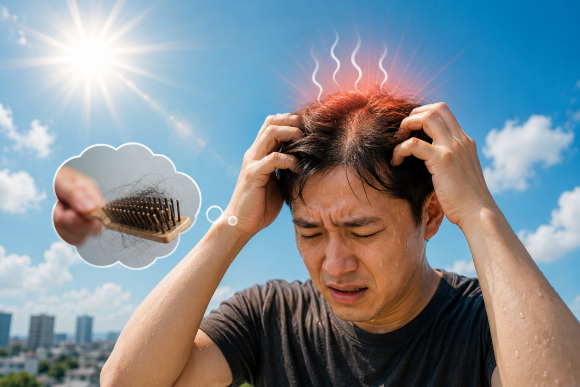
Q1. Why does it seem like more hair falls out during the summer?
Scalp temperature rises sharply during the summer.
The issue is not simply that it is “hot”; scalp cells and hair follicles actually experience stress.
Strong UV exposure damages the structure of keratin proteins, a major component of hair.¹
Hair with insufficient melanin pigment, such as gray hair or lightly dyed hair, has less UV protection, so damage may progress more quickly.
Another important factor is scalp heat.
When scalp temperature rises excessively, levels of cortisol, a stress hormone, increase, making it more likely that hair in the anagen phase will transition into the telogen phase.²
For this reason, repeated heat stimulation of the scalp throughout the summer can often lead to telogen effluvium in the fall.
In clinical practice, we often see people who spent a lot of time outdoors during the summer experience a sudden increase in hair loss two to three months later.
Q2. Can sweat and sebum worsen hair loss during the summer?
It is possible.
As temperatures rise, sebum production also increases.
When sweat, dead skin cells, and fine dust mix with it, pores may become blocked and the scalp environment can deteriorate rapidly.
Leaving sweat on the scalp for a long time can repeatedly irritate the scalp and encourage bacterial growth, increasing the risk of folliculitis.
Although folliculitis may look like a simple skin problem, repeated episodes can lead to hair follicle damage, so caution is needed.
It is not advisable to continue wearing a hat after exercise or to leave the scalp wet with sweat for a long time.
During the summer, “how quickly you clean up your scalp” is more important than “how often you wash your hair.”
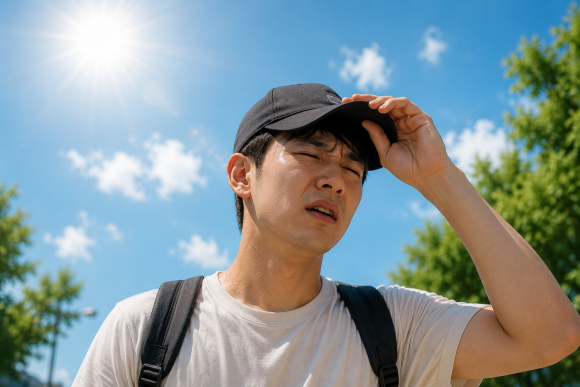
Q3. Is it okay to wash my hair twice a day during the summer?
It depends on the situation.
In general, cleansing once in the evening is ideal.
However, if you spend a lot of time outdoors or sweat heavily after exercising, shampooing twice a day is also possible.
There are some points to keep in mind.
Repeatedly using a shampoo with excessively strong cleansing power can instead damage the scalp barrier and make the scalp more sensitive.
Therefore, during the summer, it may be helpful to use a mildly acidic shampoo or a product containing soothing ingredients.
What is even more important than shampooing is “complete drying.” Leaving the scalp wet for a long time creates an environment where bacteria and fungi can multiply more easily.
Q4. Does wearing a hat in the summer cause hair loss?
This is a common misunderstanding.
A hat itself does not directly cause hair loss.
In fact, hats can be helpful during the summer because they protect against UV exposure.
However, wearing a thick hat with no ventilation for a long time can raise scalp humidity and create an environment conducive to inflammation.
Therefore, during the summer, it is best to choose:
-
Breathable mesh fabric
-
A lightweight cap style
-
Sweat-absorbing material
When indoors, it is also important to remove your hat whenever possible and allow your scalp to air out.
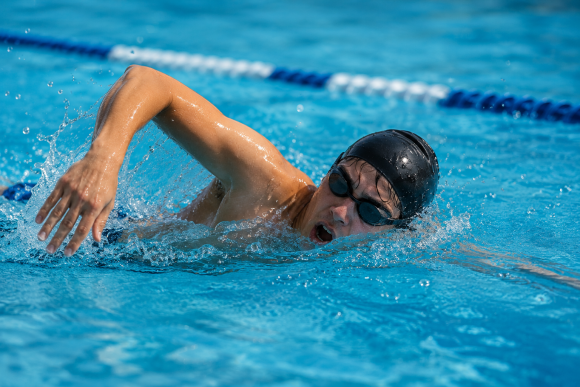
Q5. Do swimming pools and seawater affect hair loss?
They can be quite irritating to the hair and scalp.
Chlorine in swimming pool water can damage the lipid layer that acts as a protective barrier on the surface of the hair.
During this process, moisture can escape from inside the hair, making its texture rougher.
Seawater can also draw moisture from the scalp because of its salt content and may amplify UV damage.
If you do not rinse thoroughly after swimming or playing in the water, scalp irritation may persist for a long time.
| Situation | Recommended care |
|---|
| Before swimming | Wet your hair first with clean water |
| While swimming | Wear a silicone swim cap |
| After swimming | Cleanse immediately with a mildly acidic shampoo |
| After spending time at the beach | Remove all salt and apply conditioner |
Q6. What is the most important habit for preventing summer hair loss?
Ultimately, there are three key points.
The most dangerous aspect of summer scalp care is “maintaining a hot and damp scalp environment for a long time.”
In actual patients, we often find that the following groups tend to have relatively stable scalp conditions:
-
Those who shampoo immediately after exercising
-
Those who actively use parasols and hats
-
Those who have reduced sleep deprivation and excessive alcohol consumption
It is worth remembering that hair loss is not simply a matter of genetics; managing the scalp environment is also very important.
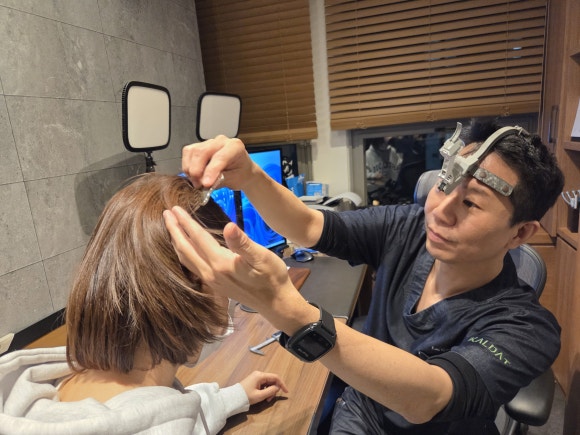
Summer is not simply a hot season; from the perspective of the scalp and hair follicles, it is a considerably stressful environment.
Strong UV exposure, high scalp temperature, and excessive sebum and sweat can disrupt the hair growth cycle and cause scalp inflammation.
In particular, accumulated damage during the summer often leads to an increase in hair loss during the fall.
Therefore, summer hair loss management should focus on these four areas:
Since hair loss can take a long time to recover once it progresses, developing the habit of managing your scalp environment in advance during the summer can make a significant difference to long-term hair health.
Now is the time to break free from hair loss. This was Jin-oh Kim.
May new hair surely grow.
Written by: Jin-oh Kim, New Hair Plastic Surgery (Public Relations Director of the Korean Association of Plastic Surgeons / Academic Director of the Korean Society of Laser, Dermatology and Hair)
[References]
-
Trueb, R. M. (2022) 'Is hair susceptibility to ozone and ultraviolet radiation source of oxidative stress in scalp?', International Journal of Trichology, 14(2), pp. 41-49. cited: "UV radiation degrades keratin fractions faster in lighter hair shades due to lack of protective melanin polymers."
-
Müller, J. and Dresdner, A. (2023) 'Analysis of hair cortisol concentrations in amateur endurance athletes and its impact on hair follicle cycling', Psychoneuroendocrinology, 148, p. 105980. cited: "High-intensity prolonged exercise induced elevated hair cortisol levels, shifting follicles from anagen to telogen phase."
-
Zhou, C. et al. (2021) 'The progressive statistics of physical activities and androgenetic alopecia outcomes in male cohorts', Journal of Dermatological Science, 102(3), pp. 155-162. cited: "Aerobic exercise demonstrated a 5.4-fold increase in hair loss improvement compared to baseline physical activities."
Recommended reading