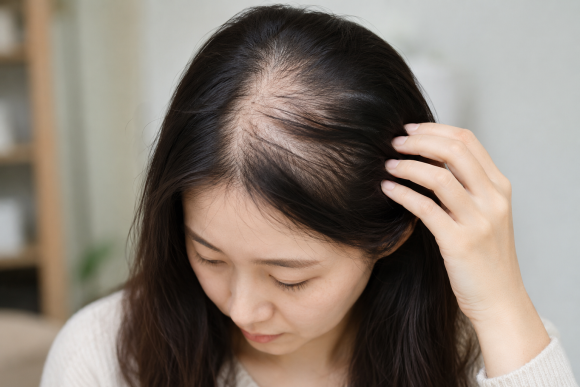
If you have hair loss, should you avoid bleaching and dyeing your hair?
One question that people experiencing hair loss often ask in the consultation room is:
Does dyeing my hair make hair loss worse?
Will bleaching make my hair fall out more?
People with a lot of gray hair or those who want to change their style often wonder whether they need to give up dyeing their hair because of hair loss.
There are even claims online that “dyeing kills the hair follicles” or “bleaching causes hair loss,” but the reality needs to be understood a little differently.
To put it simply, having hair loss does not necessarily mean that you must avoid dyeing or bleaching your hair.
However, there are some points to be cautious about depending on the condition of your scalp and the type of hair loss.
Can dyeing or bleaching directly cause hair loss?
Based on the medical evidence available to date, there is insufficient evidence that ordinary hair dyeing or bleaching directly causes male-pattern or female-pattern hair loss.
The most common causes of hair loss are genetic factors and hormonal influences.
In other words, using hair dye does not suddenly turn healthy hair follicles into hair-loss follicles.
However, the chemicals used during the dyeing or bleaching process can irritate the scalp.
As a result, scalp inflammation or contact dermatitis may develop, which can temporarily cause increased hair shedding.
In other words, rather than being a direct cause of hair loss, these procedures may indirectly worsen the scalp environment.

Why bleaching is more taxing than dyeing
Bleaching has a greater impact on the scalp and hair than dyeing.
Bleaching is the process of removing the melanin pigment from the hair.
Because strong oxidizing agents are used during this process, the surface of the hair may become damaged and moisture loss may increase.
In particular, for people with hair loss who already have a lot of thinning hair, their hair may look even thinner and weaker after bleaching.
In many cases, it is not that the hair fell out because of bleaching; rather, damaged hair breaks easily, making the hair loss appear worse.
Therefore, if your hair loss is progressing, bleaching should be approached more cautiously than dyeing.
When should people with hair loss be cautious?
It is advisable to postpone dyeing or bleaching for a while in the following situations.
-
When the scalp is red and inflamed
-
When severe seborrheic dermatitis is present
-
When you have recently undergone a hair transplant
-
When the scalp is itchy or oozing fluid
-
When hair is falling out much more rapidly than usual
Having a procedure in these conditions may increase scalp irritation and prolong the recovery period.
Especially immediately after a hair transplant, it is important to adjust the timing of dyeing according to your medical provider’s instructions until the transplant area has stabilized.
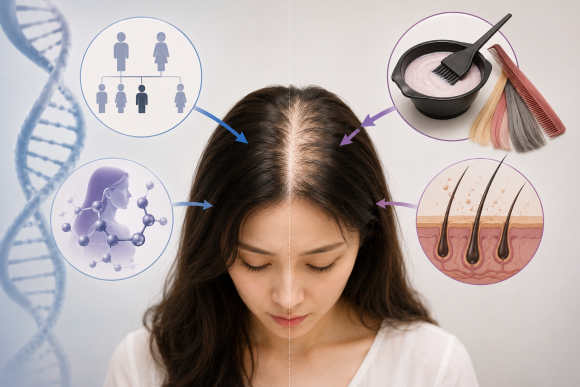
What if you need to dye your hair despite having hair loss?
Having hair loss does not mean you must give up dyeing your hair altogether.
However, the following measures are recommended.
-
Choose a salon that uses scalp-protective products
-
Avoid dyeing your hair excessively often
-
Minimize the number of bleaching sessions
-
Postpone the procedure when there are wounds on the scalp
-
Provide sufficient moisture and scalp care after the procedure
Also, if you are receiving treatment for hair loss, the safest approach is to decide when to have the procedure after consulting your medical provider.
Having hair loss does not mean that you must avoid dyeing or bleaching your hair entirely.
There is insufficient evidence that ordinary hair dyeing directly causes hair loss, and most hair loss occurs due to genetic factors and hormonal influences.
However, hair dye and bleach can irritate the scalp and hair, so caution is needed when the scalp is in poor condition or hair loss is actively progressing.
In particular, because bleaching causes significant hair damage, hair loss may appear worse when there is already a lot of thinning hair.
Ultimately, the important question is not “Should dyeing itself be prohibited?” but “Is the current condition of the scalp able to tolerate dyeing?”
If you prioritize scalp health and undergo the procedure at an appropriate time, you can still try changing your style even if you have hair loss.