The shoulders of hair-loss patients who walk through the doors of my consultation room are always slightly hunched inward. They range from people in their 20s to breadwinners in their 50s.
Watching their earnest eyes every day, I know better than anyone how important protecting one’s hair can be in a person’s daily life. The burden of spending tens of thousands of won every month on medication is by no means insignificant for young people with limited disposable income.
So when the government recently announced that it would consider expanding health insurance coverage for hair-loss treatment as a task to pursue in the second half of the year and begin a public discussion process, I had mixed feelings. What was particularly striking was that, in public forums and news comments, many people were saying, “Emergency rooms are collapsing right now—why are we talking about hair loss?” Yet completely different numbers appeared in anonymous spaces.
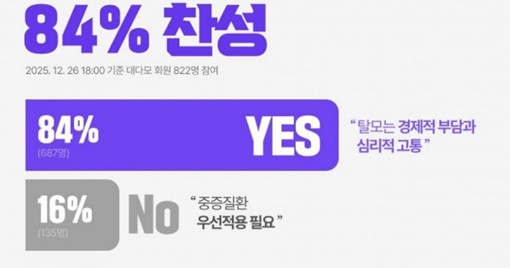
In fact, a survey of 1,222 members of the domestic hair-loss community Daedamo found that as many as 84.4% voted in favor of health insurance coverage.
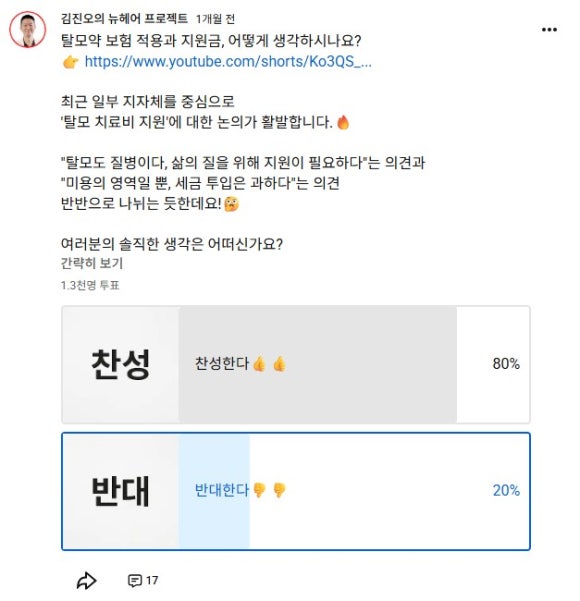
Even in a poll conducted on my YouTube channel with approximately 1,300 participants, the approval rate reached 80%. People may not be able to openly say, “Take money away from treatment for critically ill patients and spend it on my hair,” but when anonymity is involved, their instinct to be honest about their own interests is revealed in full.
It reminded me of the “shy Trump” phenomenon in the United States: people did not show their true feelings outwardly, but voted strictly in their own interests.
There is a Korean proverb that says, “A thorn stuck under my fingernail hurts more than another person’s epidemic.” That is simply how human psychology works. Compared with the grand discourse of setting aside health insurance funds for people with rare, intractable diseases or severe cancers—conditions that most people may never experience in their lifetime—the proposal to reduce the monthly cost of medication needed to protect one’s own hair feels far more immediate and compelling.
Since this is a policy that would benefit a large portion of the public, the government likely considered this option carefully as a form of welfare focused purely on people’s livelihoods.
At the same time, however, it is hard not to recall the atmosphere of class-president elections during our school years. The tteokbokki and hamburgers a friend bought us the day before the election were certainly delicious and thoughtful gifts. But once you stand in front of the ballot box, things become complicated: “Is this friend really the right person to work for our class, or should I vote based on the snacks right in front of me?”
Assemblyman Lee Jun-seok’s sharp criticism of the policy—“I understand the desire to scatter the same amount of money thinly in order to win many votes”—likely arose from a reasonable suspicion that, behind the policy’s seemingly pure intentions, there may be calculations aimed at winning votes.

Reaction to comments on insurance coverage for hair-loss treatment 1

Reaction to comments on insurance coverage for hair-loss treatment 2

Reaction to comments on insurance coverage for hair-loss treatment 3
When we look closely at the policy’s specific direction, there is a point that adds weight to this reasonable suspicion: the proposal to initially limit coverage to young adults between the ages of 20 and 34. Of course, it is easy to understand the policy’s stated purpose of easing the financial burden on young people beginning their careers and preventing psychological distress. However, from the perspective of medical professionals who see patients of various ages every day, it is also difficult not to question this approach.
The psychological stress caused by hair loss and the burden of paying for medication every month do not depend on age. Medically, there is no reason why hair loss at age 34 should differ from hair loss at age 35, and it cannot be said that the hair loss of a breadwinner in their 40s or 50s is less painful than that of a young person. By drawing an administratively convenient age-based line rather than using medical judgment or a universally equitable standard, the policy has ended up inviting unnecessary suspicion about whether it is truly intended to support people’s livelihoods or is instead intended to appeal to a particular generation of voters. No matter how good the intention, it is difficult to fully convince the public when the criteria are not sufficiently precise.
A thinly distributed sweet benefit may briefly make the public smile, but fiscal policy aimed at designing the nation’s long-term future must be thoroughly cool-headed and unsentimental.
Health insurance is not an inexhaustible source of funds.
It is the “last line of defense” and the “supporting pillars of a home,” funded by contributions from the entire population and intended to prevent a household from going bankrupt when it encounters catastrophic medical expenses or a serious illness beyond the means of an ordinary family. Our current health insurance system does not completely disregard hair loss, either.
Alopecia areata caused by autoimmune disease and severe inflammatory hair loss of the scalp are already covered by health insurance. The real question is whether the government should take responsibility for genetically caused hair loss that develops with age.
It would certainly be wonderful if the government could channel water to my field as it withers in a drought. But the problem is that, in the vast field of essential medical care next door, the water has been cut off entirely; the ground is not merely cracked but is burning away.
Even as we discuss health insurance coverage for hair-loss medication, a pregnant woman in a rural area may be wandering for dozens of kilometers in an ambulance because there is no delivery room where she can give birth. Parents carrying sick children line up before dawn for pediatric clinics to open, making this early-morning wait a daily routine, while emergency rooms often turn patients away because of doctor shortages, causing them to miss the golden hour on the way.
The tragedies of critically ill patients who give up treatment or sell their homes because they cannot afford ultra-expensive anticancer drugs costing millions of won per month or more also continue.
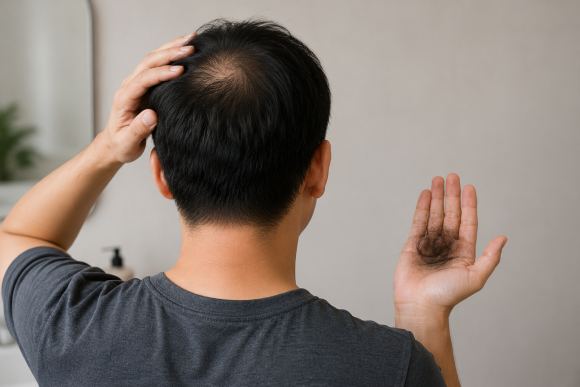
The suffering caused by hair loss is not insignificant, either.
More than anyone, I hope that the financial burden of medication for people with hair loss will become even slightly lighter. However, if we need “tangible welfare” that helps cover people’s living expenses, I believe it should be implemented through a separate government welfare budget—not through health insurance funds that serve as the lifeline of the population.
When the pillars of a house are already shaking and the roof is leaking, we cannot spend money on making the interior look prettier.
Health insurance coverage for hereditary hair loss may be a sweet, practical welfare policy that immediately reduces individuals’ medication costs. However, given the limited nature of the national health insurance budget, it could become a boomerang that accelerates the collapse of essential medical infrastructure such as emergency rooms, delivery rooms, and care for serious diseases.
In fact, 84.4% of the 1,222 members of South Korea’s largest hair-loss community, Daedamo, voted in favor, while 80% of approximately 1,300 participants in a survey on the community’s YouTube channel also supported it, demonstrating the public’s powerful “desire for personal gain in anonymity.”
Although the psychological suffering caused by hair loss is by no means insignificant, it seems more appropriate to address it through a separate government welfare budget rather than through health insurance, which serves as the nation’s lifeline.