Losing hair while having lots of chest hair and a beard? The hidden relationship between hair loss and body hair
"Why does my hair keep falling out while my beard and body hair seem to be growing more abundantly?"
It may seem strange at first. After all, the hair growing on the same body is disappearing in some places while becoming thicker and more abundant in others.
Medically, however, this is a very natural phenomenon.
To put it simply, both scalp hair and body hair are influenced by male hormones, but they respond to the same hormones in different ways.
In other words, hair loss does not occur simply because there is too much hormone. It occurs because the hair follicles in each area respond to hormones differently.
The Culprit Is the Male Hormone “DHT”
The substance that plays the most important role in hair loss and body hair growth is the male hormone dihydrotestosterone (DHT).
DHT is produced when testosterone, a male hormone, is converted by enzymes in the body. It plays an important role in producing physical changes in men after puberty.
The growth of facial hair, a deeper voice, and increased body hair are all largely influenced by DHT.
What is interesting, however, is that the same DHT can produce completely different results depending on the area of the body.

In the Scalp, It Causes “Miniaturization”
The scalp follicles of people with a genetic predisposition to hair loss are highly sensitive to DHT.
When DHT acts continuously, the follicles gradually become smaller, the hair becomes thinner, and eventually it can no longer grow.
Simply put, thick hair gradually becomes as fine as peach fuzz before disappearing, and this process repeats over time.
The hairline and crown are known to be particularly sensitive to DHT, while the sides and back of the scalp are relatively less affected.
In Contrast, It Promotes Growth in Body Hair
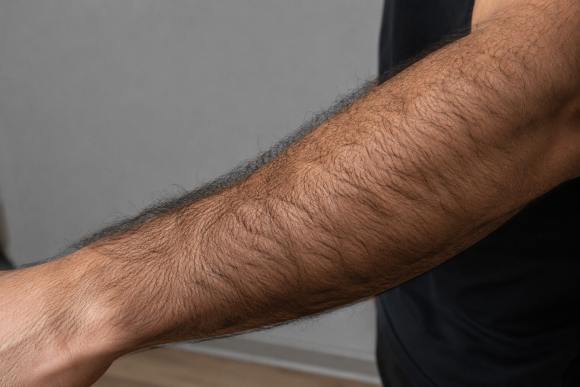
By contrast, body hair such as beards, chest hair, and arm and leg hair tends to grow thicker and darker with greater exposure to DHT.
That is why it is common to see people experiencing hair loss who nevertheless have very thick beards or abundant body hair.
This is not necessarily because they have excessive amounts of male hormones. Rather, the follicles in those areas respond to DHT by growing.
Does Having a Lot of Body Hair Mean More Severe Hair Loss?
Many people think that “having a lot of body hair means having severe hair loss,” but this is only partly true.
Some studies have observed a connection between body hair and hair loss, but the amount of body hair alone cannot accurately predict whether someone will experience hair loss or how quickly it will progress.
For example, some people have a great deal of body hair but little to no hair loss, while others have little body hair yet experience severe hair loss.
What matters is not the absolute amount of male hormones, but how sensitively each person’s hair follicles respond to DHT.
In other words, it is more accurate to understand hair loss as a matter of the follicles’ genetic sensitivity rather than simply a hormone problem.
Scalp Hair and Body Hair Grow According to Different Rules
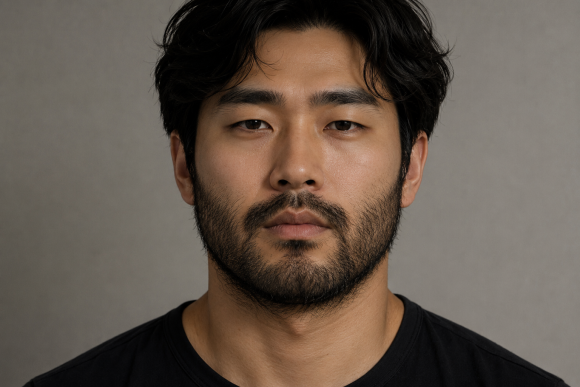
Losing scalp hair while having a lot of body hair is by no means unusual.
Rather, it is a very common phenomenon caused by the same male hormone, DHT, acting differently on the hair follicles in different areas.
DHT causes scalp follicles to shrink, while facial and body hair follicles are instead stimulated to grow.
Therefore, having a lot of body hair does not necessarily mean that hair loss will be severe. What matters is an individual’s genetic predisposition and the hormonal sensitivity of their hair follicles.
If your hairline or crown has recently begun to thin and you feel that your hair density is decreasing, the most important step is to have the condition of your scalp and hair accurately assessed, rather than focusing on the amount of body hair.