In recent hair-loss treatment research, there has been growing interest not only in conventional hormone-based treatments and vasodilators, but also in treatments that help maintain the health of the follicular environment itself.
One of the most interesting candidates is melatonin.
Although many people know melatonin simply as a sleep-support hormone, it has been discovered to be a physiologically active substance that is also produced and functions within hair follicles¹.
So, can topical melatonin actually help treat hair loss?
Based on the clinical studies published to date, let’s organize the findings in the form of frequently asked questions.
Can Topical Melatonin Help with Female Hair Loss? A Summary of Topical Melatonin Hair-Loss Treatment Based on Clinical Research
| Melatonin is not simply a sleep hormone; it is also a physiologically active substance produced within hair follicles¹. |
|---|
| Topical melatonin may help protect the follicular environment and maintain the anagen phase through antioxidant and anti-inflammatory effects². |
| Clinical studies have reported positive results, including increased hair density, a higher proportion of anagen hairs, and reduced hair shedding³⁻⁴. |
| It has attracted attention as a relatively safe adjunctive treatment option, particularly for women with hair loss⁵. |
| However, the level of evidence and study sizes remain limited, so it cannot yet completely replace standard treatments⁶. |
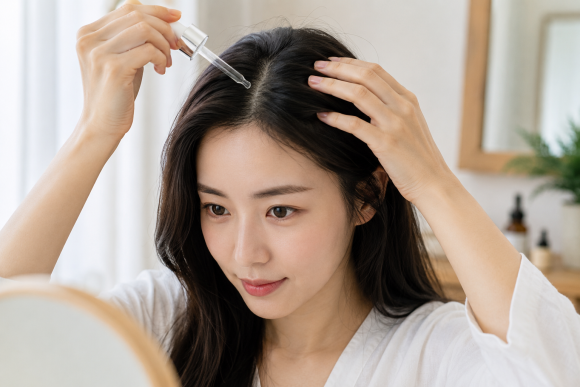
Q1. Why has melatonin attracted attention as a hair-loss treatment ingredient?
Melatonin is a powerful antioxidant.
The hair follicles in our bodies are continuously exposed to various environmental stimuli, including ultraviolet radiation, stress, sebum oxidation, and microinflammation.
As these stimuli accumulate, the follicles may gradually become damaged, and hair loss may progress as the anagen phase becomes shorter.
Researchers discovered that hair follicles themselves synthesize melatonin and respond to it through melatonin receptors¹.
This led to the possibility that melatonin is not merely a hormone associated with sleep, but may also regulate the hair-growth cycle and protect cells².
In particular, its ability to reduce damage caused by reactive oxygen species and alleviate inflammatory responses may play an important role in slowing the progression of hair loss².
Q2. Have clinical studies actually confirmed an effect on hair loss?
Yes. Several clinical studies to date have repeatedly reported positive results.
In particular, a study involving women with androgenetic alopecia and diffuse hair loss found that daily application of a low-concentration melatonin solution for six months significantly increased the proportion of anagen hairs compared with the placebo group³.
In another study of male pattern hair loss, digital hair analysis showed an approximately 29% increase in hair density three months after treatment began and approximately 41% after six months⁴.
In addition, a large observational study found a marked reduction in one of the symptoms patients notice most—the feeling that their hair comes out easily when they touch it⁴.
| Study population | Duration of use | Observed results |
|---|
| Women with androgenetic alopecia and diffuse hair loss | 6 months | Increased proportion of anagen hairs³ |
| Men with androgenetic alopecia | 3–6 months | Approximately 29–41% increase in hair density⁴ |
| Large observational study | 3 months | Reduced hair shedding and improved scalp condition⁴ |
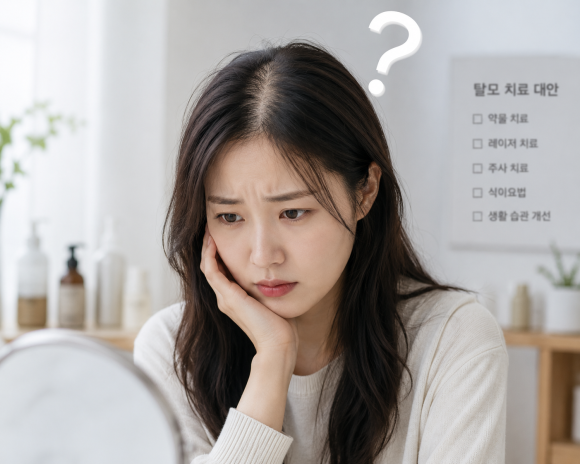
Q3. Why is it receiving particular attention for women with hair loss?
Treatment options for female hair loss are more limited than many people might expect.
This is because hormone-based medications such as finasteride and dutasteride may have restrictions on their use in women of childbearing age.
By contrast, studies to date have reported that topical melatonin has limited systemic absorption and causes limited changes in blood melatonin levels⁴.
Several review articles have also suggested that it may be a relatively safe adjunctive treatment option for female patients⁵.
In clinical practice, its potential use as an adjunctive therapy has been discussed for patients with early-stage female pattern hair loss or those who do not want intensive medication-based treatment.
Q4. Can applying melatonin alone replace existing hair-loss medications?
At this stage, it is difficult to say so.
The reason is that the studies published so far have generally been small, and their study designs, concentrations, and formulations differ from one another⁶.
Some studies may also reflect combined effects with other ingredients in addition to the effects of melatonin alone⁶.
Therefore, for now, it is more appropriate to understand melatonin as a treatment that serves a complementary role rather than one that completely replaces finasteride, dutasteride, or minoxidil.
Q5. Some people say, “Isn’t its effectiveness being exaggerated?” Is that true?
That criticism is partly valid.
In fact, research to date has not yet reached the level of large, multicenter clinical trials⁶.
However, an interesting point is that results showing a relatively consistent direction have been repeatedly observed across different study designs and patient groups³⁻⁵.
In other words, although there is not yet enough evidence to recognize it as a “definitive standard treatment,” enough data are accumulating to evaluate it as an “adjunctive treatment with a high possibility of effectiveness.”
Q6. Ultimately, which patients may be suitable for topical melatonin?
Based on the research findings to date, it may be considered for the following patients:
-
Patients with early-stage female pattern hair loss
-
Patients with diffuse hair loss
-
Patients concerned about side effects from existing medications
-
Patients seeking to improve the follicular environment
-
Patients who want to use it alongside existing hair-loss treatments
Melatonin is meaningful not because it simply makes hair grow faster, but because it is a treatment intended to create an environment in which hair follicles can function healthily.
Melatonin is becoming difficult to describe as merely a sleep hormone.
In particular, after it was discovered that melatonin is produced and functions directly in hair follicles, it has attracted attention as a new adjunctive treatment strategy in the field of hair-loss treatment¹.
Although there is not yet enough evidence for it to completely replace existing standard treatments, the approach of protecting the follicular environment through antioxidant and anti-inflammatory effects is sufficiently appealing².
If larger clinical studies accumulate in the future, melatonin may occupy a more important position in various areas of hair-loss treatment, including female hair loss.
This has been Jin-oh Kim, and now is the time for hair.
May new hair surely grow.

Written by: Jin-oh Kim of New Hair Plastic Surgery (Public Relations Director of the Korean Association of Plastic Surgeons / Academic Director of the Korean Association of Laser, Dermatology and Trichology)
-
Adjunct Professor, Department of Plastic Surgery, Yonsei University College of Medicine
-
American Board of Hair Restoration Surgery (ABHRS)
-
Executive Director, Korean Association of Plastic Surgeons
-
Executive Director, Korean Association of Laser, Dermatology and Trichology (KALDAT)
-
Executive Director, Korean Association for Laser Medicine and Surgery
[References]
-
Fischer TW, Slominski A, Tobin DJ, Paus R. 2008. Melatonin and the hair follicle. Journal of Pineal Research, 44(1), 1–15.
-
Greco G, et al. 2024. Clinical studies using topical melatonin. International Journal of Molecular Sciences, 25(10), 5167.
-
Fischer TW, Burmeister G, Schmidt HW, Elsner P. 2004. Melatonin increases anagen hair rate in women with androgenetic alopecia or diffuse alopecia. British Journal of Dermatology, 150(2), 341–345.
-
Fischer TW, Trüeb R, Hänggi G, Innocenti M, Elsner P. 2012. Topical melatonin for treatment of androgenetic alopecia. International Journal of Trichology, 4(4), 236–245.
-
Greco G, Di Lorenzo R, Ricci L, et al. 2023. Melatonin and the human hair follicle. Journal of Drugs in Dermatology, 22(3), 260–268.
-
Nestor MS, et al. 2021. Treatment options for androgenetic alopecia. Journal of Cosmetic Dermatology, 20(12), 3759–3785.
Related articles