There is a question I hear more often than you might expect in the consultation room.
Is hair transplantation impossible if my dandruff is very severe?
My scalp often becomes red. Could this prevent the grafts from taking properly?
I have been using Nizoral shampoo continuously. Is it okay to undergo surgery?
To give you the conclusion first, having seborrheic dermatitis does not mean that you cannot undergo a hair transplant.¹²
However, the first step is to determine whether your current scalp condition is stable enough to tolerate surgery.
Hair transplantation is a procedure that moves healthy hair follicles, but it is also a process of managing the scalp environment so that those follicles can take root in their new surroundings.
Summary: I Have Severe Dandruff—Will a Hair Transplant Fail? Can Patients with Seborrheic Dermatitis Undergo Hair Transplantation?
| Seborrheic dermatitis itself is not a condition that prohibits hair transplantation.¹² |
|---|
| What matters is not “whether you have seborrheic dermatitis,” but “whether the current inflammation is under control.”¹⁴ |
| If the scalp is red and itchy, with severe oily scaling, controlling the inflammation should take priority over surgery.¹³ |
| In most cases, it is safer to plan a hair transplant after maintaining a stable condition for approximately 4–6 weeks.¹⁵ |
| For a successful hair transplant, it is important to manage not only the follicles but also the scalp environment.¹⁴ |
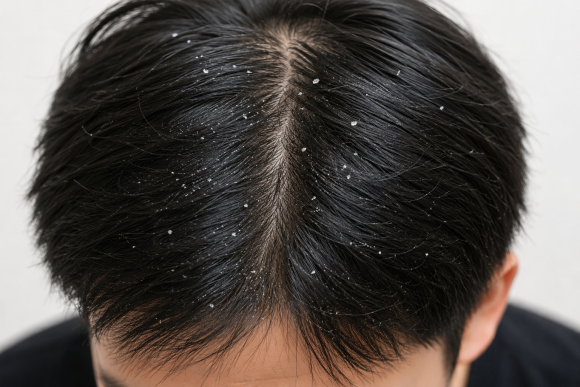
Q1. Does seborrheic dermatitis reduce the graft survival rate in hair transplantation?
It cannot be said that this is necessarily the case.
There are not yet enough large-scale studies analyzing hair transplant graft survival rates in patients with seborrheic dermatitis.¹
However, from a dermatological perspective, active inflammation can affect the wound-healing process and skin-barrier function, so surgery is not recommended when seborrheic dermatitis is active.³⁴
In clinical practice, when patients have red, itchy, or burning scalps, they are often advised to control the inflammation first rather than rush into surgery.
Conversely, when the scalp condition is sufficiently stable, results are often not significantly different from those of other patients.
Q2. Do I need to postpone a hair transplant even if I have only a little dandruff?
Not necessarily.²
Many people consider dandruff and seborrheic dermatitis to be the same condition, but there is actually a difference.
Simple dandruff refers to a condition with relatively little inflammatory response.
Seborrheic dermatitis, on the other hand, may be accompanied by the following symptoms.¹⁴
In other words, what matters more than the amount of dandruff is whether active inflammation is currently present on the scalp.
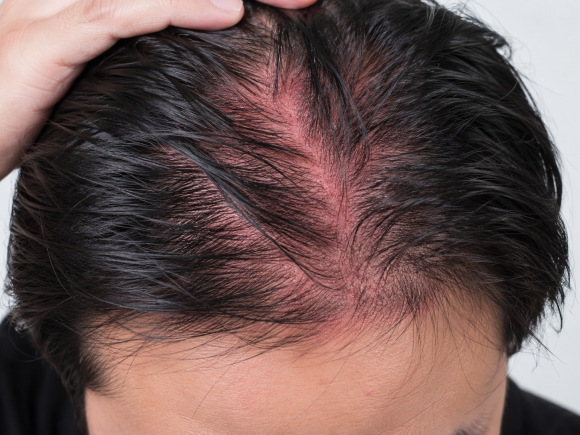
Q3. Why is hair transplantation not recommended when the scalp is red?
Hair transplantation is a procedure that creates thousands of tiny wounds.
Small wounds occur both when follicles are harvested from the occipital donor area and when they are implanted in areas affected by hair loss.
However, the following problems may occur when the scalp is already inflamed.¹³
-
Delayed wound healing
-
Increased risk of folliculitis
-
Reduced skin-barrier function
-
Worsening inflammation after surgery
-
Increased patient discomfort
The first approximately two weeks immediately after surgery are especially important, as this is when the transplanted hair adapts to its new environment.
Therefore, when seborrheic dermatitis is active, controlling the inflammation first rather than rushing into surgery is more favorable for long-term results.
Q4. How much improvement is needed before hair transplantation is possible?
Surgery may generally be considered when the following conditions are met.¹⁵
| Assessment item | Recommended condition |
|---|
| Redness | Almost none or mild |
| Itching | Stable over the past several weeks |
| Oily scaling | Not severe |
| Stinging | None |
| Occipital area | Donor area is clean |
| Medicated shampoo | Symptoms can be controlled |
In general, it is recommended to maintain a stable condition for at least 4–6 weeks.
What matters is not “looking better for one day,” but maintaining a consistently stable condition.
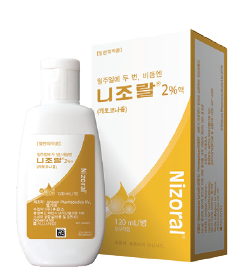
Source: Korean Pharmaceutical Information Center
Q5. Can I continue using Nizoral (ketoconazole) shampoo?
In most cases, it can be helpful.³
Ketoconazole shampoo has been shown to be effective in inhibiting the growth of Malassezia yeast and reducing inflammatory responses.³
However, excessive use may cause the following problems.
Therefore, it is generally used approximately 2–3 times a week, and once symptoms have stabilized, it is often used approximately once a week as maintenance therapy.
Q6. Can I use medicated shampoo immediately after surgery?
You should be especially careful.
The approximately 10–14 days after surgery are a very important period during which the transplanted hair becomes established.
Using a strong medicated shampoo during this period may cause irritation.
Care is generally managed in the following order.
① First two weeks: Use the mild shampoo recommended by the clinic
② After the scabs have been removed: Resume medicated shampoo approximately once a week
③ Four to six weeks after surgery: Begin the maintenance-therapy stage
However, this may vary depending on each person’s recovery, so it is important to consult with your treating medical professional.
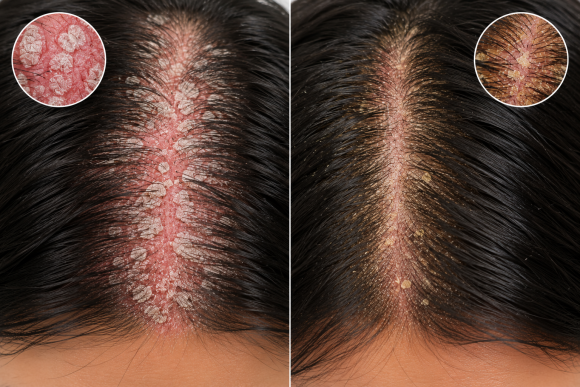
Q7. Could all of the transplanted hair eventually fall out because of seborrheic dermatitis?
In most cases, no.²
It is uncommon for transplanted hair that has already fully taken root to be permanently lost solely because of seborrheic dermatitis.
However, if chronic inflammation persists, the surrounding native hair may be affected, making the overall density appear lower.
That is why continued management of seborrheic dermatitis is necessary even after hair transplantation.
Q8. Why is it necessary to distinguish psoriasis from seborrheic dermatitis?
Although they may look similar, the surgical plan may be completely different.¹⁴
| Difference | Seborrheic dermatitis | Psoriasis |
|---|
| Scaling | Yellow and oily | Silvery-white and thick |
| Borders | Relatively indistinct | Clearly defined |
| Areas affected | Areas with more sebum | May also involve the elbows and knees |
| Surgery | May be possible after controlling the condition | A more cautious approach is required |
Psoriasis requires particularly careful judgment because the irritation from surgery itself may potentially trigger new lesions.
For hair transplantation in patients with seborrheic dermatitis, the important issue is not “whether it is possible,” but “when the timing is appropriate.”
Seborrheic dermatitis is not an absolute contraindication to hair transplantation.¹²
However, unnecessarily undergoing surgery while active inflammation is present should be avoided.
For a successful hair transplant, it is helpful to remember the following sequence.
① Control scalp inflammation
② Check the condition of the donor area
③ Allow a sufficient stabilization period
④ Establish a postoperative maintenance plan
Hair transplantation is not simply a procedure for moving hair.
It is a treatment process that also designs the scalp environment in which that hair will live in the future.
This has been Jin-oh Kim from New Hair—time for your hair to shine.
A new hair for life (必生新毛).
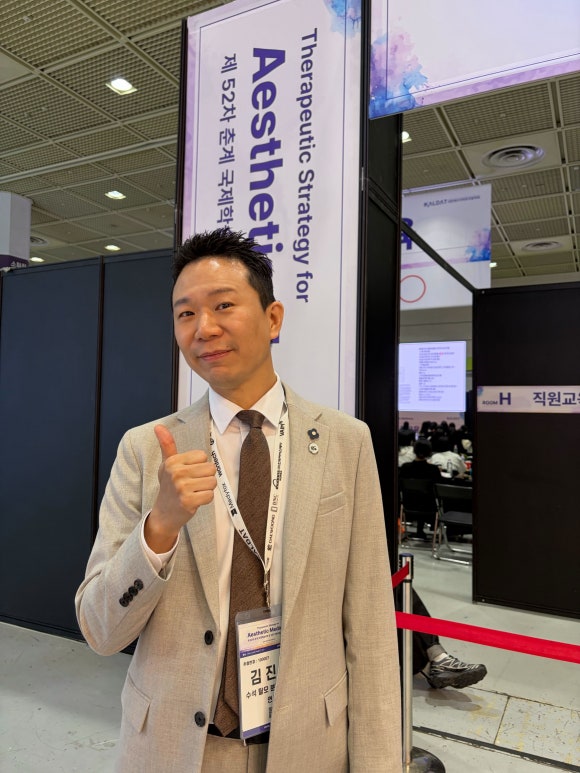
Written by: Jin-oh Kim, New Hair Plastic Surgery Clinic (Public Relations Director of the Korean Association of Plastic Surgeons / Academic Director of the Korean Association of Laser, Dermatology and Hair Research)
-
Adjunct Professor, Department of Plastic Surgery, Yonsei University College of Medicine
-
American Board of Hair Restoration Surgery (ABHRS)
-
Executive Director, Korean Association of Plastic Surgeons
-
Executive Director, Korean Association of Laser, Dermatology and Hair Research (KALDAT)
-
Executive Director, Korean Society for Laser Medicine and Surgery
[References]
-
Tucker, D., Syed, H.A. and Masood, S. (2024) Seborrheic Dermatitis. StatPearls Publishing.
-
Borda, L.J. and Wikramanayake, T.C. (2015) Seborrheic Dermatitis and Dandruff: A Comprehensive Review. Journal of Clinical and Investigative Dermatology, 3(2).
-
Okokon, E.O., Verbeek, J.H., Ruotsalainen, J.H., Ojo, O.A. and Bakhoya, V.N. (2015) Topical antifungals for seborrhoeic dermatitis. Cochrane Database of Systematic Reviews, CD008138.
-
Naldi, L. and Rebora, A. (2009) Seborrheic Dermatitis. New England Journal of Medicine, 360, pp. 387–396.
-
Turchin, I. et al. (2025) Current Understanding of Seborrheic Dermatitis: Treatment and Management. Skin Appendage Disorders.
Related articles