One of the questions most frequently asked by patients preparing for or recovering from a hair transplant is this:
I already had surgery, so why do I still need to take medication?
I heard that transplanted hair does not fall out, so is medication really necessary?
I had surgery because I did not want to take medication. Do I have to take it again?
These are perfectly understandable concerns.
However, hair transplantation and hair-loss medication are not treatments that replace each other; they serve different purposes.
Today, focusing on the questions many people have, we will review the relevant research findings together with clinical experience.
Do I Have to Take Hair-Loss Medication After a Hair Transplant? Some People Definitely Need to Take It. Summary
| The primary purpose of hair-loss medication after a hair transplant is to protect your existing hair rather than the transplanted hair. |
|---|
| For people in their 20s to 40s, those with a family history, or those with ongoing crown hair loss, combining medication with treatment is advantageous for long-term results.¹⁻⁵ |
| Recent research found that patients taking finasteride had better results in graft survival, hair density, and satisfaction, but this does not mean that every patient must take it.⁸ |
| Hair transplantation fills in areas where hair is lacking, while hair-loss medication helps slow future hair loss. |
| The important issue is not simply “whether to take medication,” but creating a long-term plan suited to the rate of your hair loss and the condition of your remaining hair. |
Q1. If I do not take hair-loss medication after a hair transplant, will all of the transplanted hair fall out?
The short answer is no.
Hair follicles harvested from the back of the scalp are relatively less affected by DHT.
For this reason, transplanted hair itself often remains for a relatively long time.
The problem, however, is not the transplanted hair but the hair that was originally still present.
Existing hair remaining between the frontal hairs, at the crown, and in the mid-scalp can still be affected by male pattern hair loss.
If only the existing hair continues to thin over time, the transplanted hair may be left standing out on its own, creating a visible boundary or an unnatural appearance.
Therefore, it is more accurate to understand hair-loss medication as treatment for protecting the hair that remains, rather than as medication for the transplanted hair.²
Q2. Does taking hair-loss medication after a hair transplant really improve the results?
The studies published so far have generally shown positive findings.
The Leavitt study found that patients who used finasteride 1 mg before and after hair transplantation maintained a greater density of existing hair around the transplant area.¹
In a recently published prospective comparative study, patients who underwent follicular-unit extraction hair transplantation were compared. The finasteride group showed a graft survival rate of approximately 94%, compared with approximately 90% in the non-medication group.⁸
The finasteride group also showed somewhat greater increases in hair density and patient satisfaction.
Of course, the study had limitations, including its relatively small sample size and follow-up period of about one year.
Therefore, rather than viewing this as evidence that medication is “mandatory for everyone,” it is appropriate to regard it as supporting evidence that taking it may increase the likelihood of better long-term results.
Q3. Does that mean everyone has to take hair-loss medication for life?
Not necessarily.
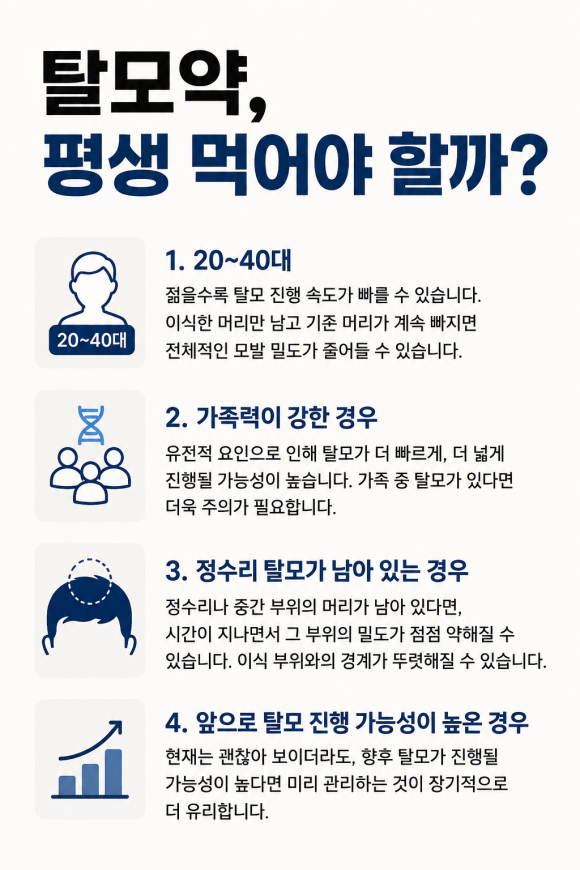
The rate of hair-loss progression and age are very important.
For example, if hair loss has barely progressed for several years, as may be the case after the age of 60, and the transplant area is limited, some people may be monitored without taking medication.
In contrast,
people in their 20s to 40s
people with a strong family history
people with remaining crown hair loss
people who are likely to experience further hair-loss progression
may have a much greater need for medication.³
Hair transplantation uses a limited resource: the donor area.
Because follicles from the back of the scalp that have been used cannot grow back, preserving existing hair for as long as possible is much more advantageous in the long term.
Q4. I am afraid of the side effects of hair-loss medication, so it is difficult to start.
This is the area of greatest concern for many people.
Commonly reported side effects include
The FDA prescribing information reported decreased libido in 1.8% of the finasteride group and 1.3% of the placebo group.⁴
Erectile dysfunction was reported in approximately 1.3% and 0.7%, respectively.
Although these figures are not high, individual sensitivity varies considerably in practice.
Therefore, in clinical practice, the condition before starting treatment is assessed first. If problems arise, options such as reducing the dose, taking the medication every other day, or switching to another medication can also be considered.
The important thing is not to simply endure the symptoms, but to consult with your treating medical professional.

Q5. Is dutasteride a better medication than finasteride?
Dutasteride is a medication that suppresses DHT more strongly.
In a randomized study involving approximately 900 people, dutasteride 0.5 mg showed a greater effect on increasing hair count than finasteride.⁵
However, because it has a long half-life and sensitivity to side effects varies from patient to patient, it is difficult to say that it is unconditionally a better medication.
It may be an option for younger patients, patients whose hair loss is progressing rapidly, and patients who had an insufficient response to finasteride.
Q6. Oral medication feels burdensome. Is topical finasteride safe?
This treatment has recently attracted considerable interest.
However, the statement “there are no systemic side effects because it is applied topically” is not accurate.
In announcing adverse-event cases related to compounded topical finasteride products in 2025,
the FDA stated that there are currently no approved topical finasteride products in the United States.⁷
Topical products can also be absorbed to some extent through the skin,
and concentrations may vary depending on how they are compounded.
Therefore, it is important to use such products only after sufficiently confirming their quality and safety.
Q7. Is it a good idea to use minoxidil as well?
Minoxidil and finasteride have different roles.
Finasteride is a medication that slows hair-loss progression itself, while minoxidil helps increase the number of hairs in the growth phase and increase hair thickness.³
For people with crown hair loss or considerable thinning of existing hair, combined treatment can often be helpful.
However, because consistent use is more important than anything else, it is best to choose a treatment method while also considering your daily routine.
| Question | Key answer |
|---|
| Will the transplanted hair also fall out? | In most cases, protecting the existing hair is the more important purpose. |
| Does everyone have to take medication? | No. It depends on the extent of hair-loss progression. |
| When is it most helpful? | In younger people and those with a family history or remaining crown hair loss. |
| What if side effects occur? | Dose adjustment, changing the dosing interval, or switching medications may be considered. |
| Is dutasteride better? | It may be more effective for some patients, but this does not apply to everyone. |
| Should I use minoxidil as well? | Combined use may be helpful when needed. |
Hair transplantation can be viewed not as the end of hair-loss treatment, but as the beginning of long-term management.
Surgery fills in areas that are already empty.
Hair-loss medication, on the other hand, helps slow future hair loss and preserve existing hair for longer.
Therefore, a more important question than “Do I have to take medication?” is:
“How is my hair loss likely to progress in the future?”
Considering the current condition of your remaining hair, family history, donor-area availability, and the possibility of additional surgery in the future, creating a long-term plan suited to you may lead to the best results.
This was Jin-oh Kim from New Hair Plastic Surgery.
A lifetime of new hair.

Written by: Jin-oh Kim, New Hair Plastic Surgery (Public Relations Director of the Korean Association of Plastic Surgeons / Academic Director of the Korean Association of Laser, Dermatology and Hair Research)
-
Adjunct Professor, Department of Plastic Surgery, Yonsei University College of Medicine
-
American Board of Hair Restoration Surgery (ABHRS)
-
Executive Director, Korean Association of Plastic Surgeons
-
Executive Director, Korean Association of Laser, Dermatology and Hair Research (KALDAT)
-
Executive Director, Korean Society for Laser Medicine and Surgery
[References]
-
Leavitt, M. et al. (2005) ‘Effects of finasteride (1 mg) on hair transplant’, Dermatologic Surgery, 31, pp. 1268–1276. cited: “improves scalp hair surrounding the hair transplant.” ([PubMed][1])
-
Kaufman, K.D. et al. (1998) ‘Finasteride in the treatment of men with androgenetic alopecia’, Journal of the American Academy of Dermatology. cited: “slowed the progression of hair loss.” ([PubMed][2])
-
European Dermatology Forum (2017/2018) Evidence-based S3 guideline for the treatment of androgenetic alopecia in women and in men. cited: “treatment needs to be continued to maintain efficacy.” ([클라바][6])
-
U.S. Food and Drug Administration (2012) PROPECIA® finasteride 1 mg label. cited: “Decreased Libido 1.8; placebo 1.3.” ([FDA Access Data][3])
-
Gubelin Harcha, W. et al. (2014) ‘A randomized, active- and placebo-controlled study of dutasteride in androgenetic alopecia’, Journal of the American Academy of Dermatology. cited: “Dutasteride 0.5 mg significantly increased hair count.” ([PubMed][5])
-
European Medicines Agency (2025) Measures to minimise risk of suicidal thoughts with finasteride and dutasteride medicines. cited: “suicidal ideation as a side effect.” ([European Medicines Agency (EMA)][4])
-
U.S. Food and Drug Administration (2025) Potential risks associated with compounded topical finasteride products. cited: “no FDA-approved topical formulation of finasteride.” ([U.S. Food and Drug Administration][7])
-
Kishen, A. et al. (2025) ‘Post Operative Finasteride Following Hair Transplant Compared with no Medication: A Prospective Comparative Study’, Journal of Chemical Health Risks, 15(5), pp. 930–933. cited: “Graft Survival 94 vs 90.”
Recommended reading