After starting a diet, some people reach their desired weight, only to find that, one day, handfuls of hair begin collecting in the drain every time they wash their hair.
At such times, most people first look for supplements such as biotin or brewer’s yeast, but in actual clinical practice, there is something that should be checked before considering supplements.
That is distinguishing whether the current hair loss is truly caused by a nutritional deficiency or whether female- or male-pattern hair loss is also progressing.
Today, we will discuss hair loss after dieting, focusing on the questions most frequently asked in the clinic.
Sudden Hair Loss After Dieting? FAQ on Nutritional Deficiency–Related Hair Loss: Summary
| Hair loss after a rapid diet usually occurs in the form of telogen effluvium, and increased shedding often begins about 2–3 months after the cause develops.⁵ |
|---|
| Iron, vitamin D, vitamin B12, and zinc may be associated with hair loss, but taking supplements without testing is not recommended.¹³ |
| Iron deficiency is one of the nutritional conditions that should be checked first, especially in women with hair loss.⁶⁹ |
| Nutritional deficiency–related hair loss can coexist with female- or male-pattern hair loss, making an accurate diagnosis important.⁵ |
| The key to treating hair loss is not taking many supplements, but accurately identifying the cause and replenishing only what is deficient.¹ |
| Category | Key information |
|---|
| Most common form | Telogen effluvium |
| When hair loss begins | About 2–3 months after the cause occurs⁵ |
| Nutrients to check first | Iron (ferritin), vitamin D, vitamin B12, zinc |
| Most important evaluation | Medical history + blood tests + scalp examination |
| Behavior to avoid | Taking several supplements without testing |

Q1. Does dieting inevitably cause hair loss?
No.
Losing weight does not cause hair loss in everyone.
The problem occurs when weight is lost rapidly over a short period or food intake is significantly reduced, resulting in insufficient intake of nutrients such as protein and iron.¹
In this situation, some hairs in the growth phase may shift into the resting phase, leading to telogen effluvium, in which a large amount of hair may fall out overall about 2–3 months later.⁵
In clinical practice, it is common to see a reduction in overall hair volume rather than hair loss limited to a specific area.⁵
Q2. I am losing a lot of hair. Would taking biotin first help?
Biotin is the supplement many people look for first.
However, true biotin deficiency is not as common as many people think.¹
When a deficiency has not been confirmed, there is insufficient evidence to support the effectiveness of high-dose biotin for improving hair loss.¹²
Moreover, biotin can distort the results of certain blood tests, including thyroid and cardiac enzyme tests, so you must inform your healthcare provider whether you are taking it before undergoing testing.¹⁰
In other words, it is much more important to identify the cause first than to take the approach of “Since it is hair loss, let’s start with biotin.”
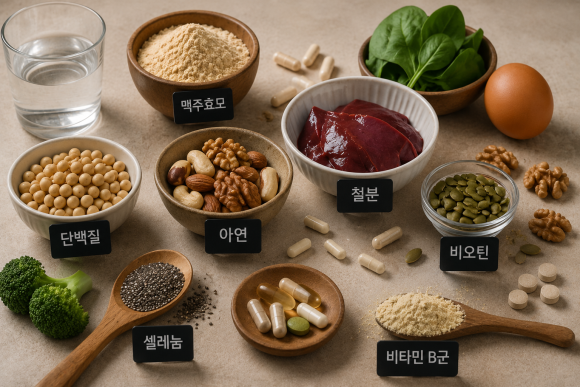
Q3. Can iron deficiency really cause hair loss?
Iron is the nutrient checked first when evaluating nutritional deficiency–related hair loss.
In particular, women with heavy menstrual bleeding or those whose food intake has recently decreased significantly may have low iron stores.
Recent research suggests that iron deficiency should be considered when serum ferritin is below 30 μg/L.⁹
However, hair loss should not be attributed to iron deficiency based on a single iron measurement alone.
Hemoglobin, iron metabolism tests, menstrual blood loss, dietary habits, and other factors must be evaluated together to accurately determine the actual cause.⁶⁷
Q4. If my ferritin is normal, should I continue taking iron supplements?
Many people hear during a health checkup, “Your ferritin is normal,” but still wonder whether they should continue taking iron supplements because of hair loss.
However, a normal ferritin level does not automatically mean that iron supplements are necessary.
This is because iron status is difficult to assess using ferritin alone.
In fact, ferritin can be affected by inflammation, infection, liver disease, and other conditions, and may be measured at a level higher than the actual amount of stored iron.⁶
There is also still no clear medical consensus that everyone with hair loss should raise their ferritin level above a specific threshold.⁷
Therefore, it is advisable to assess several factors together—including hemoglobin, serum iron, transferrin saturation, menstrual blood loss, and dietary habits—before deciding whether to take iron supplements.⁶⁹
In particular, long-term iron supplementation in people who are not iron deficient can cause gastrointestinal problems or iron overload, so treatment based on test results is most important.¹
Q5. Will hair loss improve if I consistently eat only black beans or brewer’s yeast?
The short answer is no.
Nutritionally beneficial foods such as black beans and nuts can be part of a balanced diet.
However, there is no evidence that any one specific food treats telogen effluvium or female-pattern hair loss.¹
If you have an actual nutrient deficiency, it should be corrected, and if hereditary hair loss is also present, separate treatment is needed.
Healthy foods may help, but they cannot replace treatment.
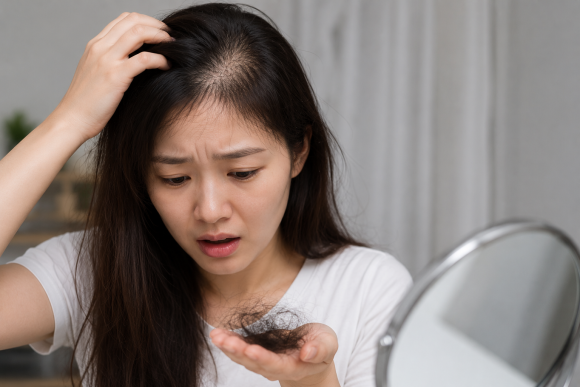
Q6. Will my hair grow back if I take only vitamin D?
Quite a few people hear that vitamin D is associated with hair loss and immediately look for supplements.
Several studies have indeed reported that vitamin D deficiency is relatively common among patients with hair loss.⁴
However, this does not mean that hair loss will be resolved by taking vitamin D alone.
Various factors, including lifestyle, obesity, and chronic disease, may contribute to low vitamin D levels, and hair loss is also a condition in which multiple causes can act together.⁴
Therefore, if vitamin D deficiency is confirmed, correcting it is necessary for overall health. However, there is not yet sufficient evidence that adding high-dose vitamin D causes more hair growth in people whose levels are normal.²
Some studies have observed positive changes after vitamin D supplementation in patients with telogen effluvium, but the studies were small, and further research is needed.⁸
Ultimately, the current medical evidence supports understanding vitamin D as a nutrient used to correct a deficiency rather than as a “hair-loss treatment.”
Q7. Can nutritional deficiency–related hair loss fully recover?
If it is acute telogen effluvium and the cause has been removed, the likelihood of recovery is relatively high.⁵
However, shedding does not stop the day your nutritional status recovers.
Hair that has already entered the resting phase may continue to fall out for a certain period, and it may take several months for newly growing hair to regain sufficient length and thickness.
In addition, if shedding continues for more than six months, the part continues to widen, or the hair gradually becomes thinner, it should be reassessed to determine whether female- or male-pattern hair loss is also present.⁵
The fact that hair loss began after dieting does not necessarily mean that it was all caused by nutritional deficiency.
Conversely, correcting a nutritional deficiency alone does not resolve every type of hair loss.
In actual clinical practice, telogen effluvium and female- or male-pattern hair loss are often found together.
Therefore, rather than indiscriminately adding supplements, the most important step is to first determine which nutrients your body is lacking and what is causing the hair loss.
Based on an accurate diagnosis, the most efficient treatment strategy is to replenish only the nutrients that are needed and, when necessary, proceed with hair-loss treatment at the same time.
This was Kim Jin-oh from New Hair Plastic Surgery.
A lifelong commitment to growing new hair.

Written by: Kim Jin-oh of New Hair Plastic Surgery (Public Relations Director of the Korean Association of Plastic Surgeons / Academic Director of the Korean Academy of Laser, Dermatology and Hair)
-
Adjunct Professor, Department of Plastic Surgery, Yonsei University College of Medicine
-
American Board of Hair Restoration Surgery (ABHRS)–certified physician
-
Executive Director, Korean Association of Plastic Surgeons
-
Executive Director, Korean Academy of Laser, Dermatology and Hair (KALDAT)
-
Executive Director, Korean Society for Laser Medicine and Surgery
[References]
- Guo, E.L. and Katta, R. (2017) ‘Diet and hair loss: effects of nutrient deficiency and supplement use’, Dermatology Practical & Conceptual, 7(1), pp. 1–10. doi:10.5826/dpc.0701a01.
cited: “In the absence of deficiency, supplementation may actually prove harmful to hair.”
- Almohanna, H.M., Ahmed, A.A., Tsatalis, J.P. and Tosti, A. (2019) ‘The role of vitamins and minerals in hair loss: A review’, Dermatology and Therapy, 9(1), pp. 51–70. doi:10.1007/s13555-018-0278-6.
cited: “Micronutrients play an important, but not entirely clear role.”
- Turkoglu, I.N.D. et al. (2024) ‘Analysis of Hb, ferritin, vitamin B12, vitamin D, thyroid function tests and zinc levels in telogen effluvium patients’, Journal of Cosmetic Dermatology. PMCID: PMC11626366.
cited: “The evidence regarding the safety and effectiveness of OTC supplements is quite insufficient.”
- Yongpisarn, T. et al. (2024) ‘Vitamin D deficiency in non-scarring and scarring alopecias: A systematic review and meta-analysis’, Journal of Dermatological Science. PMID:39416654.
cited: “Numerous studies have linked vitamin D deficiency to various alopecia disorders.”
- Mysore, V. et al. (2019) ‘Expert consensus on the management of telogen effluvium in India’, International Journal of Trichology, 11(3), pp. 107–112. PMCID: PMC6580807.
cited: “Diffuse hair loss is usually observed and global rather than patterned.”
- Cheng, T. et al. (2021) ‘The diagnostic value of serum ferritin for telogen effluvium: A cross-sectional comparative study’, Clinical, Cosmetic and Investigational Dermatology, 14, pp. 137–141. PMCID: PMC7882421.
cited: “Serum ferritin may be a potential biomarker for telogen effluvium.”
- Treister-Goltzman, Y. and Yarza, S. (2022) ‘Iron deficiency and nonscarring alopecia in women: Systematic review and meta-analysis’, Skin Appendage Disorders, 8(2), pp. 83–92. PMCID: PMC8928181.
cited: “There is no clear-cut evidence of an association.”
- El-Tatawy, R.A. et al. (2024) ‘Oral vitamin D treatment in patients with telogen effluvium: Clinical and dermoscopic evaluation’, International Journal of Trichology. PMCID: PMC11335050.
cited: “The results need to be verified on a larger scale.”
- Al-Naseem, A. et al. (2021) ‘Iron deficiency without anaemia: A diagnosis that matters’, Clinical Medicine, 21(2), pp. 107–113. doi:10.7861/clinmed.2020-0582.
cited: “Ferritin levels below 30 μg/L indicate iron deficiency.”
- U.S. Food and Drug Administration (2022) ‘Biotin interference with troponin lab tests—assays subject to biotin interference’.
cited: “Biotin can significantly interfere with certain lab tests.”
Other recommended articles