If your maternal grandfather is bald, you will be bald too.
Hair loss is inherited every other generation.
You have probably heard this at least once.
In fact, this is one of the questions I am asked most often in the clinic.
However, as genetics has advanced, this belief has been substantially revised.
Recent genomic studies involving tens of thousands of people, along with twin studies, have shown that male pattern hair loss is not a condition determined solely by either the maternal or paternal side of the family.¹⁻⁷
In this article, I will organize the questions patients are most curious about in an FAQ format, based on actual research papers.
Summary: Is Hair Loss Inherited Every Other Generation? The Truth About the Maternal Grandfather Hair-Loss Theory
| There is no medical rule that hair loss is inherited by skipping a generation. Male pattern hair loss is a polygenic condition involving the combined effects of multiple genes.¹⁻⁷ |
|---|
| It is not only the maternal side that matters. A family history on the father’s side and in the paternal family is also an important factor that can increase the risk of hair loss.²³ |
| Even with a family history, hair loss does not necessarily develop. Conversely, hair loss can occur even without a known family history.¹²⁵ |
| Recent genetic testing also cannot perfectly predict the future. Current hair thickness and changes in the hairline are more important criteria for assessment.⁷ |
| For practical management, consistently documenting your current hairline and crown changes is more helpful than looking at family photographs. |
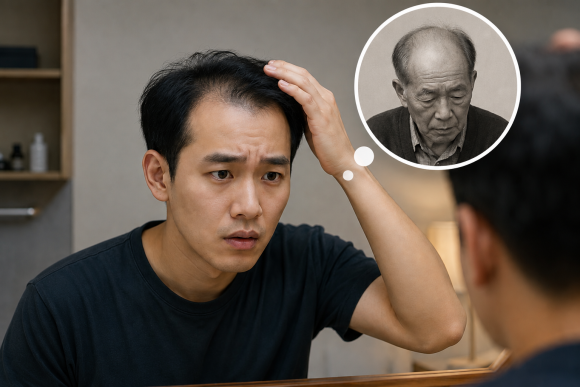
Q1. Is hair loss really inherited every other generation?
This is the first question many people ask.
To put it simply, there is no medical rule that hair loss is inherited by skipping a generation.⁵⁶
Male pattern hair loss is not a condition determined by a single gene. It is a polygenic condition influenced by hundreds or more genes acting together.
Recent GWAS research identified 287 independent genetic signals associated with hair loss,⁵ while another study identified 71 susceptibility loci.⁶
In other words, various gene combinations inherited from both parents work together with the sensitivity of hair follicles to male hormones. This can make hair loss appear to skip a generation, but the actual inheritance pattern does not work that way.
It is common for patients to say in the clinic, “My grandfather had hair loss, but my father is fine, and I am the one losing hair.” In most cases, this can be explained by differences in gene combinations and the timing of gene expression.
Q2. If my maternal grandfather had hair loss, am I more likely to develop it too?
The claim that a family history on the maternal side is important is only partly correct.
Men inherit their X chromosome from their mother, and the X chromosome contains the androgen receptor (AR) gene.⁴
This gene has a very strong association with male pattern hair loss, so the influence of a maternal grandfather may be passed on to his grandson.
However, this is not the only factor that determines hair loss.
Hair-loss-related genes are distributed across multiple autosomes in addition to the X chromosome, and these are inherited from both the father and the mother.⁵⁶
Therefore, it is not accurate to judge risk based only on the maternal side.
Q3. Can I start losing hair even if my father has a full head of hair?
Yes, it is entirely possible.
Even if your father carried genes associated with hair loss, their effects may have appeared later or been less pronounced.
Conversely, when combined with genes inherited from the mother, symptoms may begin at an earlier age in her son.
A study examining family history reported that having a father with hair loss increased the risk of hair loss by approximately 2.5 times.²
A study of Koreans also found a significant association between a paternal family history and male pattern hair loss.³
In other words, rather than feeling reassured simply because your father is fine, it is more important to check the current condition of your own hair.
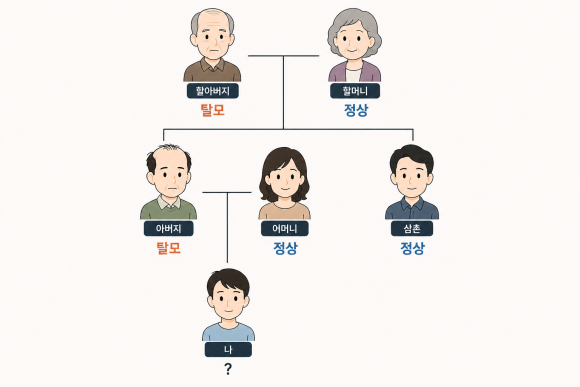
Q4. Is the claim that hair loss is inherited from the maternal side wrong?
It is not completely wrong.
However, it is only a partly accurate explanation.
The basis for the maternal-side influence is the AR gene.⁴
However, the risk of hair loss is not determined by the AR gene alone.
Because numerous autosomal genes also contribute, actual risk should be assessed by considering both the paternal and maternal sides of the family.⁵⁶
Recent studies also explain that assessing the family history on both sides is more accurate than looking only at the maternal side.
Q5. My older brother has hair loss, but I am fine. Will I continue to be fine?
Being fine now does not necessarily mean that you will never develop hair loss.
Even though siblings have the same parents, they inherit different combinations of genes.
On average, they share only about half of their genes.
Twin studies found that the heritability of male pattern hair loss was very high, at approximately 81%, but even identical twins did not have the same age of onset or rate of progression.¹
Therefore, it is also common for hair loss to begin later than it did in an older brother.
Q6. If there is no family history, will I not develop hair loss?
No.
Male pattern hair loss can certainly occur even when there is no known family history.
In practice, hair loss along the part in female relatives often goes unnoticed, and in previous generations hair loss was frequently not documented accurately.
In addition, newly combined gene variants may result in an elevated risk in an individual alone.⁵⁷
Therefore, it is not advisable to feel reassured solely because there is no known family history.
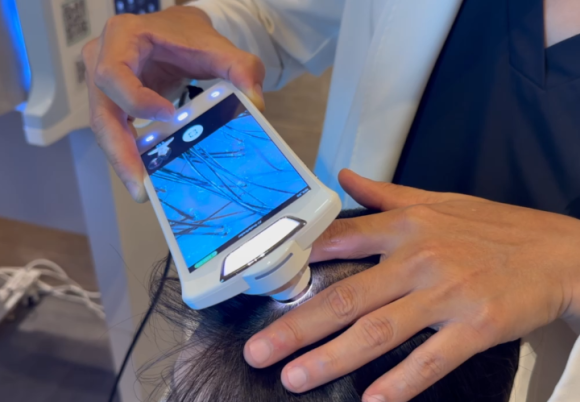
Q7. Can genetic testing for hair loss tell me what will happen in the future?
This is a frequently asked question as genetic testing services have become more widely available.
Based on the research available so far, such testing may be useful as a reference, but it cannot accurately predict the future.⁷
Even in a study analyzing more than 180,000 people, predictive accuracy (AUC) was reported to be approximately 0.60–0.73.⁷
In other words, it is possible to estimate risk to some extent, but testing cannot accurately tell you when hair loss will begin or how far it will progress.
In clinical practice, changes in hair thickness and the hairline are assessed as more important than genetic testing.
Q8. If I have a family history, when should I visit a clinic?
Changes matter more than age.
If you notice any of the following changes, it is a good idea to seek medical evaluation.
-
Your bangs part more easily than they used to.
-
Your M-shaped hairline is gradually deepening.
-
More of the scalp is visible at the crown.
-
There are more fine hairs among the thick hairs.
-
Density has decreased compared with photographs taken under the same lighting.
Conversely, even with a family history, if there are no changes at all, it is often sufficient to monitor the condition by taking photographs under the same conditions every 6–12 months.
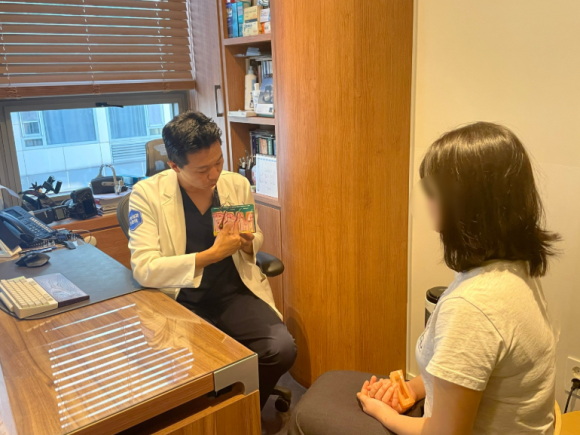
| Question | Key answer |
|---|
| Is hair loss inherited every other generation? | No. It is a polygenic condition. |
| Is only the maternal side important? | No. Both the paternal and maternal sides are important. |
| Am I safe if my father is fine? | Not necessarily. Your current hair condition is more important. |
| Will I not develop hair loss if there is no family history? | It can still occur without a family history. |
| Is genetic testing accurate? | It can provide a reference for risk, but it cannot determine the future with certainty. |
| What is most important? | Current changes in your hair, rather than family photographs. |
Hair loss is not a condition that can be predicted simply by looking at one person, such as your maternal grandfather.
Research to date shows that it is a complex condition in which various genes inherited from both parents, hormonal responses, age, and other factors work together.¹⁻⁷
Therefore, rather than feeling reassured or anxious based only on the belief that “hair loss runs in our family every other generation,” it is much more important to check changes in your current hairline and hair thickness.
Family history is only a reference for estimating risk, and the most reasonable approach is to determine whether treatment is needed based on the current state of progression.
This has been Jino Kim, from Hair Day.
A lifetime devoted to growing new hair.
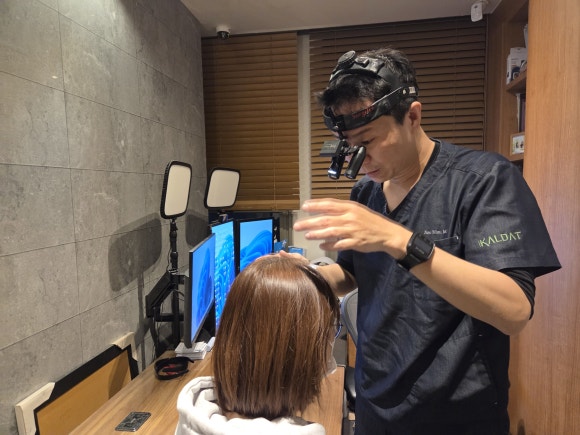
Written by: Jino Kim, New Hair Plastic Surgery Clinic (Public Relations Director of the Korean Association of Plastic Surgeons / Academic Director of the Korean Association of Laser, Dermatology and Hair Research)
-
Adjunct Professor, Department of Plastic Surgery, Yonsei University College of Medicine
-
American Board of Hair Restoration Surgery (ABHRS)
-
Standing Director, Korean Association of Plastic Surgeons
-
Standing Director, Korean Association of Laser, Dermatology and Hair Research (KALDAT)
-
Standing Director, Korean Society for Laser Medicine
[References]
- Nyholt, D.R., Gillespie, N.A., Heath, A.C. and Martin, N.G. (2003) ‘Genetic basis of male pattern baldness’, Journal of Investigative Dermatology, 121(6), pp. 1561–1564. doi:10.1111/j.1523-1747.2003.12615.x.
cited: “81% heritability.”
- Chumlea, W.C., Rhodes, T., Girman, C.J., Johnson-Levonas, A., Lilly, F.R.W., Wu, R. and Guo, S.S. (2004) ‘Family history and risk of hair loss’, Dermatology, 209(1), pp. 33–39. doi:10.1159/000078584.
cited: “Family history and risk of hair loss.”
- Lee, W.S., Oh, Y., Ji, J.H. et al. (2011) ‘Analysis of familial factors using the basic and specific classification in Korean patients with androgenetic alopecia’, Journal of the American Academy of Dermatology, 65(1), pp. 40–47. doi:10.1016/j.jaad.2010.05.005.
cited: “predominantly from the paternal side.”
- Prodi, D.A., Pirastu, N., Maninchedda, G. et al. (2008) ‘EDA2R is associated with androgenetic alopecia’, Journal of Investigative Dermatology, 128(9), pp. 2268–2270. doi:10.1038/jid.2008.60.
cited: “Xq11-q12 as strongly associated with AGA.”
- Hagenaars, S.P., Hill, W.D., Harris, S.E. et al. (2017) ‘Genetic prediction of male pattern baldness’, PLoS Genetics, 13(2), e1006594. doi:10.1371/journal.pgen.1006594.
cited: “287 independent genetic signals.”
- Pirastu, N., Joshi, P.K., de Vries, P.S. et al. (2017) ‘GWAS for male-pattern baldness identifies 71 susceptibility loci explaining 38% of the risk’, Nature Communications, 8, 1584. doi:10.1038/s41467-017-01490-8.
cited: “71 susceptibility loci explaining 38%.”
- Chen, Y., Hysi, P., Maj, C., Heilmann-Heimbach, S., Spector, T.D., Liu, F. and Kayser, M. (2023) ‘Genetic prediction of male pattern baldness based on large independent datasets’, European Journal of Human Genetics, 31, pp. 321–328. doi:10.1038/s41431-022-01201-y.
cited: “AUC ranges of 0.725–0.728 for severe.”
- Lee, S.H., Kang, H. and Lee, W.S. (2023) ‘Association between family history and male androgenetic alopecia with female pattern hair loss’, Annals of Dermatology, 35(5), pp. 348–354. doi:10.5021/ad.22.221.
cited: “maternal history ... significantly associated.”
Related articles