Taking hair loss medication every day is the most basic part of hair loss treatment, and it is a choice made not only for treatment itself but also to protect one’s social self-esteem. However, one of the most challenging situations encountered in the clinic is treating patients whose hair loss continues to progress despite taking their medication faithfully for more than a year.
They may feel betrayed by the medication and conclude that they themselves have an “incurable disease.” From a medical perspective, however, what is needed is not emotional frustration but a clear analysis of the biological mechanisms occurring inside the body.
Why Are Hair Loss Medications Effective for Most People?
Finasteride and dutasteride, the most commonly prescribed hair loss medications, inhibit 5-alpha reductase and lower levels of dihydrotestosterone (DHT), the main hormone responsible for hair loss. Finasteride blocks the type 2 enzyme and suppresses blood DHT levels by approximately 70%, while dutasteride blocks both type 1 and type 2 enzymes, increasing the suppression rate to approximately 90%.
Numerically, this is close to a perfect defensive barrier. Nevertheless, clinical statistics show that 15–25% of all patients do not experience meaningful improvement in hair growth. This is classified pharmacologically as a “reduced treatment response” or “nonresponse.”
First Reason: Genetically Sensitive Androgen Receptors
Patients may suspect that they have taken the medication incorrectly or that it is ineffective, but the academic explanation lies in much finer genetic and metabolic differences. The first variable is the “sensitivity” of the androgen receptor. Put simply, hair follicles have “antennas” that receive the hair loss hormone DHT. The performance of these antennas is determined by the length of a specific genetic region, known as the CAG repeat sequence.
People who genetically have shorter sequences in this region are born with antennas that function much more effectively and are more sensitive than those of others. Even when medication suppresses the level of the hair loss hormone in the blood by up to 90%, these individuals can strongly detect and transmit even the tiny signal represented by the remaining 10% to the hair follicles. The amount of the hormone has been reduced by medication, but the antennas are excessively sensitive, continuing to promote hair loss. In finasteride users with high type 1 enzyme activity in the scalp sebaceous glands, switching to dutasteride may be an alternative. However, when the antennas themselves are excessively sensitive, simply changing medications has clear limitations.
Second Reason: The Hair Follicles Have Already Lost Their Capacity to Recover
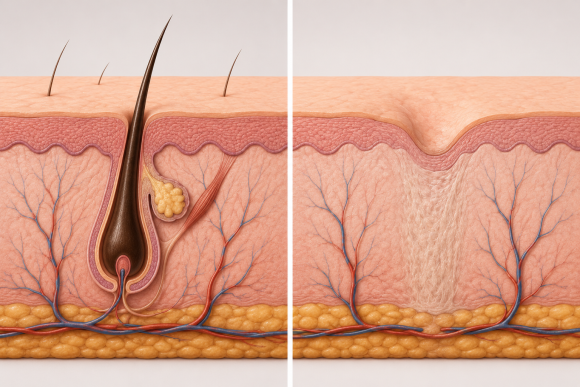
The second possibility is that the “root factory” that produces hair has already shut down. When the stem cells inside the hair follicles are reduced by 70–80% or more after being exposed to prolonged attacks from hair loss hormones, the pores may become completely blocked and transform into smooth scar tissue.
In other words, the condition has reached a point where the “self-renewing capacity of the soil” that allows hair to grow back has disappeared—such as an advanced stage in which the M-shaped hairline or crown has become broadly bare. Once this point is reached, even if the hormones are blocked with an excellent medication, it is difficult for hair to grow back because the factory itself is gone. This is not a problem with the medication; biologically, the opportunity for treatment was missed.
Third Reason: The Hormonal Environment Itself Has Changed
The third possibility is that the medication is doing its job, but a metabolic problem in the body causes the “raw materials” for hormones to increase sharply. When blood sugar is not well controlled or insulin resistance is high, the “safety mechanism” that binds hormones in the body stops functioning. As a result, the amount of free male hormones—the raw materials—flowing to the scalp increases dramatically.
Even if medication reduces the operating rate of the hormone-conversion factory by 90%, the amount of raw material supplied from upstream may increase dozens of times over. As a result, hair loss hormones continue to be produced. If chronic stress or thyroid problems are also present, the hair follicles may wither before they have a chance to respond to the medication.
Therefore, if there is no response despite faithfully taking medication for more than 12 months, the medication should not simply be discontinued; instead, the treatment paradigm should be changed. If 5-alpha reductase inhibitors serve a defensive role by blocking the causative substance, minoxidil promotes growth by dilating the microvessels of the hair follicles and supplying nutrients. Because their mechanisms of action are completely different, a multifaceted treatment system combining the two medications, follicle injections, low-level laser therapy (LLLT), or other approaches can be a meaningful alternative for people who do not respond to a single medication.
Hair Loss Treatment Is Not Determined by a Single Medication
In hair loss treatment, it is important to guard against misunderstandings about medication and arbitrarily stopping treatment. Hastily judging a medication’s effectiveness after only about six months, or believing that surgical treatment alone can replace medication therapy, may result in the loss of existing hair. If a medication intended to prevent drought does not fulfill its purpose, the proper medical approach is to examine the condition of the soil and the channels supplying it from multiple angles. When the cause is precisely diagnosed and a comprehensive strategy is established, even nonresponse—once considered a difficult problem—can finally move onto a path toward resolution.
Written by: Jin-oh Kim, Nuhair Plastic Surgery (Public Relations Director of the Korean Association of Plastic Surgeons / Academic Director of the Korean Association of Laser, Dermatology and Hair Research)
-
Visiting Professor, Department of Plastic Surgery, Yonsei University College of Medicine
-
Diplomate of the American Board of Hair Restoration Surgery (ABHRS)
-
Standing Director, Korean Association of Plastic Surgeons
-
Standing Director, Korean Association of Laser, Dermatology and Hair Research (KALDAT)
-
Standing Director, Korean Society for Laser Medicine and Surgery