I have been taking the medication for three months, but nothing has changed.
If anything, it seems like I am losing more hair. Should I stop taking it?
This is a question frequently asked in the clinic by people who are taking finasteride or dutasteride for the first time.
It is easy to expect that, after taking the medication every day, changes such as reduced hair loss or thicker hair will appear within two or three months.
However, the point at which hair loss medication begins to act in the body and the point at which visible changes in the hair can actually be observed may be different.
Therefore, at three months of taking hair loss medication, rather than simply deciding whether it is “working” or “not working,” it is important to check how the hair loss is currently progressing.
Hair Loss Medication After 3 Months: Should You Stop If There Is No Effect? Finasteride·Dutasteride FAQ Summary
| Three months is generally too early to determine whether finasteride or dutasteride is effective. |
|---|
| In general, changes are evaluated over approximately 6–12 months by comparing photographs taken under the same conditions and the condition of the scalp. |
| Just because hair loss increases after taking finasteride or dutasteride, it should not automatically be interpreted as “good shedding.” |
| If a large amount of hair suddenly falls out, or if hair loss extends to the sides and back of the head, other causes such as telogen effluvium should be investigated. |
| If persistent side effects or mental health-related abnormalities occur, consult a healthcare professional and review the treatment plan rather than simply waiting. |
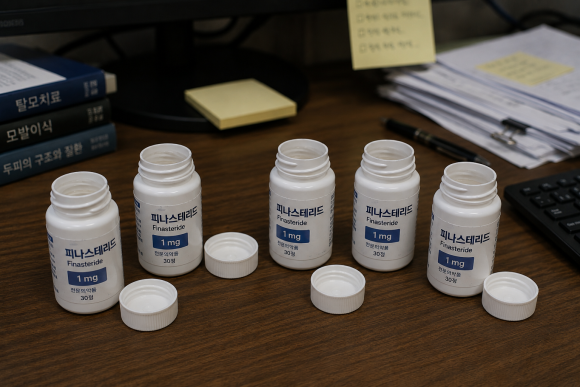
Q1. I have taken hair loss medication for three months, but it has had no effect. Does this mean the treatment has failed?
No.
Finasteride and dutasteride work by inhibiting the production of DHT, which is involved in male pattern hair loss.
In a study of finasteride 1 mg, serum DHT decreased by approximately 68%, while scalp DHT decreased by approximately 64%.¹
However, a reduction in DHT does not mean that hair that has already become thinner will become thicker within a few days or weeks.
This is because hair has a growth cycle.
The finasteride prescribing information also explains that daily use for at least three months is generally necessary before an effect can be observed.²
In actual treatment, rather than looking at the three-month point alone, the intermediate course is reviewed around six months, and changes may be compared through 12 months as needed to assess the treatment response.
Therefore, if you are taking the medication as prescribed without side effects, stopping on your own simply because there is no noticeable change at three months is not recommended.
Q2. My hair is falling out more after taking hair loss medication. Isn’t that “shedding,” and therefore a good sign?
Not necessarily.
Minoxidil is known to possibly cause a temporary increase in hair loss early in treatment.
On the other hand, the major clinical trials and prescribing information for finasteride and dutasteride do not present increased hair loss during the first 4–12 weeks as an inevitable process or as an indicator that predicts treatment success.
Therefore, it is difficult to conclude that increased hair loss after taking finasteride or dutasteride means that “the medication is working well.”
It is necessary to distinguish among possibilities such as ongoing male pattern hair loss that has not yet been sufficiently suppressed, concurrent telogen effluvium, or the effects of minoxidil started at the same time.
In particular, if the amount of hair loss continues to increase, it is better to check the pattern of hair loss and the condition of the scalp rather than simply assuming that it is shedding and waiting.
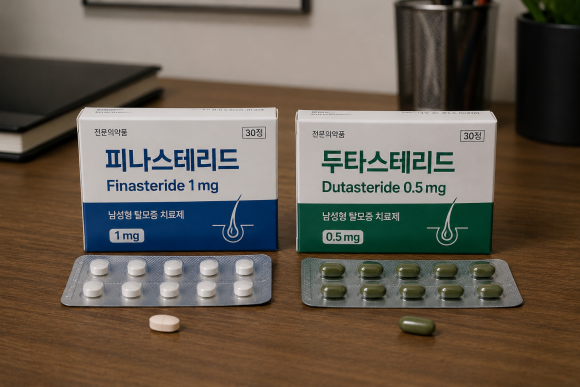
Q3. If there has been no change for three months, should I switch from finasteride to dutasteride?
There is no need to change medications based on the three-month period alone.
Long-term clinical trials of finasteride showed that the treatment group maintained significantly more hair than the placebo group at one and two years.³
A five-year follow-up study also observed a long-term difference between the group that continued taking finasteride and the placebo group.⁴
In other words, hair loss treatment should not be evaluated solely by checking the amount of new hair growth over a short period. It should also be assessed in terms of how well it suppresses the progression of hair loss and maintains existing hair over the long term.
Frequently changing medications simply because there is no change at three months may instead make it difficult to properly evaluate the effect of each treatment.
Usually, the decision to change treatment is made after considering adherence, the extent of hair loss progression, scalp examination results, and other factors together.
Q4. If I just wait until six months, will it definitely get better?
Not necessarily.
Saying that “three months is too early” does not mean “wait for six months without checking anything.”
If another type of hair loss is present in addition to male pattern hair loss, taking only finasteride or dutasteride may not produce sufficient improvement.
In particular, if you have recently experienced a high fever or severe infection, surgery, hospitalization, rapid weight loss, extreme dietary restriction, severe stress, or started taking a new medication within the past two or three months, the possibility of telogen effluvium should also be considered.
Hair loss treatment guidelines also emphasize the importance of determining treatment based on an accurate diagnosis.⁶
Therefore, if hair loss continues to progress clearly on standardized photographs or scalp examinations despite taking the medication consistently for six months or longer, it is better to review the diagnosis and treatment plan rather than simply extending the duration of treatment.

Q5. Should I keep taking hair loss medication even if my hair is falling out by the handful?
If the amount of hair loss has suddenly increased substantially, it needs to be checked.
Male pattern hair loss generally progresses as the hair gradually becomes thinner.
By contrast, if hair suddenly falls out by the handful, or if hair loss occurs throughout the scalp—including the sides and back, not just the frontal hairline and crown—it is necessary to consider the possibility that another type of hair loss is also present.
The same applies if a specific area appears empty like a coin, or if scalp pain, severe itching, redness, or a large amount of scaling develops.
In these situations, it is important to first identify the cause of the current hair loss rather than deciding that “this is because the hair loss medication has not worked yet.”
Q6. If I have side effects from hair loss medication, should I tolerate them and continue taking it until six months?
There is no need to do so.
In a one-year clinical trial of finasteride 1 mg, decreased libido was reported in 1.8% of the finasteride group and 1.3% of the placebo group; erectile dysfunction was reported in 1.3% and 0.7%, respectively; and ejaculation-related disorders were reported in 1.2% and 0.7%, respectively.²
Although the incidence itself is not high, if actual symptoms occur, you do not necessarily have to endure them and continue taking the medication.
In particular, if sexual-function changes persist or affect daily life, it is necessary to consult the prescribing healthcare professional and decide whether to continue taking the medication, adjust the treatment, or stop it.
In addition, the European Medicines Agency (EMA) reviewed and strengthened mental health-related safety measures for medicinal products containing finasteride and dutasteride.⁵
In particular, if mental health-related abnormalities such as depressed mood, depression, or thoughts of suicide occur while taking finasteride, prompt medical evaluation is necessary.⁵



Q7. I missed my hair loss medication for several days. Will the effects I have received so far disappear?
Missing one or two doses does not mean that all the treatment effects achieved so far will disappear.
What is important is to take the medication consistently over the long term as prescribed.
If you forget to take a dose, it is generally better to return to your original prescribed schedule rather than taking twice the dose on your own the next day.
Conversely, if you frequently stop taking the medication or change the dosage on your own, it may become difficult to accurately evaluate the treatment effect.
It may also help to connect the dosing time with a daily routine that you repeat regularly.
Q8. If I stop taking hair loss medication, will the hair I have maintained so far fall out immediately?
All of the effects do not disappear overnight.
However, hair loss medications such as finasteride suppress the progression of male pattern hair loss while they are being taken.
Therefore, when the medication is stopped, the DHT-inhibiting effect disappears, and the maintenance effect gained through treatment may gradually decrease as well.
The finasteride prescribing information explains that the treatment effect may generally reverse within 12 months after treatment is discontinued.²
Therefore, rather than stopping on your own simply because “there was not much difference over three months,” it is better to objectively evaluate your current condition before making a decision.
How Should You Assess Your Condition at Three Months of Hair Loss Medication?
| Current condition | What to check | Recommended response |
|---|
| No major change at three months | Adherence and photographic changes | Continue treatment and monitor progress |
| Feeling that hair loss has increased slightly | Amount and extent of hair loss | Do not automatically conclude that it is shedding |
| Sudden hair loss by the handful | Telogen effluvium and other causes | Identify the cause |
| Hair loss extending to the sides and back | Overall pattern of hair loss | Reassess the diagnosis |
| Continued worsening for six months or longer | Photographs and scalp examination | Reconsider the treatment plan |
| Persistent side effects | Type and severity of symptoms | Consult the prescribing healthcare professional |
There is no need to immediately conclude that treatment has failed just because your hair has not become fuller after taking hair loss medication for three months.
The practical treatment goal of finasteride and dutasteride is not simply to produce a large amount of new hair. Rather, it is to slow the progression of male pattern hair loss, maintain existing hair, and potentially restore some of the hair that has become thinner.
Therefore, using photographs taken before treatment as a reference, it is advisable to regularly photograph the front, sides, and crown under the same lighting and from the same angle, with a similar hair length.
At three months, record your current condition; around six months, conduct an interim evaluation; and, if necessary, compare long-term changes through 12 months.
However, if sudden, extensive hair loss, expansion of the affected area, scalp abnormalities, or persistent side effects occur, identifying the cause through a healthcare professional should take priority over simply completing a set treatment period.
This has been Jin-oh Kim from 뉴헤어성형외과, with “time to hair.”
必生新毛.

Written by: Jin-oh Kim of 뉴헤어성형외과 (Public Relations Director of the Korean Association of Plastic Surgeons / Academic Director of the Korean Association of Laser, Dermatology and Hair Research)
-
Adjunct Professor, Department of Plastic Surgery, Yonsei University College of Medicine
-
American Board of Hair Restoration Surgery (ABHRS)
-
Executive Director, Korean Association of Plastic Surgeons
-
Executive Director, Korean Association of Laser, Dermatology and Hair Research (KALDAT)
-
Executive Director, Korean Society for Laser Medicine
References
-
Drake L, Hordinsky M, Fiedler V, et al. The effects of finasteride on scalp skin and serum androgen levels in men with androgenetic alopecia. J Am Acad Dermatol. 1999;41(4):550–554. doi:10.1016/S0190-9622(99)70051-4.
-
US Food and Drug Administration. PROPECIA (finasteride) tablets: prescribing information. 2022. FDA prescribing information.
-
Kaufman KD, Olsen EA, Whiting D, et al. Finasteride in the treatment of men with androgenetic alopecia. J Am Acad Dermatol. 1998;39(4 Pt 1):578–589. doi:10.1016/S0190-9622(98)70007-6.
-
Finasteride Male Pattern Hair Loss Study Group. Long-term (5-year) multinational experience with finasteride 1mg in the treatment of men with androgenetic alopecia. Eur J Dermatol. 2002;12(1):38–49. PubMed PMID:11809594.
-
European Medicines Agency. Finasteride- and dutasteride-containing medicinal products: referral and risk-minimisation measures. 2025. EMA safety communication.
-
Kanti V, Messenger A, Dobos G, et al. Evidence-based (S3) guideline for the treatment of androgenetic alopecia in women and in men—short version. J Eur Acad Dermatol Venereol. 2018;32(1):11–22. doi:10.1111/jdv.14624.