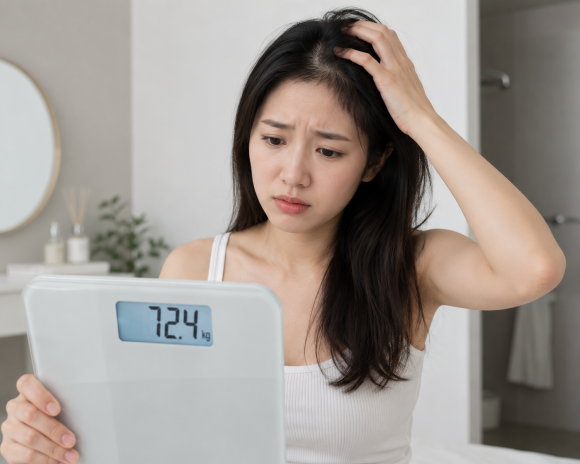
There are people who say that while they are satisfied with the weight-loss effects of Mounjaro, they notice at some point that they are losing more hair than usual when shampooing.
This naturally raises the concern, “Could Mounjaro be causing my hair loss?”
In fact, hair loss is listed as an adverse reaction in the official prescribing information for Zepbound, the obesity-treatment indication of tirzepatide.¹¹
Hair loss is also listed as a postmarketing adverse reaction in the prescribing information for Mounjaro.¹²
However, an important point is that it is difficult to conclude that hair loss associated with Mounjaro occurs because the drug directly attacks the hair follicles.
The possibility of telogen effluvium should be considered, as multiple factors—including rapid weight loss and changes in food intake—may work together.¹³
So, what should you do if you begin losing a significant amount of hair while using Mounjaro?
Let’s organize the information around the questions patients commonly ask.
Summary: Should You Stop Mounjaro If You Experience Hair Loss? (Stopping Before Surgery, Comparison with Wegovy)
| Hair loss has been reported during use of tirzepatide, the active ingredient in Mounjaro, and the Zepbound prescribing information describes the adverse reaction as being associated with weight loss.¹¹ |
|---|
| Based on current evidence, rather than concluding that Mounjaro directly damages hair follicles, the possibility of telogen effluvium due to rapid weight loss and changes in nutritional intake should also be considered.¹³ |
| If hair loss appears while using Mounjaro, it is important to assess the rate of weight loss, food intake, nutritional status, and any preexisting hair loss rather than stopping the medication automatically. |
| GLP-1 medications can delay gastric emptying. Therefore, if you are scheduled for surgery requiring sedation or anesthesia, such as a hair transplant, you must tell your medical team that you are taking the medication.¹ ² ³ |
| The 2024 multisociety guidance recommends assessing each patient’s individual risk—including whether they are in the dose-escalation phase, their dose, and gastrointestinal symptoms—instead of having all patients stop the medication uniformly.⁵ ⁶ |

Q1. Can Mounjaro really cause hair loss?
It is possible.
The official prescribing information for Zepbound, the obesity-treatment indication of tirzepatide, reports hair loss as an adverse reaction and explains that the hair loss was associated with weight loss.¹¹
A difference by sex was also observed: it was reported more frequently in women, at 7.1%, than in men, at 0.5%.¹¹
Hair loss is also included among the postmarketing adverse reactions in the official prescribing information for Mounjaro.¹²
In addition, a pharmacovigilance study analyzing reports of hair loss among semaglutide and tirzepatide users examined the association with hair loss.¹³
However, these data do not prove a causal relationship in which Mounjaro directly damages the hair follicles.
Other factors should also be assessed, including how quickly weight was lost while using the medication and how much food intake decreased.
Q2. Why does hair loss occur with Mounjaro?
The first possibility to consider is telogen effluvium.
The body may perceive a substantial amount of weight loss over a short period, or a sudden reduction in calorie and nutrient intake, as physical stress.
During this process, some hair that was in the growth phase may transition into the resting phase, and the amount of hair shedding may increase after a certain period.¹³
If your appetite has decreased significantly while using Mounjaro, it is important to consider not only a reduction in total food intake but also the possibility of insufficient intake of nutrients needed for hair growth, such as protein, iron, and zinc.
Therefore, rather than focusing only on the fact that you received the medication, it is important to examine both the rate of weight loss and your actual dietary status.
Q3. If I develop hair loss with Mounjaro, should I stop the medication immediately?
Stopping Mounjaro on your own solely because hair loss has occurred is not recommended.
First, it is necessary to determine whether the current hair loss is telogen effluvium, worsening preexisting male- or female-pattern hair loss, or the result of another cause.
If rapid weight loss or reduced nutritional intake is the cause, adjusting the rate of weight reduction and dietary status may be important.
If necessary, blood tests can be used to check for other factors associated with hair loss, such as anemia, iron stores, and thyroid function.
Conversely, if the hair is gradually thinning mainly around the hairline or crown, it is also necessary to determine whether preexisting hereditary hair loss is progressing at the same time.


Q4. Is hair loss more severe with Mounjaro than with Wegovy or Saxenda?
Based on the currently available data, it is difficult to establish a simple ranking of hair-loss risk by medication, such as Saxenda < Wegovy < Mounjaro.
For Mounjaro, the official Zepbound materials for the obesity-treatment indication of tirzepatide specify the frequency of hair loss.¹¹
Pharmacovigilance data have also reported an analysis of the association between semaglutide and tirzepatide use and reports of hair loss.¹³
However, the fact that a particular adverse reaction is reported frequently in a pharmacovigilance study does not mean that the medication directly causes that side effect.
Therefore, rather than deciding that one medication is unconditionally more likely to cause severe hair loss, it is better to consider the actual rate of weight loss and changes in food intake together.
Key Points About Mounjaro-Associated Hair Loss
| Question | Key information |
|---|
| Can Mounjaro cause hair loss? | Hair loss has been reported as an adverse reaction in official materials.¹¹ ¹² |
| Does it directly damage the hair follicles? | A direct causal relationship has not yet been established.¹³ |
| Why might hair loss occur? | The possibility of telogen effluvium due to rapid weight loss and changes in food intake should be considered. |
| Must I stop the medication unconditionally? | Assess the cause of the hair loss and the weight-loss situation before stopping the medication on your own. |
| What should be checked? | Weight changes, food intake, nutritional status, and any preexisting hair loss. |
| What if a hair transplant is scheduled? | Inform the medical team in advance of the medication name, dosing schedule, and gastrointestinal symptoms.⁵ ⁶ |




Q5. If I continue using Mounjaro, will the hair I lost fail to grow back?
That is not necessarily the case.
If the hair loss is telogen effluvium associated with rapid weight loss, the hair growth cycle may gradually recover as the body’s condition and nutritional intake stabilize.
Therefore, whether hair recovers is not determined solely by whether you continue or stop using Mounjaro.
Instead, it is necessary to check whether your food intake has become excessively low or whether you are losing weight too quickly.
If shedding continues for an extended period or the hair in a specific area continues to thin, it is also advisable to check whether preexisting hair loss is progressing at the same time.

Q6. Should I take biotin or iron for Mounjaro-associated hair loss?
There is no need to automatically take a particular supplement simply because hair loss has occurred.
If you are actually deficient in iron or another nutrient, supplementation may be helpful. However, taking more than necessary when your levels are normal will not make your hair recover faster.
Especially while losing weight, it is more important to first check whether your overall food intake and protein intake have decreased excessively than to focus on one or two supplements.
When necessary, supplementing nutrients that are deficient based on test results is a more reasonable approach.
Q7. Can I get a hair transplant while using Mounjaro?
Using Mounjaro does not by itself mean that you cannot undergo a hair transplant.
However, if sedation or general anesthesia is used during the hair-transplant procedure, you must tell the medical team that you are using a GLP-1 medication, including Mounjaro.
GLP-1 medications can delay gastric emptying, and studies have reported that gastric contents may remain in patients using these medications even after fasting.¹ ²
There has also been a reported case of pulmonary aspiration during anesthesia in a patient using semaglutide despite adequate fasting.³
Therefore, if a sedative is used for a relatively lengthy procedure such as a hair transplant, it is important to check the medication use and gastrointestinal status in advance.
Q8. Do I absolutely have to stop Mounjaro one week before surgery?
Current guidance has shifted away from uniformly applying a one-week discontinuation period to all patients and toward assessing each patient’s individual risk.
In 2023, the American Society of Anesthesiologists (ASA) recommended considering the discontinuation of weekly GLP-1 medications one week before surgery and daily formulations on the day of surgery.⁴
However, the multisociety guidance published in 2024 stated that patients who do not have a high risk of delayed gastric emptying and aspiration may continue GLP-1 medications before surgery.⁵ ⁶
Instead, risk should be assessed more carefully when the medication has recently been started, the patient is in the dose-escalation phase, a high dose is being used, or gastrointestinal symptoms such as nausea, vomiting, abdominal pain, indigestion, or constipation are present.⁶
If it is determined that the risk of delayed gastric emptying is high and the decision is made to stop the medication, current guidance allows reference to the previous ASA recommendation: stop daily formulations on the day of surgery and weekly formulations one week before surgery.⁴ ⁶
In other words, rather than automatically stopping Mounjaro for one week simply because it is Mounjaro, the decision should be made with the medical team based on the patient’s condition and the anesthesia method, which is closer to the current standard.

When you begin losing a significant amount of hair after using Mounjaro, it is easy to wonder whether stopping the medication should be the first step.
Hair loss has in fact been reported as an adverse reaction in official materials related to tirzepatide, and the Zepbound materials also mention an association with weight loss.¹¹ ¹²
However, based on the data available so far, it is difficult to conclude that Mounjaro directly damages the hair follicles and causes hair loss.¹³
Therefore, if Mounjaro-associated hair loss is suspected, it is important to assess not only the medication itself but also the rate of weight loss, food intake and nutritional status, and any preexisting hair loss.
In addition, if you are planning a hair transplant or another surgery or procedure, you must tell the medical team that you are using a GLP-1 medication, regardless of the hair loss.
Current recommendations favor making decisions based on the dose-escalation phase, gastrointestinal symptoms, dosage, anesthesia method, and other factors rather than uniformly stopping GLP-1 medications for all patients.⁵ ⁶
Rather than giving up either weight loss or hair health, it is important to accurately assess your current physical condition and adjust the treatment plan.
This has been Jin-oh Kim, and now is the time to hairhair.
May new hair grow for life.

Written by: Jin-oh Kim, New Hair Plastic Surgery (Public Relations Director, Korean Association of Plastic Surgeons / Academic Director, Korean Association of Laser, Dermatology and Hair Research)
-
Visiting Professor, Department of Plastic Surgery, Yonsei University College of Medicine
-
Diplomate of the American Board of Hair Restoration Surgery (ABHRS)
-
Executive Director, Korean Association of Plastic Surgeons
-
Executive Director, Korean Association of Laser, Dermatology and Hair Research (KALDAT)
-
Executive Director, Korean Society for Laser Medicine and Surgery
[References]
- Alkabbani, W. et al. (2024) ‘Glucagon-like peptide-1 receptor agonists before upper endoscopy and retained gastric contents’, BMJ, 387:e080340.
Cited: “GLP-1 receptor agonists were associated with a higher risk of discontinuation of endoscopy, possibly owing to a higher risk of retained gastric content.”
- Silveira, S.Q. et al. (2023) ‘Relationship between perioperative semaglutide use and retained gastric contents during elective EGD’, Anaesthesia Critical Care & Pain Medicine, 42(5), 101223.
Cited: “Semaglutide was associated with increased retained gastric contents in patients undergoing elective esophagogastroduodenoscopy.”
- Klein, S.R. and Hobai, I.A. (2023) ‘Semaglutide, delayed gastric emptying, and intraoperative pulmonary aspiration: a case report’, Canadian Journal of Anesthesia, 70, pp. 1394–1396.
Cited: “The use of semaglutide for weight loss was associated with delayed gastric emptying and intraoperative pulmonary aspiration.”
- American Society of Anesthesiologists Task Force (2023) ‘Consensus-Based Guidance on Preoperative Management of Patients on Glucagon-Like Peptide-1 (GLP-1) Receptor Agonists’, 29 Jun.
Cited: “For patients on weekly dosing consider holding GLP-1 agonists a week prior to the procedure/surgery.”
- American Society of Anesthesiologists (2024) ‘Most Patients Can Continue Diabetes, Weight Loss GLP-1 Drugs Before Surgery, New Guidance Suggests’, ASA News Release, 29 Oct.
Cited: “Most patients should continue taking their glucagon-like peptide-1 (GLP-1) receptor agonists before elective surgery.”
- Kindel, T.L. et al. (2024) ‘Multisociety clinical practice guidance for the safe use of glucagon-like peptide-1 receptor agonists in the perioperative period’, Surgery for Obesity and Related Diseases, online ahead of print Oct 29; and Clinical Gastroenterology and Hepatology, 23(12), pp. 2083–2085.
Cited: “GLP-1RA therapy may be continued preoperatively in patients without elevated risk of delayed gastric emptying and aspiration.”
- Sharaiha, R.Z. et al. (2025) ‘ASGE position statement: GLP-1 receptor agonists and gastrointestinal endoscopy’, Gastrointestinal Endoscopy, in press.
Cited: “Immediate pre-procedure evaluation for GI symptoms is recommended in GLP-1 users.”
- Ayers, A.T. et al. (2025) ‘Use of gastric ultrasound to identify GLP-1RA users at risk of retained gastric content’, Trends in Anaesthesia and Critical Care.
Cited: “Preoperative point-of-care gastric ultrasound would be expected to identify patients with increased gastric contents.”
- Hurley, C. et al. (2024) ‘Gastric ultrasound and mitigating risk of glucagon-like peptide-1 agonists’, Anaesthesia, 79(10), pp. 1181–1185.
Cited: “A gastric ultrasound-guided decision aid may help assess regurgitation risk in patients on GLP-1 agonists.”
- Klein, S.R. et al. (2024) ‘Perioperative management of GLP-1 receptor agonists: risk assessment using gastric ultrasound’, Journal of Clinical Anesthesia, 93, 111143.
Cited: “Point-of-care gastric ultrasound can inform anesthesia planning in GLP-1RA users to prevent aspiration.”
-
Eli Lilly and Company. ZEPBOUND (tirzepatide) Injection, US Prescribing Information. 2024/2025. Available at: pi.lilly.com/us/zepbound-uspi.pdf (Accessed 18 Aug 2025).
-
Eli Lilly and Company. MOUNJARO (tirzepatide) Label, Full Prescribing Information — Revised 05/2025. FDA. Available at: accessdata.fda.gov/drugsatfda_docs/label/2025/215866s031lbl.pdf (Accessed 18 Aug 2025).
-
Godfrey H, Leibovit-Reiben Z, Jedlowski P, Thiede R. (2025). ‘Alopecia associated with semaglutide and tirzepatide: a disproportionality analysis using FAERS 2022–2023’, J Eur Acad Dermatol Venereol, 39(2), e153–e154.