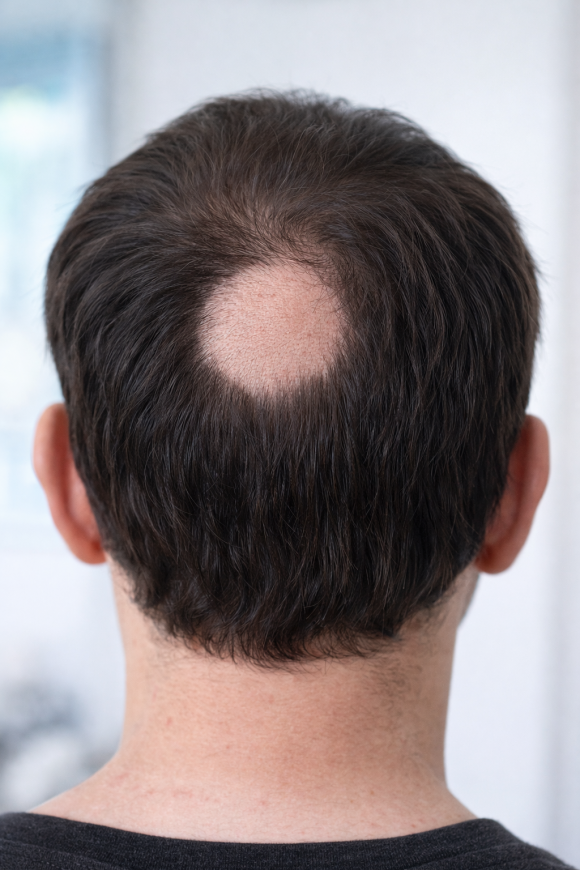
Alopecia areata is often thought of as a “condition that affects only the hair.”
Some people also assume that treatment is over once coin-sized patches of hair loss grow back.
However, alopecia areata is not simply hair loss. It is an autoimmune disease that develops when the immune system attacks its own hair follicles.
Recently, research has continued to explore the possibility that these immunological characteristics may not be limited to the scalp.
In particular, a systematic review and meta-analysis published in 2026 analyzed 49,449 patients with alopecia areata and 57,304,696 controls. The results showed that the likelihood of stroke was relatively higher among patients with alopecia areata.¹
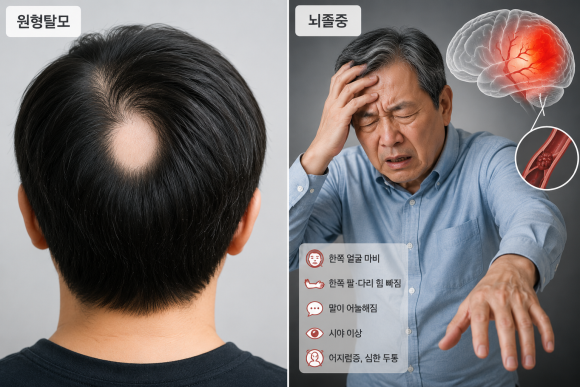
Does this mean you should worry about stroke simply because you experienced alopecia areata in the past?
Let us review the research findings available so far, focusing on questions that patients may genuinely have.
The Connection Between Alopecia Areata and Stroke: What You Should Check If You Have Had Alopecia Areata — Summary
| A 2026 meta-analysis found that the likelihood of stroke was 36% higher among patients with alopecia areata than among controls.¹ |
|---|
| This does not mean that alopecia areata directly causes stroke. It means that a statistical association was observed between the two conditions. |
| Atrial fibrillation was also observed approximately 28% more often in patients with alopecia areata, prompting research into the relationship between immune and inflammatory responses and vascular health.¹ |
| A history of alopecia areata alone does not mean that you need a brain MRI or carotid ultrasound. It is more important to first check established stroke risk factors such as blood pressure, blood sugar, cholesterol, smoking status, and pulse. |
| In particular, if you have hypertension, diabetes, atrial fibrillation, a history of smoking, or a previous stroke or transient ischemic attack, it is advisable to inform your healthcare provider about your history of alopecia areata and manage these factors accordingly. |
Q1. Does having alopecia areata really increase the risk of stroke by 36%?
Yes.
A meta-analysis published in 2026 found that the likelihood of stroke was approximately 36% higher among patients with alopecia areata than among controls without alopecia areata.¹
The study included a total of seven observational studies: three retrospective cohort studies, two cross-sectional studies, and two case-control studies.¹
However, the figure of a “36% increase” should not be misunderstood as an absolute risk.
It does not mean that 36 out of every 100 people with alopecia areata will have a stroke.
It means that stroke was observed relatively more often when the group with alopecia areata was compared with the group without it.
An individual’s actual risk of stroke can vary considerably depending on several factors, including age, blood pressure, diabetes, smoking status, dyslipidemia, and atrial fibrillation.
Q2. Does this mean that alopecia areata directly causes stroke?
The current research does not allow us to conclude that.
This study was a meta-analysis combining several observational studies.¹
Therefore, it can show that an association exists between alopecia areata and stroke, but it does not prove a causal relationship in which alopecia areata itself is the direct cause of stroke.
In fact, another meta-analysis published in 2025 observed an association between alopecia areata and overall cardiovascular disease. However, when ischemic stroke was analyzed separately, no statistically clear association was identified.⁶
Results may differ between studies because of differences in participants’ ages, the severity of alopecia areata, coexisting conditions, follow-up periods, and other factors.
Therefore, at this stage, the most accurate interpretation is that “stroke was observed relatively more often in patients with alopecia areata and further research is needed,” rather than that “alopecia areata causes stroke.”

Q3. Why might alopecia areata and stroke occur together?
One of the most closely studied connections involves immune and inflammatory responses.
Alopecia areata is an autoimmune disease that develops when immune cells attack the hair follicles.
The immunological changes that occur during this process may not necessarily be limited to the scalp.
Some studies have observed systemic inflammatory and immune changes in patients with alopecia areata and have suggested that these changes could affect vascular endothelial function or the blood-clotting process.
In particular, the 2026 meta-analysis found that atrial fibrillation was approximately 28% more common among patients with alopecia areata.¹
Atrial fibrillation is a representative arrhythmia in which the heart beats irregularly. If a blood clot forms inside the heart and travels to block a blood vessel in the brain, it can lead to stroke.
Venous thromboembolism was also approximately 32% more common among patients with alopecia areata, but this result was at the borderline of statistical significance and requires further confirmation.¹
Although the exact mechanism connecting these conditions has not yet been established, these findings have led to research examining alopecia areata from a somewhat broader perspective than simply as a scalp condition.
Q4. Do I still need to pay attention if I had alopecia areata in the past but recovered completely?
If your alopecia areata has completely recovered, there is no need to worry excessively.
However, the fact that you experienced alopecia areata in the past can be considered part of your medical history.
Alopecia areata is not as rare as many people think.
A study using South Korean national health insurance data reported a prevalence of approximately 0.37% and an annual incidence of approximately 0.2%.²
In contrast, a long-term population-based study in the United States estimated the lifetime risk of developing alopecia areata at approximately 2.1%.³
In other words, about 1 in 50 people may experience alopecia areata at least once in their lifetime.
In particular, when one or two small round patches of alopecia appear and recover naturally, people often forget that they ever had alopecia areata as time passes.
Even if you do not currently have alopecia areata, if you have other vascular risk factors such as hypertension, diabetes, smoking, or atrial fibrillation, it is appropriate to mention your past history during health screenings or medical visits.
Q5. If I have had alopecia areata, should I get a brain MRI or carotid ultrasound?
Brain MRI or carotid ultrasound is not recommended for every patient with alopecia areata who has no symptoms.
The current findings are not sufficient to support performing separate stroke screening tests for patients with alopecia areata.
Instead, the first step should be to check the stroke risk factors that are already well established.
| Item to check | What to look for |
|---|
| Blood pressure | Whether it is repeatedly measured at a high level |
| Blood sugar | Whether fasting blood glucose or glycated hemoglobin is high |
| Blood lipids | Abnormal LDL cholesterol or triglyceride levels |
| Heart rhythm | An irregular pulse or recurrent palpitations |
| Smoking | Current smoking or a history of heavy smoking |
| Lifestyle | Lack of exercise, obesity, or frequent alcohol consumption |
| Medical history | A history of stroke or transient ischemic attack |
The 2024 stroke prevention guidelines from the American Heart Association and American Stroke Association also identify blood pressure management, smoking cessation, physical activity, a healthy diet, and management of diabetes and atrial fibrillation as major preventive factors.⁷
Rather than substantially increasing the number of tests simply because you have a history of alopecia areata, it is more important to first confirm that these basic risk factors are being properly managed.
Q6. If I have alopecia areata, wouldn’t it be better to take aspirin for prevention?
No.
You should not take aspirin or anticoagulants on your own to prevent stroke simply because you have experienced alopecia areata.
These medications may help reduce the formation of blood clots, but they can also increase the risk of bleeding.
Therefore, they should be used only when indicated, based on a comprehensive assessment of the patient’s history of cardiovascular or cerebrovascular disease, age, coexisting conditions, bleeding risk, and other factors.
There is currently no evidence that preventive medication should be added solely because an association between alopecia areata and stroke has been reported.
There is also no reason to stop any alopecia areata treatment you are taking on your own because of this study.
Q7. If alopecia areata is severe or recurrent, is the risk of stroke also higher?
At present, it is difficult to confirm that the risk of stroke increases in proportion to the severity of alopecia areata.
However, some studies have examined the relationship between the extent of alopecia areata and cardiovascular disease.
A meta-analysis published in 2025 observed an association between alopecia areata and overall cardiovascular disease. Cardiovascular disease was identified more often particularly among patients with alopecia totalis and alopecia universalis.⁶
However, as explained above, no clear association appeared when ischemic stroke alone was analyzed separately.⁶
Therefore, rather than labeling someone as being at “high risk for stroke” simply because their alopecia areata is extensive or recurrent, it is important to check whether other cardiovascular risk factors are also present.
Q8. If I treat my alopecia areata, will my risk of stroke decrease again?
This has not yet been confirmed.
Although an association between the inflammatory and immune responses involved in alopecia areata and vascular disease has been proposed as a hypothesis, there is currently insufficient evidence showing that treatment for alopecia areata reduces the subsequent occurrence of stroke.
Therefore, changing the intensity of alopecia areata treatment or selecting a specific treatment for the purpose of preventing stroke is not supported by the current evidence.
Alopecia areata should be treated according to its own condition and severity, while stroke risk should be assessed and managed separately based on established cardiovascular and cerebrovascular risk factors. This is the practical approach.
Q9. If I have alopecia areata but am young and healthy, do I still need to worry?
If you are young, have normal blood pressure and blood sugar, do not smoke, and have no other cardiovascular risk factors, your absolute risk of stroke itself is likely to be low.
Therefore, there is no need to become excessively anxious just because of the figure “36% increase.”
On the other hand, the situation is different if you have the same history of alopecia areata along with hypertension, diabetes, dyslipidemia, obesity, chronic kidney disease, smoking, or atrial fibrillation.
In particular, if you have experienced a stroke or transient ischemic attack in the past, it is important to review with your healthcare provider the stroke-prevention treatment you are currently receiving and how well your blood pressure, blood sugar, and cholesterol are being controlled.
Q10. What symptoms mean that I should go to the hospital immediately?
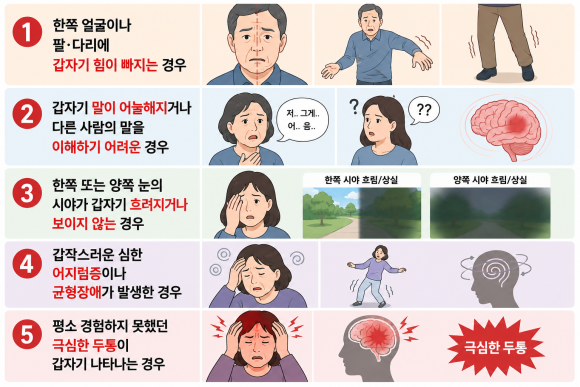
Although it is important to assess stroke risk in advance, it is much more important not to lose treatment time when actual symptoms appear.
If any of the following symptoms appear suddenly, call 119 immediately.⁸
-
Sudden weakness in one side of the face, arm, or leg
-
Sudden slurred speech or difficulty understanding what another person is saying
-
Sudden blurred vision or loss of vision in one or both eyes
-
Sudden severe dizziness or problems with balance
-
A sudden, extremely severe headache unlike any you have experienced before
Even if the symptoms disappear after a few minutes, that does not mean everything is fine.
Because they may indicate a transient ischemic attack, emergency evaluation is necessary even if the symptoms improve.⁸
The finding from the 2026 meta-analysis that the likelihood of stroke was observed to be 36% higher in patients with alopecia areata than in controls is noteworthy.¹
However, this result alone does not allow us to conclude that alopecia areata is a direct cause of stroke or to classify everyone who has experienced alopecia areata as being at high risk for stroke.
Therefore, there is no need to become anxious and undergo a brain MRI first simply because you have had alopecia areata.
Instead, it is more practical to first check whether your recent blood pressure has been normal, whether your blood sugar and cholesterol are being managed, whether you smoke, and whether your pulse is irregular.
In particular, if you have risk factors such as hypertension, diabetes, atrial fibrillation, or smoking, or if you have previously experienced a stroke or transient ischemic attack, it is advisable to tell your healthcare provider about your history of alopecia areata during your visit.
The association between alopecia areata and stroke remains an area requiring further research.
Rather than interpreting this study as a reason to immediately regard alopecia areata as a dangerous disease, it is more appropriate to understand it as a signal that immune disease affecting the hair and scalp may also need to be considered from the perspective of overall health.
This has been Jin-oh Kim, and it’s time to hair on.
New Hair for Life.
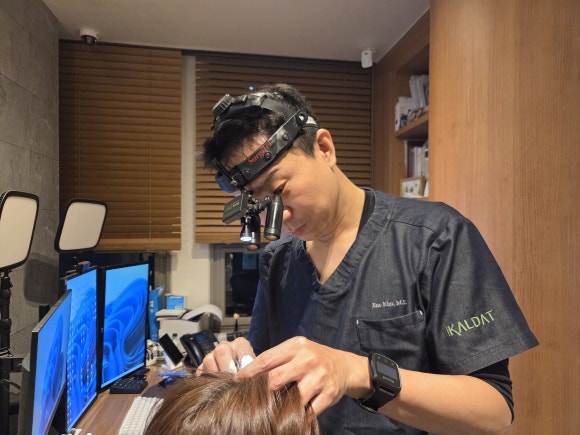
Written by: Jin-oh Kim, New Hair Plastic Surgery (Public Relations Director, Korean Association of Plastic Surgeons / Academic Director, Korean Laser Dermatology and Hair Society)
-
Visiting Professor, Department of Plastic Surgery, Yonsei University College of Medicine
-
American Board of Hair Restoration Surgery (ABHRS)–certified physician
-
Executive Director, Korean Association of Plastic Surgeons
-
Executive Director, Korean Association of Laser Dermatology and Hair (KALDAT)
-
Executive Director, Korean Society for Medical Laser
[References]
-
Rahnemayan S, Farhoudi M, Ghazanfar Ahari S. Increased stroke risk in patients with Alopecia Areata: A systematic review and meta-analysis. Heliyon. 2026;12. DOI: 10.1016/j.heliyon.2026.e45276.
-
Lee JH, Kim HJ, Han KD, et al. Incidence and prevalence of alopecia areata according to subtype: a nationwide, population-based study in South Korea (2006-2015). Br J Dermatol. 2019;181(5):1092-1093. DOI: 10.1111/bjd.18145.
-
Mirzoyev SA, Schrum AG, Davis MDP, Torgerson RR. Lifetime incidence risk of alopecia areata estimated at 2.1% by Rochester Epidemiology Project, 1990-2009. J Invest Dermatol. 2014;134(4):1141-1142. DOI: 10.1038/jid.2013.464.
-
Kang JH, Lin HC, Kao S, Tsai MC, Chung SD. Alopecia areata increases the risk of stroke: a 3-year follow-up study. Sci Rep. 2015;5:11718. DOI: 10.1038/srep11718.
-
Huang KP, Joyce CJ, Topaz M, Guo Y, Mostaghimi A. Cardiovascular risk in patients with alopecia areata: a propensity-matched retrospective analysis. J Am Acad Dermatol. 2016;75(1):151-154. DOI: 10.1016/j.jaad.2016.02.1234.
-
Lu J, Cao X, Feng Y, Yu Y, Lu Y. Association between alopecia areata and cardiovascular disease: a systematic review and meta-analysis. Front Immunol. 2025;16:1643709. DOI: 10.3389/fimmu.2025.1643709.
-
Bushnell C, Kernan WN, Sharrief AZ, et al. 2024 Guideline for the Primary Prevention of Stroke. Stroke. 2024;55(12). DOI: 10.1161/STR.0000000000000475.
-
Korea Disease Control and Prevention Agency. Stroke. National Health Information Portal. https://health.kdca.go.kr/. Accessed August 12, 2026.