When preparing for a hair transplant, people usually think first about how many hairs to implant and which method—strip or non-shaven extraction—would be better.
However, before surgery, it is also important to check whether the scalp environment will allow the transplanted follicles to establish securely.
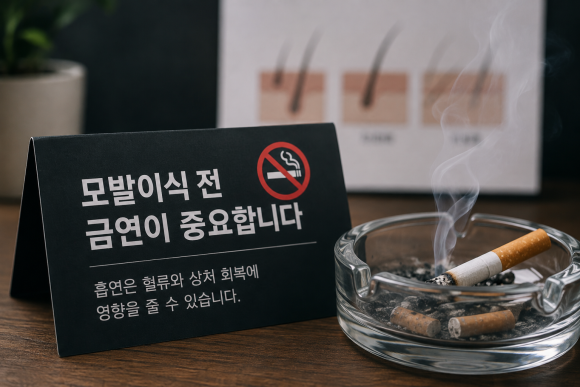
Smoking, diabetes, scalp scars, and active cicatricial alopecia can affect scalp blood flow and wound healing.¹
Having these conditions does not mean that you must give up on hair transplantation.
You can assess your current condition, make the necessary preparations, and then undergo surgery.
Conditions to Check Before Hair Transplantation|Can You Have Surgery Despite Smoking, Diabetes, or Scalp Scars? Summary
| Smoking, diabetes, or scalp scars do not necessarily make hair transplantation impossible. |
|---|
| If possible, smokers should quit about one month before surgery.¹⁻³ |
| With diabetes, the important factor is not simply whether you have been diagnosed, but whether your current blood glucose is stably controlled.¹ |
| For scalp scars or cicatricial alopecia, blood flow and inflammatory activity should be assessed first.¹ |
| For female pattern hair loss, the condition of existing hair must be considered along with the hair to be newly transplanted.⁵ |
| Item to check | Points to check before surgery |
|---|
| Smoking | Period of abstinence and scalp blood flow |
| Diabetes | Recent blood glucose and HbA1c |
| Scalp scars | Fibrosis and blood-flow status |
| High-density transplantation | Transplantation area and appropriate density |
| Cicatricial alopecia | Whether inflammation is active |
| Female pattern hair loss | Thickness and density of existing hair |
Q1. Should I avoid hair transplantation if I smoke?
Being a smoker does not make hair transplantation impossible.
However, smoking can negatively affect microvascular circulation and wound healing, so caution is necessary.¹⁻³
A study analyzing cases of scalp necrosis, a very rare complication after hair transplantation, also identified smoking as one of the risk factors.² ³
This requires particular attention if a large-volume transplant or transplantation into a scarred area is planned.
If possible, it is advisable to stop smoking for about one month before surgery.¹
Q2. Can I not have a hair transplant if I have diabetes?
That is not necessarily the case.
What matters is not simply whether you have diabetes, but how stably your blood glucose is currently being controlled.
Poor blood glucose control can affect microvascular circulation and wound healing, and the possibility of infection must also be considered.¹
Therefore, recent blood glucose levels, glycated hemoglobin (HbA1c), and overall health are assessed together.
Surgery may be planned if blood glucose is stable, but if it is not controlled, it is better to stabilize your overall condition first.
Q3. Will transplanted follicles fail to establish properly if I have scars on my scalp?
Not necessarily.
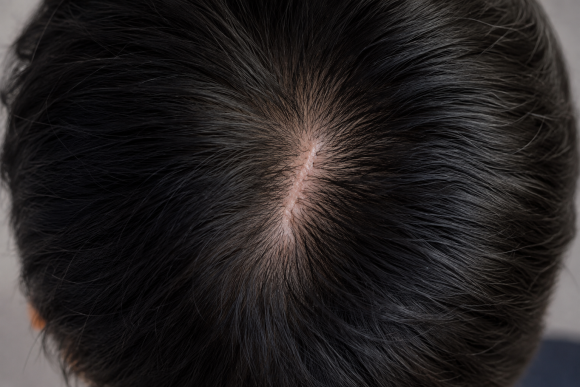
However, fibrosis may have developed beneath a scar, and the vascular structure may differ from that of normal scalp tissue.¹
Therefore, it is important to assess the current tissue and blood-flow status rather than looking only at the size of the scar.
If insufficient blood flow is anticipated, options may include adjusting the density within a safe range or dividing the procedure into multiple sessions instead of transplanting at a high density from the beginning.
Q4. Isn’t it better to transplant as much hair as possible?
Transplanting more hair is not always better.
A 2024 study reported that large-volume transplantation involving more than 4,000 follicles and high-density transplantation exceeding 45 grafts/cm² were associated with an increased incidence of postoperative folliculitis.⁴
The appropriate density varies depending on the size of the transplantation area, scalp thickness, blood flow, and the condition of the existing hair.
Therefore, rather than simply aiming for a high graft count, both stable follicular establishment and sufficient visual density should be considered.
Q5. Can I have a hair transplant immediately if I have cicatricial alopecia?
If the condition is active, treatment may be necessary first.
If inflammation from cicatricial alopecia is ongoing when follicles are transplanted, the newly implanted follicles may also be affected and may fail to establish.¹
Therefore, scalp redness or scaling, inflammatory symptoms, and microscopic findings are assessed to determine whether the condition has stabilized sufficiently.
If necessary, the timing of surgery is decided after treatment and a period of observation.
Q6. Can I have a hair transplant immediately for female pattern hair loss?
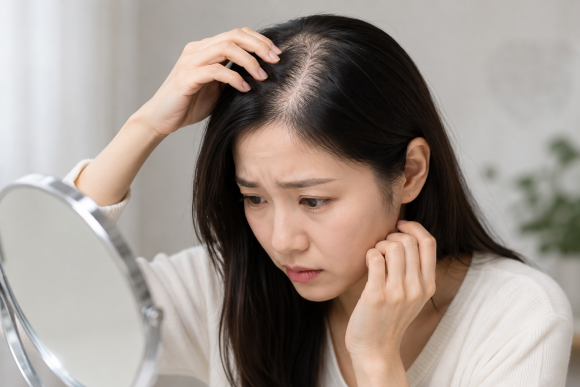
For female pattern hair loss, transplantation is often performed between existing hairs that have become thinner rather than in completely bare areas.
Therefore, the condition of the remaining existing hair is just as important as the hair to be newly transplanted.
A study analyzing temporary shedding after hair transplantation found that the risk was higher in women, particularly those aged 40 and older.⁵
If the existing hair has become significantly weakened, one option is to stabilize the condition first through hair-loss treatment and then plan surgery.
There is no need to give up on hair transplantation simply because you smoke, have diabetes, or have scalp scars.
What matters is accurately assessing the current condition of your scalp and overall health.
If you need to quit smoking, allow enough time to do so; if your blood glucose is high, control it first; and if you have scars or cicatricial alopecia, the tissue and inflammatory status should be evaluated.
Rather than transplanting as much as possible, it is important to perform surgery within the range that your current scalp can safely accommodate.
Good hair transplantation begins not on the day of surgery, but with the process of creating the right conditions for the procedure.
This has been Jin-oh Kim from Hair Hairnal.
A lifetime devoted to new hair.
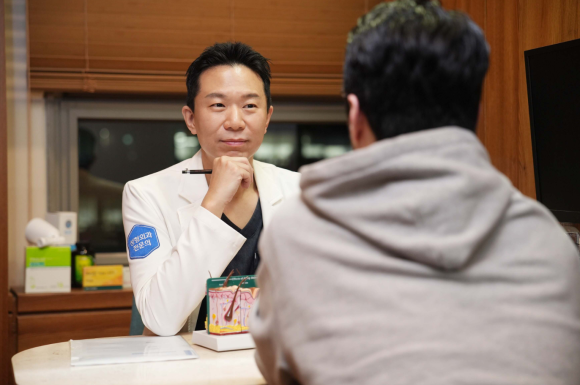
Written by: Jin-oh Kim, New Hair Plastic Surgery (Public Relations Director, Korean Association of Plastic Surgeons / Academic Director, Korean Association of Laser, Dermatology and Trichology)
-
Adjunct Professor, Department of Plastic Surgery, Yonsei University College of Medicine
-
Diplomate of the American Board of Hair Restoration Surgery (ABHRS)
-
Executive Director, Korean Association of Plastic Surgeons
-
Executive Director, Korean Association of Laser, Dermatology and Trichology (KALDAT)
-
Executive Director, Korean Association of Medical Laser
[References]
-
Sturm, S.R., Slavin, B.R., Jessup, M. et al. (2026) ‘Safety Considerations in Hair Restoration Procedures: A Comprehensive Review’, Journal of Craniofacial Surgery. doi:10.1097/SCS.0000000000013195.
-
Chen, J., Qu, Q., Guo, Y. et al. (2024) ‘Recipient site scalp necrosis: A rare postoperative complication of hair transplantation’, Journal of Cosmetic Dermatology, 23, pp. 622–629.
-
Ceran, F. (2024) ‘Recipient Site Necrosis After Follicular Unit Excision Technique for Hair Transplantation: Evaluation of 18 Patients’, Aesthetic Plastic Surgery, 48, pp. 3735–3740.
-
Zhou, Y., Zhang, J., Yi, Y. et al. (2024) ‘Characterization and Risk Factors of Folliculitis after Hair Transplantation: A Multicenter Retrospective Study’, Plastic and Reconstructive Surgery, 154, pp. 1115e–1122e.
-
Okochi, H., Onda, M., Momosawa, A. and Okochi, M. (2024) ‘An Analysis of Risk Factors of Recipient Site Temporary Effluvium After Follicular Unit Excision: A Single-Center Retrospective Study’, Aesthetic Plastic Surgery, 48, pp. 1258–1263.