Goku from Dragon Ball recovers his strength by eating a Senzu bean after fighting to his limits.
In medicine, the stronger the treatment, the more important the corresponding recovery process becomes.
Energy-based procedures such as Ultherapy and Thermage also induce tissue regeneration through sufficient stimulation, but if the treatment exceeds what the tissue can tolerate, the risk of side effects may increase.¹⁻²
Hair transplantation is similar.
The greater the density and the larger the number of grafts, the more important it is to consider both blood flow in the recipient area and wound healing in the donor area.³
So, can hyperbaric oxygen therapy play a role similar to a Senzu bean in hair transplantation?
Let’s take a look, focusing on the questions patients commonly ask.
Hyperbaric Oxygen Therapy After Hair Transplantation: Does It Really Help Graft Survival and Recovery? Summary
| Hyperbaric oxygen therapy is a treatment that increases oxygen delivery to tissues with compromised blood flow, supporting wound healing and angiogenesis.⁴⁻⁵ |
|---|
| In a clinical study of hair transplantation, folliculitis and temporary hair shedding after surgery were observed less frequently in the hyperbaric oxygen therapy group.⁶ |
| High-density and large-volume transplantation can increase not only the burden on blood flow in the recipient area but also the recovery burden on the donor area, requiring more careful management.³ |
| However, the current evidence is not sufficient to definitively conclude that hyperbaric oxygen therapy increases hair transplant graft survival rates.⁶ |
| It may be considered as an adjunctive treatment to support recovery in cases such as scarred scalps, scalps with compromised blood flow, or non-shaven hair transplantation requiring extensive harvesting. |
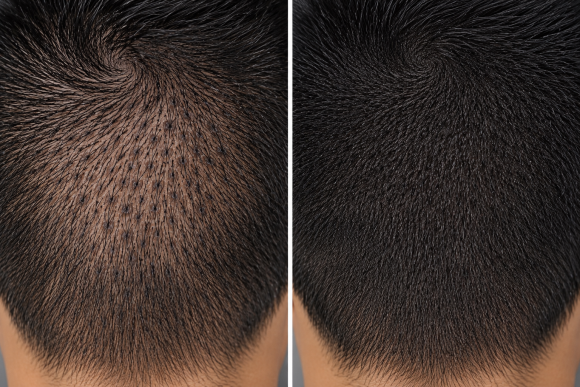
AI-generated image for easier understanding.
Q1. Isn’t hair transplantation always better when the grafts are placed as densely as possible?
Not necessarily.
The key to hair transplantation is not simply inserting a large number of follicles, but creating an environment in which the transplanted follicles can survive and establish themselves stably.
Immediately after transplantation, the follicles must receive oxygen and nutrients from the surrounding tissue until sufficient new blood vessels have formed connections.
If too many grafts are placed in a small area, or if the grafts are inserted too deeply or overlap, microvascular damage and the burden on tissue blood flow may increase.
A recent review of complications following non-shaven hair transplantation identified high-density transplantation of 50 or more follicles/cm² and large-volume transplantation of more than 3,500–4,000 hairs as risk factors for scalp necrosis.³
Of course, these figures are not absolute limits that apply to every patient.
Ultimately, with high-density hair transplantation, the important process is not simply determining “how closely the grafts can be placed,” but assessing how much density the patient’s scalp can safely tolerate.
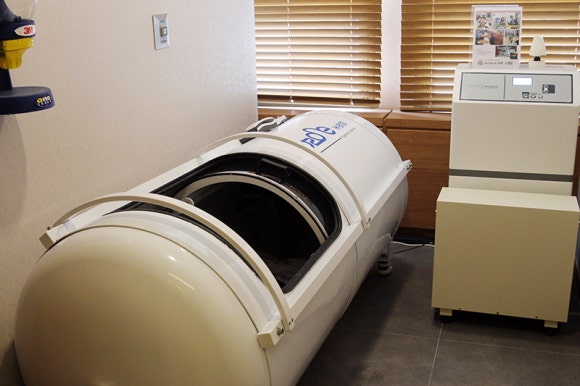
Q2. Does hyperbaric oxygen therapy definitely increase hair transplant graft survival rates?
Based on the current evidence, it is difficult to make that claim definitively.
In a clinical study of hair transplantation published in 2021, hyperbaric oxygen therapy was administered at 2.0 atmospheres for 60 minutes per day over seven days after non-shaven hair transplantation.⁶
At nine months, the graft survival rate was 96.9% in the hyperbaric oxygen group and 93.8% in the control group. Although the rate was higher in the hyperbaric oxygen group, the difference was not statistically significant.⁶
Therefore, saying that “hyperbaric oxygen therapy increases the graft survival rate by a certain percentage” may go beyond the current evidence.
The more noteworthy aspect may be the recovery process during the early postoperative period.
Q3. If so, what are the actual benefits of hyperbaric oxygen therapy?
In the same study, the incidence of itching and folliculitis was 11.8% in the hyperbaric oxygen group and 35.3% in the control group.⁶
The percentages of temporary postoperative hair shedding also differed, at 27.6% and 69.1%, respectively.⁶
Hyperbaric oxygen therapy supplies highly concentrated oxygen under increased pressure, increasing the amount of oxygen dissolved in the plasma and enhancing oxygen delivery even to tissues with insufficient blood flow.
It is also known to be involved in wound-healing processes, including the regulation of inflammation and oxidative stress, fibroblast activation, collagen synthesis, and angiogenesis.⁴⁻⁵
In other words, when considering hyperbaric oxygen therapy in hair transplantation, it is more appropriate to view it not simply as a “graft survival rate booster,” but as a treatment that supports the scalp’s recovery environment immediately after surgery.
Q4. Is hyperbaric oxygen therapy necessary for large-volume hair transplantation as well?
It is not essential for every patient undergoing large-volume transplantation.
However, harvesting thousands of follicles using a non-shaven technique creates an equally large number of micro-wounds in the occipital region.
Although each wound is small, healing occurs simultaneously across a broad area. Therefore, as the number of harvested follicles increases, the burden on the tissue must also be considered.
Considering the oxygen-delivery and angiogenic effects of hyperbaric oxygen observed in general wound-healing research, it may also play an adjunctive role in the recovery of the donor area.⁴⁻⁵

Q5. Which hair transplant patients may want to consider hyperbaric oxygen therapy more carefully?
The need for hyperbaric oxygen therapy is not determined solely by the number of grafts transplanted.
| Situations that may warrant consideration | Reason |
|---|
| High-density hair transplantation | A large number of grafts are placed in a small area, increasing the burden on the tissue |
| Large-volume hair transplantation | The recipient area and numerous donor-site wounds must recover simultaneously |
| Hair transplantation into scarred areas | Blood flow may be less favorable than in normal scalp tissue |
| Scalp with poor blood flow | Oxygen delivery may be relatively unfavorable during the early postoperative period |
| Scalp with recurrent inflammation | Managing the inflammatory response after surgery is important |
| Extensive non-shaven harvesting | Numerous micro-wounds develop in the occipital region |
In particular, the distribution of blood vessels in a scalp with scars from previous surgery or trauma may differ from that in normal tissue, requiring a more cautious surgical plan.
In addition, if folliculitis or seborrheic dermatitis occurs repeatedly, the priority is to stabilize the inflammation sufficiently before surgery. Hyperbaric oxygen therapy should be approached not as a substitute for this, but as a method of supporting recovery after surgery.
Q6. If hyperbaric oxygen therapy is available, is it okay to undergo excessively high-density and large-volume transplantation?
No.
This is one of the most important misunderstandings.
The availability of hyperbaric oxygen therapy does not make it safe to transplant at a density that the scalp cannot tolerate or to harvest an excessive number of follicles.
Hyperbaric oxygen is only a means of supporting recovery.
A good design, an appropriate harvest volume, proper control of insertion depth and spacing, and surgical techniques that minimize follicular damage must come first.
It is like saying that having a Senzu bean does not mean everyone can fight like Goku.
High-density and large-volume hair transplantation may aim for a fuller result, but the burden that the scalp tissue must tolerate also increases accordingly.
Hyperbaric oxygen therapy may be used as an adjunctive treatment to compensate for insufficient oxygen delivery and support wound healing and angiogenesis during this process.⁴⁻⁷
It is particularly noteworthy that actual hair transplantation research observed reductions in folliculitis and temporary hair shedding.⁶
However, hyperbaric oxygen is not a “万能 treatment” that can replace good surgical technique or make excessively high-density transplantation possible.
A good hair transplant does not end with placing a large number of grafts. It also includes assessing the range that the patient’s scalp can tolerate and managing the transplanted follicles and donor area so that they recover stably.
Just as a Senzu bean gives Goku room to recover, appropriate adjunctive recovery treatment may be one option for creating a more stable surgical process in hair transplantation.
Now is the time to hair-escape; this was Jin-oh Kim.
May new hair surely grow.
Written by: Jin-oh Kim, New Hair Plastic Surgery (Public Relations Director of the Korean Association of Plastic Surgeons / Academic Director of the Korean Association of Laser, Dermatology and Hair Research)
-
Adjunct Professor, Department of Plastic Surgery, Yonsei University College of Medicine
-
Diplomate of the American Board of Hair Restoration Surgery (ABHRS)
-
Executive Director, Korean Association of Plastic Surgeons
-
Executive Director, Korean Association of Laser, Dermatology and Hair Research (KALDAT)
-
Executive Director, Korean Society for Laser Medicine
[References]
-
Marquardt, K. et al. (2025) ‘Microfocused ultrasound with visualization induces remodeling of collagen and elastin within the skin’, Journal of Cosmetic Dermatology, 24(1), e16638. https://doi.org/10.1111/jocd.16638
-
Suh, D.H. et al. (2020) ‘Monopolar radiofrequency treatment for facial laxity: Histometric analysis’, Journal of Cosmetic Dermatology, 19(9), pp. 2317–2324. https://doi.org/10.1111/jocd.13449
-
Romera de Blas, C. et al. (2026) ‘Complications in follicular unit extraction hair transplantation: Current evidence and practical approaches’, Frontiers in Medicine, 13, 1750989. https://doi.org/10.3389/fmed.2026.1750989
-
De Wolde, S.D. et al. (2021) ‘The effects of hyperbaric oxygenation on oxidative stress, inflammation and angiogenesis’, Biomolecules, 11(8), 1210. https://doi.org/10.3390/biom11081210
-
Kleban, S. and Baynosa, R.C. (2020) ‘The effect of hyperbaric oxygen on compromised grafts and flaps’, Undersea & Hyperbaric Medicine, 47(4), pp. 635–648. https://doi.org/10.22462/10.12.2020.13
-
Fan, Z.X. et al. (2021) ‘Hyperbaric oxygen therapy in hair transplantation surgery: A clinical study’, Journal of Cosmetic Dermatology, 20(3), pp. 917–921. https://doi.org/10.1111/jocd.13665
-
Mortada, H. et al. (2025) ‘Hyperbaric oxygen therapy as an adjunct in aesthetic surgery: A systematic review and meta-analysis’, Aesthetic Plastic Surgery, 49(9), pp. 2498–2512. https://doi.org/10.1007/s00266-025-04728-9
-
Heyboer, M. et al. (2017) ‘Hyperbaric oxygen therapy: Side effects defined and quantified’, Advances in Wound Care, 6(6), pp. 210–224. https://doi.org/10.1089/wound.2016.0718