What is better: strip or non-incisional hair transplantation?
This is the question I hear most often in the consultation room.
The two methods differ in terms of scarring, recovery, procedure time, and the number of follicles that can be harvested.
However, the result patients actually see is determined not by the donor area, but by the recipient area.
Therefore, rather than comparing only the names of the surgical methods, you should check where the limited number of follicles will be placed and in what direction and density.¹˒²
What Matters More Than Strip or Non-Incisional Hair Transplantation? A Summary of the 5 Factors That Determine the Outcome
| Strip and non-incisional procedures differ in how the follicles are harvested. |
|---|
| Naturalness varies greatly depending on the direction, angle, and depth of implantation. |
| Even with the same number of grafts, coverage varies depending on how they are distributed between the hairline and crown. |
| Rather than pursuing the highest possible density, an appropriate density suited to the scalp condition is important. |
| Existing hair and future hair-loss progression must also be considered for a result that remains natural over time. |
Q1. Does non-incisional hair transplantation produce a more natural result?
Not necessarily.
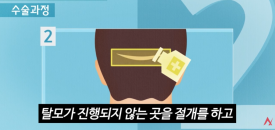
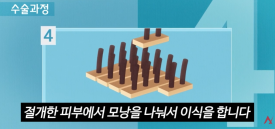
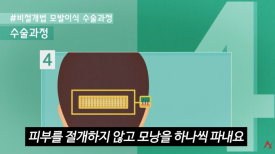
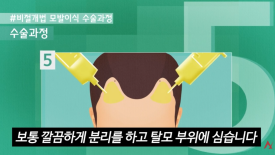
Strip and non-incisional procedures describe how follicles are removed from the back of the head, while the shape of the hairline and crown is determined by recipient-area design.
Even if the follicles are harvested without damage, implanting them in a direction that differs from the surrounding hair can make the result look unnatural, regardless of the number of grafts.²˒³
Q2. If the same number of grafts is implanted, will everyone achieve a similarly full appearance?
No.
Thick, slightly wavy hair can cover the scalp well with the same number of grafts, whereas fine, straight hair may be relatively more see-through.
When hair loss covers a wide area, it may be more advantageous to allocate grafts first to areas with a greater visual effect, such as the hairline and part, rather than distributing them evenly across every area.
Donor-area follicles are a limited resource that does not regenerate, so future hair-loss progression and the possibility of additional surgery must also be considered.¹˒²
Q3. Is hair transplantation always better when the grafts are implanted as densely as possible?
Not necessarily.
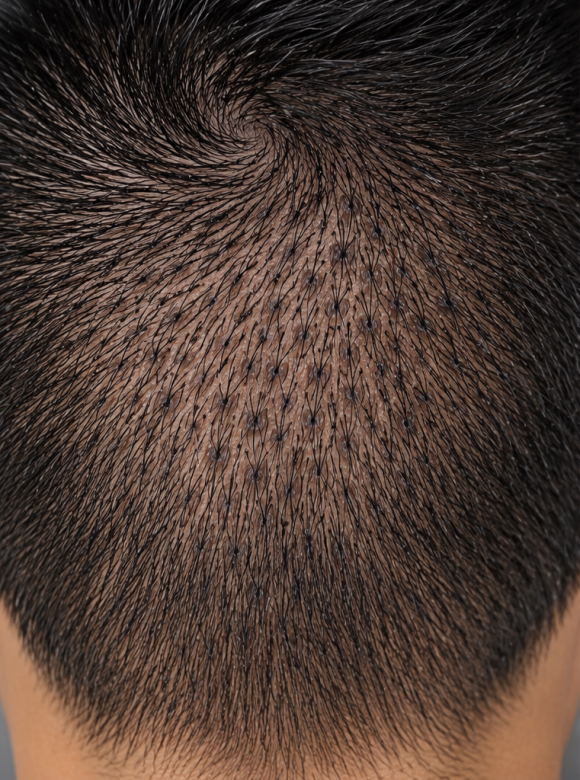
Implanting grafts more densely than necessary can cause follicles to be pushed out, or lead to repeated compression and drying during the insertion process.²˒⁴
Although rare, necrosis of the recipient area can lead to scarring and loss of transplanted hair.
In a study analyzing 18 patients who developed recipient-area necrosis, smoking, hypertension, and diabetes were frequently identified. However, because there was no control group, they cannot be conclusively identified as direct causes.⁵
Q4. Can the direction and depth of transplanted hair be corrected later?
It is not easy.
The frontal hair should flow forward at a low angle, the temples should be directed backward and downward, and the crown should be arranged along the whorl to look natural.
If the implantation depth is incorrect, follicles may be pushed out, the skin may become uneven, or cysts may develop.³˒⁶
Therefore, the direction and depth must be adjusted precisely according to the length of the follicles and the condition of the scalp.
Q5. If existing hair remains, is hair transplantation alone sufficient?
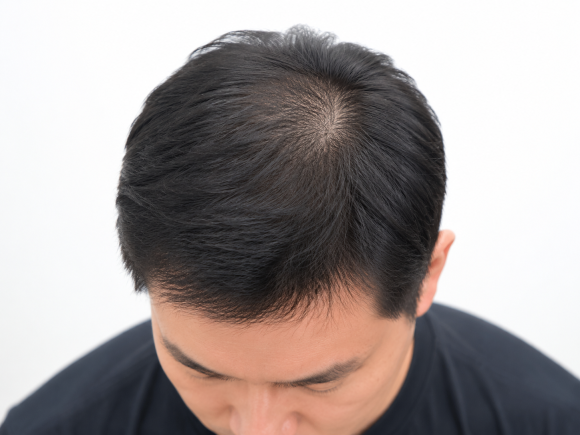
If the hair loss is progressive, it is difficult to consider the treatment complete with surgery alone.
When grafts are implanted among existing hair, surgical stimulation can cause temporary shedding of surrounding hair, and severely miniaturized hair may not recover sufficiently.⁶
In clinical practice, the assessment considers not only the number of grafts to be newly implanted, but also the direction and thickness of existing hair, the need for medication, and long-term hair-loss progression.
| Items to confirm during the consultation | Questions you should ask |
|---|
| Graft allocation | How will the grafts be divided between the hairline and crown? |
| Direction and depth | Will they blend naturally with my existing hair? |
| Appropriate density | Is this a level that my hair and scalp can accommodate? |
| Long-term plan | Will the design remain natural even if my hair loss progresses? |
Which method is suitable—strip or non-incisional—is certainly important.
However, a good hair-transplant result is achieved not by the harvesting method alone, but when the direction, depth, density, graft allocation, and protection of existing hair all work together.
During your consultation, ask not only, “How will the follicles be harvested?” but also, “Where will my follicles be implanted, and why will they be placed that way?”
The appropriate plan may vary depending on the individual’s type of hair loss and the condition of the donor area and scalp.
This was Kim Jin-oh. Now is the time to break free from hair loss.
A lifetime of new hair (必生新毛).

Written by: Kim Jin-oh of 뉴헤어성형외과 (Public Relations Director of the Korean Society of Plastic Surgeons / Academic Director of the Korean Laser, Dermatology and Hair Society)
-
Adjunct Professor, Department of Plastic Surgery, Yonsei University College of Medicine
-
American Board of Hair Restoration Surgery (ABHRS)
-
Standing Director, Korean Society of Plastic Surgeons
-
Standing Director, Korean Association of Laser, Dermatology and Hair (KALDAT)
-
Standing Director, Korean Society for Laser Medicine
[References]
-
Jimenez, F., Alam, M., Vogel, J.E. and Avram, M. (2021). Hair transplantation: Basic overview. Journal of the American Academy of Dermatology, 85(4), 803–814.
-
Marwah, M.K. and Mysore, V. (2018). Recipient Area. Journal of Cutaneous and Aesthetic Surgery, 11(4), 202–210.
-
Jimenez, F., Vogel, J.E. and Avram, M. (2021). CME article Part II. Hair transplantation: Surgical technique. Journal of the American Academy of Dermatology, 85(4), 818–829.
-
Parsley, W.M. and Perez-Meza, D. (2010). Review of Factors Affecting the Growth and Survival of Follicular Grafts. Journal of Cutaneous and Aesthetic Surgery, 3(2), 69–75.
-
Ceran, F. (2024). Recipient Site Necrosis After Follicular Unit Excision Technique for Hair Transplantation: Evaluation of 18 Patients. Aesthetic Plastic Surgery, 48(19), 3735–3740.
-
Kerure, A.S. and Patwardhan, N. (2018). Complications in Hair Transplantation. Journal of Cutaneous and Aesthetic Surgery, 11(4), 182–189.