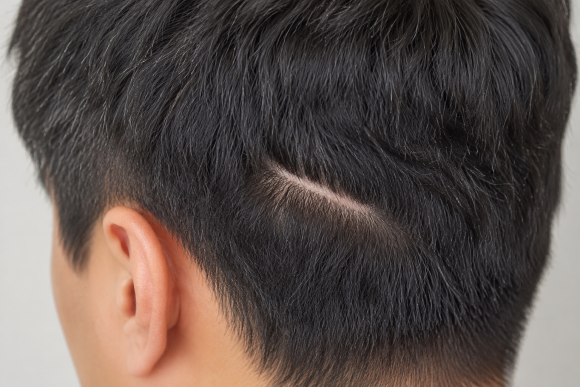
Scalp scars are not merely a matter of marks left on the skin.
When hair is missing only from that area, the white skin may stand out when wearing short hair or when the wind blows.
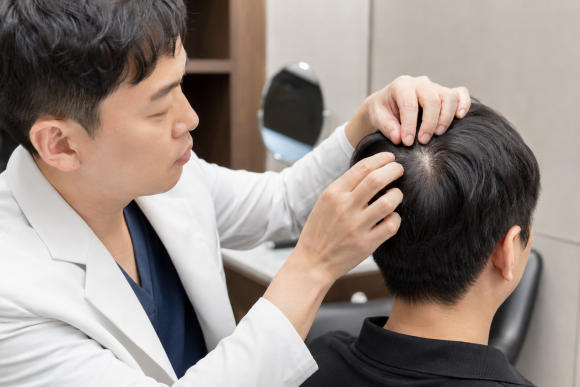
During an actual consultation, we also examine the thickness and direction of the surrounding hair, hairstyle, and the extent of exposure.
I will answer the questions most frequently asked during consultations about hair transplantation for scalp scars.
Hair Transplantation for Scalp Scars: Can Hair Grow on a Scar? Summary
| The primary goal of hair transplantation for scalp scars is not to remove the scar, but to make it less noticeable by covering it with hair. |
|---|
| Scars have less blood flow and flexibility than normal scalp tissue, so it is important to design the density and direction according to the condition of the scar. |
| Recent clinical studies have observed improvements in scar volume, color, firmness, and flexibility after hair follicle transplantation. |
| A hair follicle is not merely a root that produces hair, but a living organ that exchanges signals with surrounding tissues. |
| However, the extent of scar improvement varies greatly from person to person, so treatment should not be decided on the assumption that the scar will be completely removed. |
Q1. Will a scalp scar disappear completely after hair transplantation?
No.
The clearest goal is to make hair grow on the scar where hair is absent, so that the white or shiny skin is not directly visible.
This treatment does not return the scar to normal skin, but once hair grows, concerns about its appearance may be substantially reduced.
Q2. Since scars have fewer blood vessels, won't the transplanted hair fail to take root?
Hair follicles can take root in scars, allowing hair to grow.
However, scar tissue may be firmer and have less blood flow than normal scalp tissue, so all scars are not transplanted in the same way.
The first step is to assess whether the tissue is in a condition that can accept hair follicles, after determining whether the scar is old and thin or red, thick, and firm.
Q3. Does the scar have to be transplanted with hair at an extremely high density to be better concealed?
Not necessarily.
If hair is transplanted too densely beyond what the scar tissue can tolerate, this may be unfavorable for graft survival.
It is more important to place the follicles at an appropriate density while considering the thickness and angle of the surrounding hair and the location of the scar.
Q4. Can the scar itself improve, aside from hair growing on it?
It is possible.
In a randomized clinical trial involving hair follicle transplantation into human scars, scar volume decreased more than in untreated scars, and improvements were observed not only in height, color, firmness, and flexibility, but also in pain and itching.1
Tissue examinations showed that the epidermis became thicker, while Ki67-positive cells, which indicate cell proliferation, increased from 4.8% before treatment to 16.5% six months later. The arrangement of collagen and type IV collagen also changed in a direction closer to that of normal skin.1
Clinically, there are also cases in which the scar gradually becomes somewhat softer over time and the difference in texture from the surrounding skin appears less noticeable.
Q5. Why would scar tissue change when all that was done was to transplant hair?
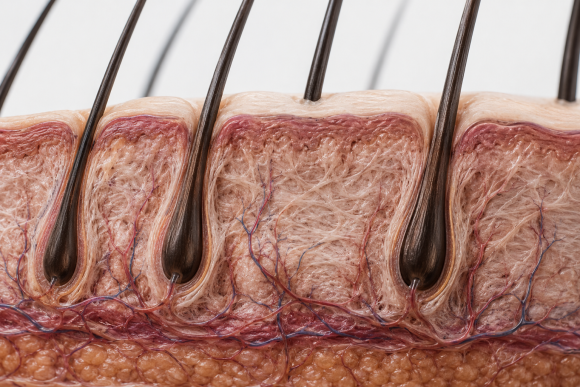
A hair follicle is not simply a hair root. It is more like a small organ containing the dermal papilla, various cells, and stem cells, and exchanging signals with blood vessels, nerves, and skin cells.3
After hair follicle transplantation, gene expression related to regeneration, inflammation, and extracellular matrix remodeling, including collagen, changed. Studies have also reported that transplanting anagen hair follicles into mature human scars reorganized the fibrotic tissue in a direction resembling normal skin.1,2
In addition to the microscopic wounds and healing process created during transplantation and changes in blood flow, the living hair follicles themselves may be interpreted as participating in scar remodeling.
Q6. If the research results are positive, can everyone expect their scar to improve as well?
It is not yet possible to state that definitively.
The most predictable effect at present is that hair grows and makes the scar less noticeable. How much the color, texture, and softness change varies considerably depending on the cause and condition of the scar.
The primary goal should be concealment, while changes in the tissue should be viewed as an additional possibility.
Hair transplantation for scalp scars is not surgery to erase a scar. It is a treatment that transfers living hair follicles to recreate natural-looking hair in that area.
If you have always had to grow your hair long to conceal a scar or have been unable to cut a particular area short at the salon because of it, simply having hair grow there can greatly reduce the inconvenience of daily life and the burden of other people's attention.
If the scar's texture and flexibility also improve, that could be a meaningful additional benefit. However, a conservative and precise plan tailored to the condition of the scar must come first to promote safe graft survival.
This has been 김진오, from Hairhairnal Time.
May new hair surely grow (必生新毛).

Written by: 김진오 of 뉴헤어성형외과 (대한성형외과의사회 Public Relations Director / 대한레이저피부모발학회 Academic Director)
-
Visiting Professor, Department of Plastic Surgery, Yonsei University College of Medicine
-
American Board of Hair Restoration Surgery (ABHRS)
-
Executive Director, 대한성형외과의사회
-
Executive Director, 대한레이저피부모발학회 (KALDAT)
-
Executive Director, 대한의학레이저학회