Hello, I’m Director Lim Seong-yun of Just Plastic Surgery, a specialist in eye surgery and anti-aging treatments for the past 21 years.
“Honestly, I’m worried that if I go to a clinic, they’ll just recommend surgery for no reason. Is there a way to judge it on my own?”
These days, under-eye fat repositioning surgery has become widely known to the public, so many people come in for consultations even when their under-eye area is actually fine. If you check in advance, you can save yourself unnecessary energy. ^^
Today, for those of you in that situation, I’ll accurately explain two specific self-check methods you can do on your own at home.
Introduction to Director Lim Seong-yun of Just Plastic Surgery
-
21 years as a board-certified plastic surgeon, 9 years since opening the clinic
-
Specialized in microsurgery at a university hospital, with a precise understanding of eye structure
-
Performs specialized eye surgeries such as double eyelids, under-eye fat repositioning, upper eyelid surgery, and lower eyelid surgery
-
A conservative treatment principle that pre-selects patients who are suitable for surgery
Self-Check 1. Does the fat protrude when you press with your finger?
The first check is simple. Sit in front of a mirror and gently press below your eyes with your index finger. At this time, if a yellowish fat lump bulges out beneath the eyelid skin, it may be time to consider under-eye fat repositioning.
The more the fat protrudes, and the more noticeable it becomes when your eyes are open rather than closed, the more it suggests that the fat is pushing through the orbital septum (the thin membrane inside the eye).
In this state, no matter how expensive an eye cream you use, it won’t improve. That’s because the problem is not the skin surface, but the position of the fat that has been pushed forward from inside the eye.
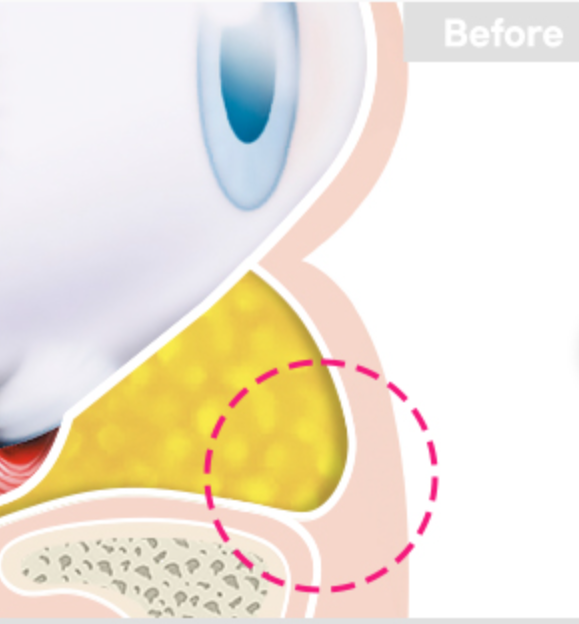 Schematic diagram of under-eye protrusion caused by a weakened orbital septum
In fact, when we conduct consultations at Just Plastic Surgery, this is the first check we perform. When patients look in the mirror and confirm for themselves how much the fat is protruding, they can objectively understand their own condition.
 A view of consulting on under-eye structure while applying pressure to the eyeball
Self-Check 2. When you raise the mirror upward, does the under-eye boundary become clearer?
The second check is a bit special. Please prepare a handheld mirror or a small mirror.
How to check:
-
While facing forward, position the mirror at eye level and look at your eyes
-
Keeping your face fixed, slowly raise only the mirror upward
-
As the mirror rises and your eyes follow it, changes in the under-eye area will appear
At this time, observe the changes under your eyes carefully.
If the following appears, it may be time to consider surgery:
-
The under-eye fat becomes clearly bulging → the fat is in a state where it is ready to be pushed forward
-
The boundary line becomes clearly visible → a sign that the area below the protruding fat is hollowed out
-
Both the fat bulge and the boundary line are distinct → a condition with a very high potential for improvement through surgery
Why is this method important? When you raise your eyes upward, the eyeball is pressed upward, causing the lower under-eye fat to be pushed further forward. At this time, fat protrusion that is usually hard to see becomes visible, and the boundary beneath it also becomes clearly visible at the same time, allowing you to accurately understand your actual condition.
In fact, this also means that this is how other people may see you, especially in bright places when looking down from above.
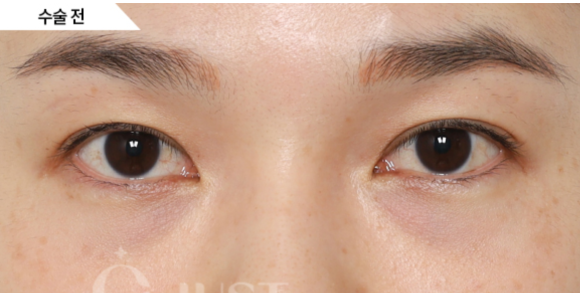 Example 1 of a case requiring under-eye surgery
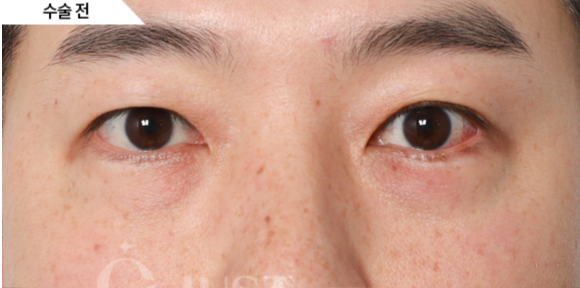 Example 2 of a case requiring under-eye surgery
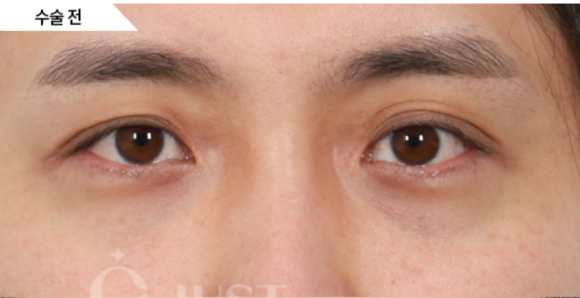 Example 3 of a case requiring under-eye surgery
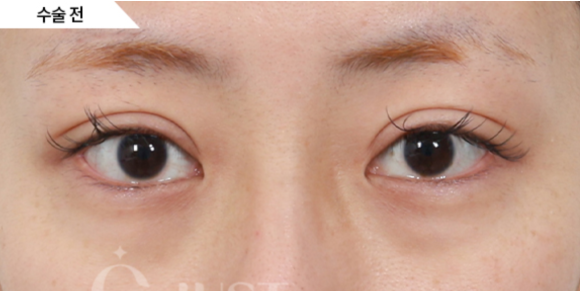 Example 4 of a case requiring under-eye surgery
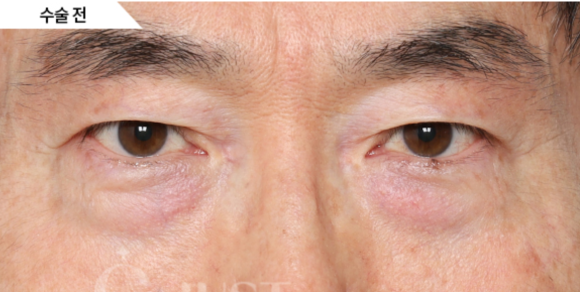 Example 5 of a case requiring under-eye surgery
At Just Plastic Surgery, we carry out this check together with the patient during consultation. That’s because an accurate diagnosis is only possible when the eye condition is examined from various angles.
How should you interpret the self-check results?
Cases where surgery may be worth considering:
-
The fat clearly protrudes in the first check
-
The under-eye fat becomes bulging or the boundary becomes distinct in the second check
-
If both symptoms appear, improvement through surgery is usually possible
Cases where there is no need to rush yet:
-
The fat hardly protrudes at all
-
The boundary barely appears even when the mirror is raised
-
In such cases, management or follow-up observation may be more appropriate than immediate surgery
However, these two self-checks are only rough guidelines. If you’re unsure, you’re welcome to visit the clinic for an accurate diagnosis.
The structure of the eyes differs from person to person, and the amount and position of fat, skin thickness, and muscle condition all vary as well. So even if the symptoms look similar, the treatment method may differ.
At Just Plastic Surgery, we use a 1:1 doctor-responsibility care system before surgery to precisely analyze the patient’s eye condition and think together about the most suitable method. This is based on our experience of performing numerous eye surgeries over 21 years, including double eyelids, under-eye fat repositioning, and upper and lower eyelid surgery.
Please check your condition with the self-check methods shared today, and if either of the two symptoms applies to you, I recommend getting a consultation with me. If you have any questions, please feel free to contact us anytime.
If surgery is not actually necessary, I will tell you honestly and may recommend another method instead.
Try checking it! Leave your result in the comments!
https://blog.naver.com/justprs/223982429366
https://blog.naver.com/justprs/224157356574
📌 Under-Eye Fat Repositioning Information
https://www.justprs.com/htm/eyefat_01_01.php