Hello, today I’ll talk about Jellami, a no-prep laminate treatment.
If there is no permanent tooth, the baby tooth often remains for a long time.
A baby tooth in this condition is called a retained deciduous tooth.
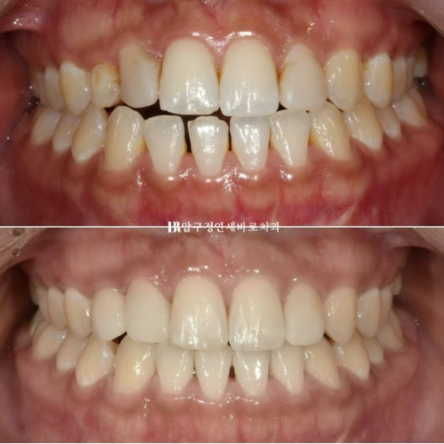
If the root condition of this retained deciduous tooth is acceptable, it is left in place and used for a long time, just like a permanent tooth.
However, because it is a baby tooth, the tooth is small and there will be gaps in the space, so this problem needs to be addressed.
If you are going to keep using it anyway, many people use baby teeth for 10 or even 20 years or more, so it is a good idea to restore the shape and size with no-prep laminates.
Today, I’ll show you how treatment progresses with no-prep laminates in a case where retained deciduous teeth are present.
23.02
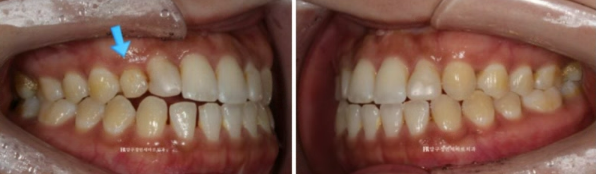
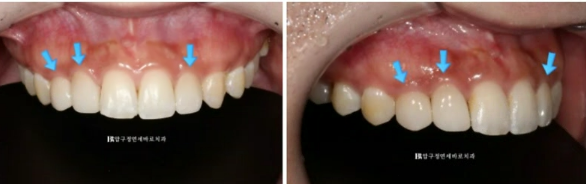
This patient had a retained baby tooth in the area marked by the blue arrow on the right canine.
This is because the permanent canine is missing.
Compared with the normal canine on the opposite side, the size is much smaller.
Because it is a baby tooth, that cannot be avoided, but if the space is appropriately opened with partial orthodontic treatment for the front teeth, the size can be restored to match the canine with no-prep Jellami laminates.
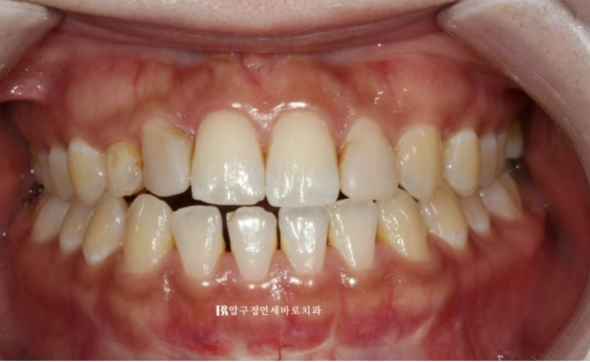
The mottled area on the side incisor, not the middle one, is a trace of dwarf tooth treatment with resin.
A drawback of resin is that it becomes discolored over time.
So, on this occasion, the old resin was removed and no-prep Jellami laminates were placed.
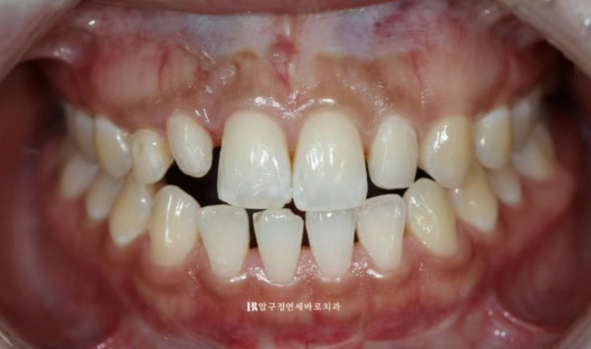
23.02
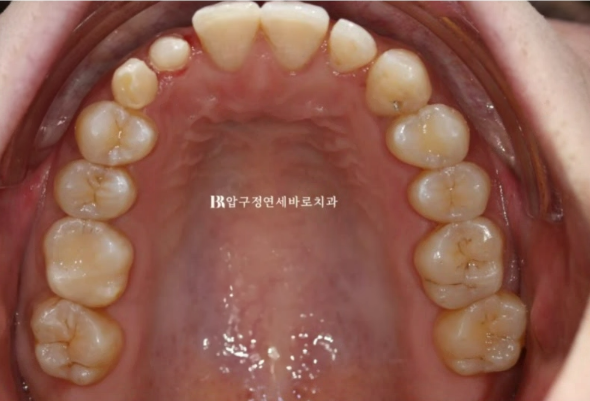
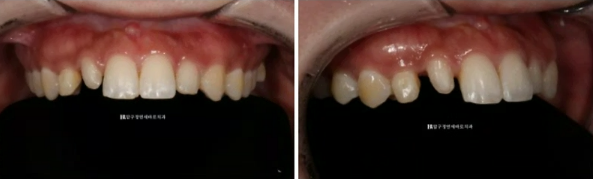
This is what the lateral incisor looked like after the resin was removed on the first day. After removing the resin, the remaining space and position on the left and right were quite different. In this state, it would be difficult to fabricate no-prep laminate sizes that are identical on both sides.
Also, when the upper and lower front teeth do not overlap and instead meet edge to edge in a straight line, as in this incisal bite condition, the laminate may crack, come off, or cause discomfort after treatment.
If there is an incisal bite or crossbite in the front teeth, no-prep laminate treatment is only possible after improving the bite with short-term orthodontic treatment for a few months.
For this patient as well, we decided to first do partial orthodontic treatment for the front teeth before the laminate procedure, and while doing that, we also decided to address the open bite in the lower front teeth.
To deepen a shallow bite, a self-ligating Clippy C appliance that allows elastic wear is effective.
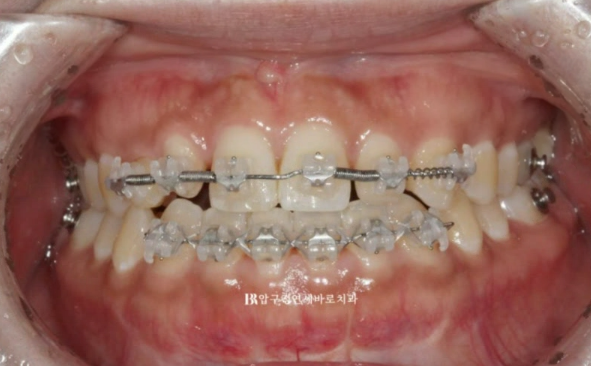
23.05
By the fourth month after treatment started, the orthodontic work was nearly complete.
The most important principle when including baby teeth in an orthodontic treatment plan is that they should not be moved carelessly.
Because of the nature of baby teeth, they do not respond well to orthodontic force, and root resorption will simply occur instead.
23.05
The space distribution was completed so that the thickness and size of the left and right laminates could be made in balance.
23.08
Seven months after orthodontic treatment began, the appliance was removed.
23.08
The laminates were placed without any tooth reduction.
The two front teeth in the middle are the original teeth, and only the area marked by the blue arrow has no-prep laminates.
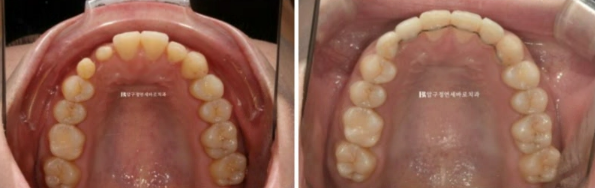
23.08
Because the space on the left and right, which had been different in size, was properly distributed through orthodontic treatment, identical-sized laminates could be placed on each side.
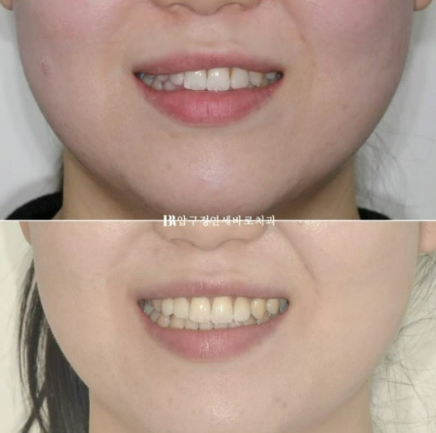
23.02~23.08
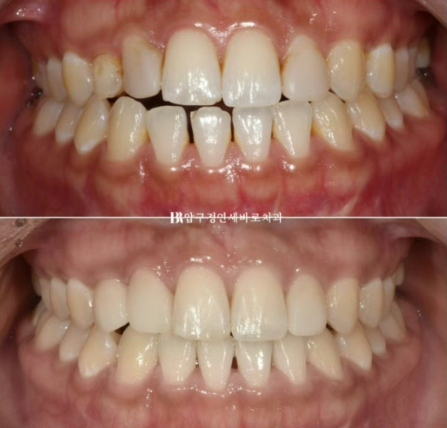
23.02~23.08
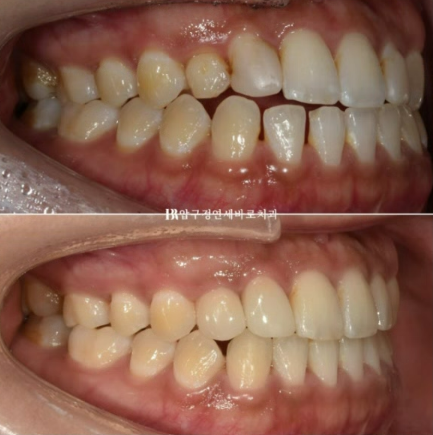
23.02~23.08
Conclusion!
For no-prep laminates, the front teeth bite needs to be good.
The best results can be achieved by first combining short-term partial orthodontic treatment for the front teeth.
If a baby tooth is going to be used for a long time in place of a permanent tooth, no-prep laminates are recommended.