Hello.
This is Apgujeong Orthodontic Clinic.
Today, I’d like to share a story about clear aligners for children.
Although this is a clear aligner case for a child, I will show you a treatment called Invisalign Teen rather than Invisalign First.
Invisalign Teen for children is Invisalign for adolescents.
What makes it different from adult Invisalign treatment is that an additional function called MA (mandible advance), which acts as a semi-functional appliance used for growing patients with a retruded chin or asymmetry, can be added.
However, because adolescents with permanent dentition are generally considered equivalent to adults, the cost and warranty period are the same as the adult program.
If a child still has baby teeth and is 11 years old or younger, Invisalign First treatment for children is possible.
Invisalign First is cheaper than the adult or teen version, but the warranty period is relatively short at 18 months.
In other words, if a child’s dental age is ahead of peers and the baby teeth fall out early, Invisalign First cannot be applied.
In that case, the device must be ordered as Invisalign Teen.
Today, I’ll share a child orthodontic case treated with Invisalign Teen.
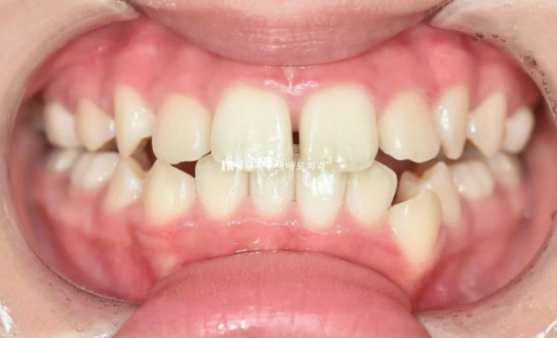
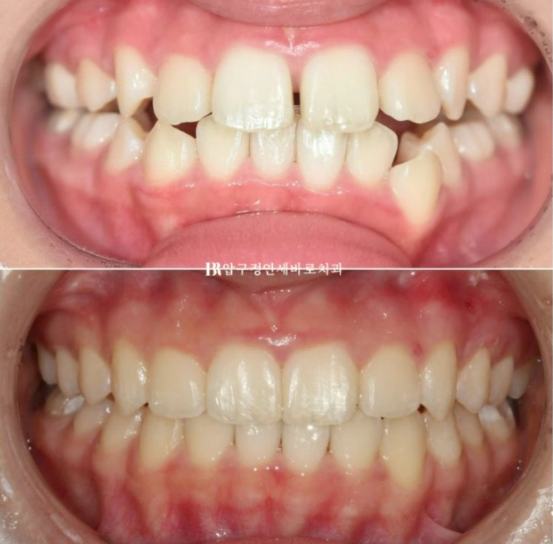
22.07
This is a 10-year-old child who visited our clinic for orthodontic treatment in July 2022.
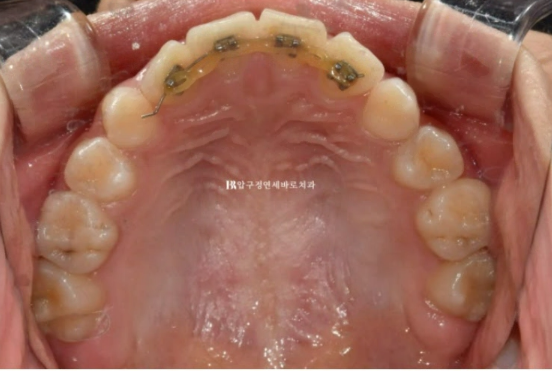
She had already been undergoing orthodontic treatment at another pediatric dental clinic, and because she was a friend who did model work, her front teeth needed to be aligned neatly.
An arrangement appliance called a 2D appliance had already been attached to the four front teeth, and alignment was in progress.
She also wore a headgear appliance to suppress maxillary growth.
22.07
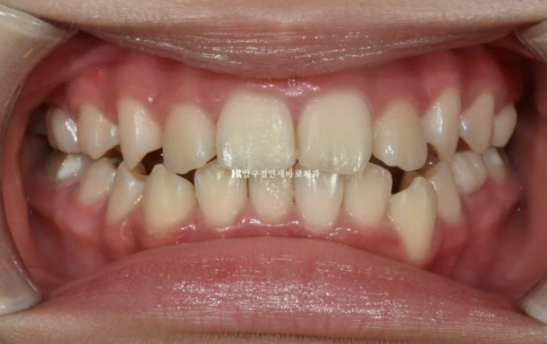
The front teeth had become aligned, but the family wanted to correct the asymmetry.
X-ray analysis showed that this was not a jaw asymmetry issue, but simply a deviation of the dental midline, so it could be corrected with orthodontic treatment.
In fact, when looking at the face as a whole, the upper front teeth midline was shifted to one side relative to the philtrum.
They had probably been treated with a headgear at another clinic before coming here, and I think this was a side effect caused by an imbalance in the left-right force.
A jaw orthopedics appliance applies force to the jawbone, producing much greater force than a simple tooth-moving force.
Therefore, detailed adjustments and monitoring are important throughout the treatment process.
The headgear appliance was indeed working favorably for the child’s current jaw growth pattern, so we decided to have the child continue wearing the headgear from the previous clinic a bit longer and begin orthodontic treatment after all the baby teeth had fallen out.
2022.12
At the regular checkup six months later, the remaining baby teeth had fallen out and the permanent teeth were erupting.
We decided to wait a few more months until the permanent teeth had fully erupted.
After another seven months, in August 2023, the photos finally show the start of Invisalign treatment.
23.08
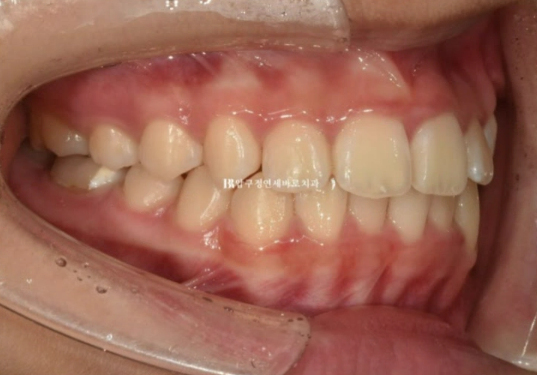
The right-side bite is not bad.
23.08
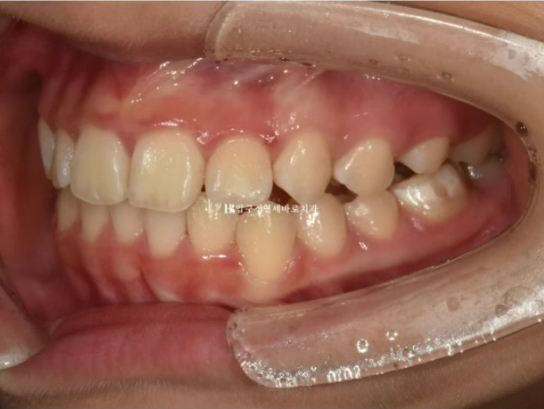
On the left side, due to a Class III occlusal relationship, the left molars do not meet well, and this affected the front teeth, causing the upper front teeth midline to become tilted relative to the philtrum and the face.
We proceeded with appliance fabrication, and from September 2023, the first stage appliances of the first set were finally worn.
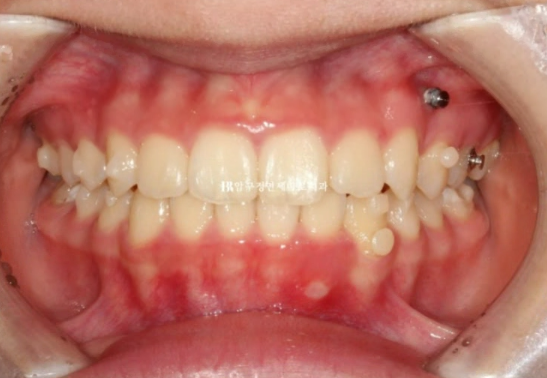
24.03
This is the appearance after wearing all of the first set over about seven months.
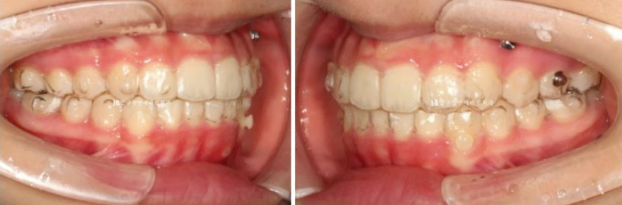
24.03
Correcting a midline that has already shifted to one side so that it matches the face and philtrum may seem simple, but it is not.
Because the problem began in the molars and extended to the front teeth, the entire left-side molars had to be moved.
To pull the upper left molars forward, we placed orthodontic mini-screws in the gums and used removable elastics during treatment.
After remaking the appliance, the additional appliance was modified to include a feature for pulling the premolars into parallel alignment all the way to the roots.
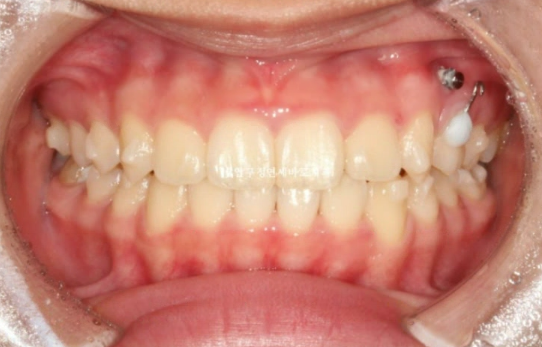
24.07
And this is the appearance after wearing the additional appliance for another four months.
The midline was well aligned.
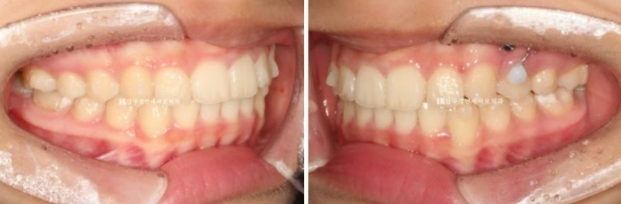
24.07
The bite is also good.
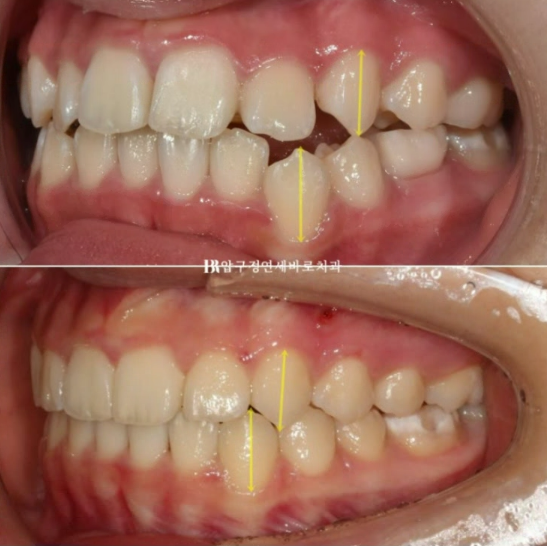
23.08~24.07
Most importantly, the Class III molar relationship on one side became Class I.
Since the treatment ended well, let’s look at the changes over one year.
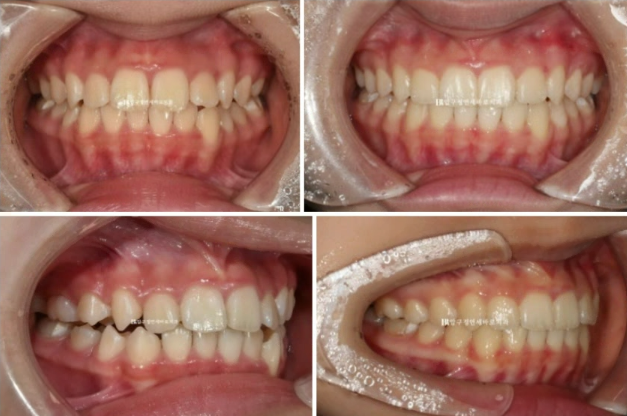
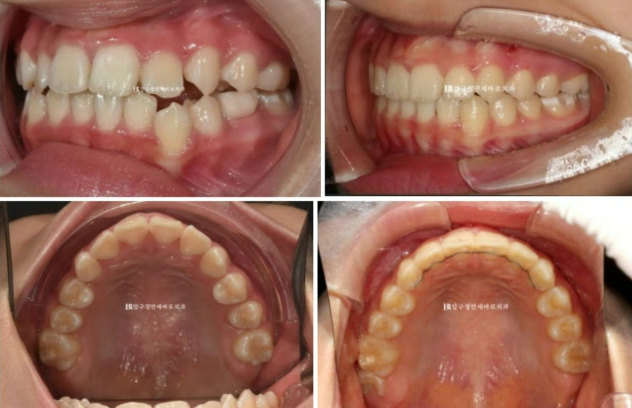
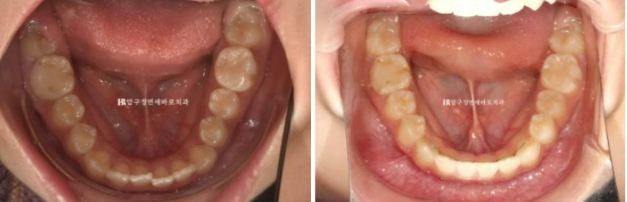
23.08~24.07
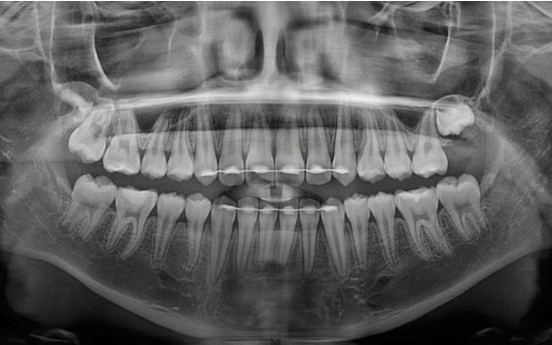
24.07
The root parallelism is also good.
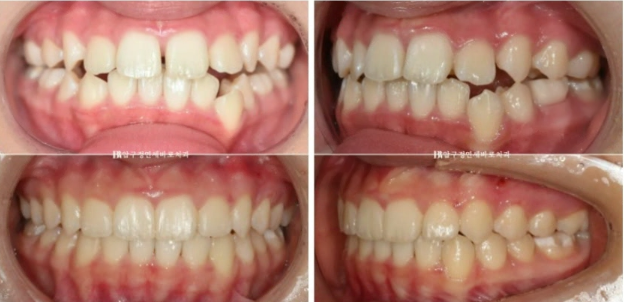
22.12~24.07
In pediatric orthodontics, rather than explaining the limits of child orthodontic treatment, we focus on treating child patients with the goal of creating a perfect bite so they will not need orthodontic treatment as adults.