Hello.
Today, I will show you the process of improving protruding front teeth and crowding without extraction by looking at cases treated with Invisalign Comprehensive.
In particular, I will also talk about the part many prospective orthodontic patients are curious about: the unavoidable situation during Invisalign treatment where the back teeth rise slightly and do not bite together well.
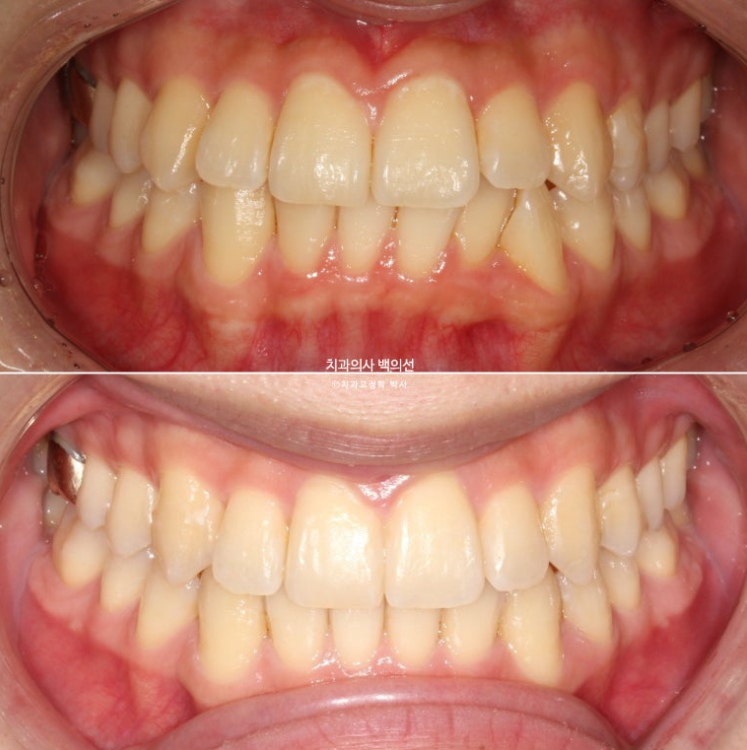
2022.10~2025.03
This patient came for Invisalign orthodontic treatment because of protruding lips and asymmetry.
Because the patient had to travel from a distant province, the interval between visits was important.
The patient also had jaw pain in daily life due to a habit of clenching tightly when concentrating.
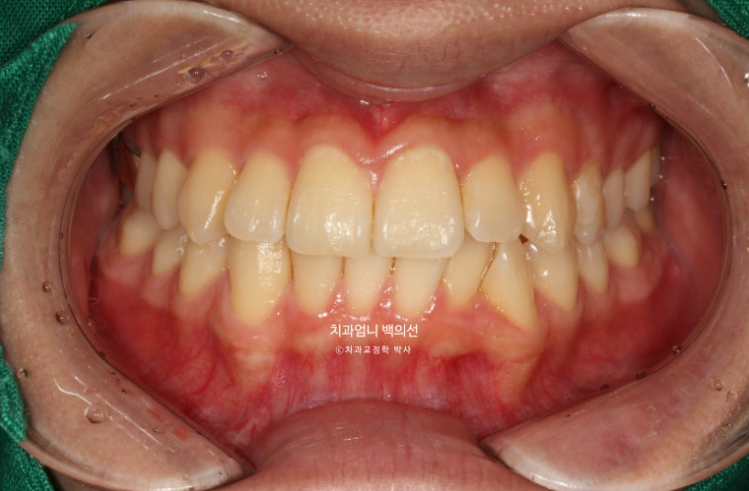
2022.10
A discrepancy in the midline is visible.
The skeletal asymmetry is mild, but because the front teeth midline is significantly off, the patient feels a strong sense of asymmetry.
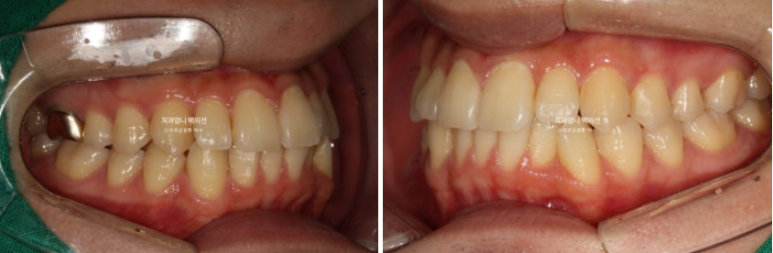
2022.10
The posterior occlusion is Class III, and the front teeth are protruding.
The lips are not protruded, but when speaking or smiling, the front teeth jut forward, creating a protrusive appearance.
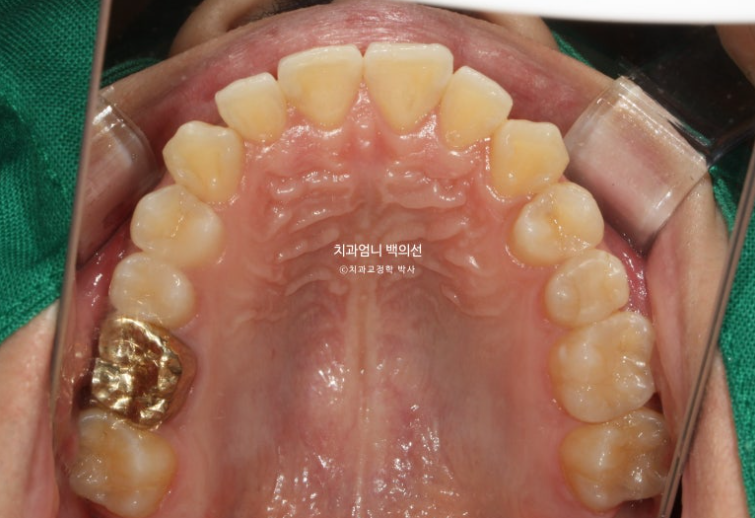
22.10
The canines are significantly rotated.
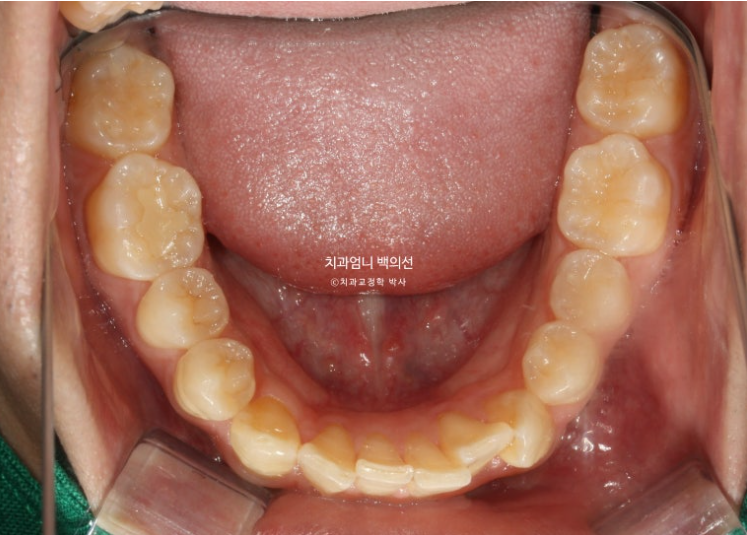
22.10
The front teeth, including the canines, are crowded and overlapping.
The patient, a medical student, was told at a university hospital where they were being diagnosed as a preclinical student that unless four premolars were extracted, the mouth would protrude more than before.
My diagnosis was different. There was no lip protrusion, and there was sufficient space for wisdom teeth, so I recommended treatment to push the molars backward into the wisdom tooth space without extracting premolars, thereby improving the protrusion angle of the front teeth and the crowding.
If the patient had had lip protrusion and no wisdom tooth space, I would also have recommended extraction orthodontic treatment.
To briefly mention something else: during the initial consultation, at the end of the counseling session,
<At other hospitals, they said extraction orthodontic treatment cannot be done with Invisalign. Why do you say it can here?>
Some people ask.
In such cases, it may be faster to ask the doctor who said it cannot be done why they said so.
The treatment recommended by an orthodontic doctor is the treatment that doctor is most confident in.
Being confident means they have a lot of treatment experience and are able to ensure results.
Let me explain something that is obvious from the doctor’s perspective but often overlooked by many patients.
If a certain amount of clinical experience has accumulated, regardless of skill level,
from the doctor’s perspective, it is fully possible to predict whether treatment will go well or not if method A is used.
If it seems like the treatment will not go well, or if there is no experience with treatment method A at all, of course the doctor will explain to the patient that the results will be poor if that method is used.
Assuming the doctor’s standards for treatment results are reasonably high, if treatment does not progress well, both the patient and the clinic will have a hard time.
Naturally, treatments that cannot be done are explained as such.
You can think of any treatment method recommended by a doctor as a treatment that doctor is most confident in and can take responsibility for in terms of results.
The patient trusted our diagnosis and treatment plan, separate from the university hospital’s diagnosis that four premolars needed to be extracted, and began treatment. As I always say, meeting a good doctor and having orthodontic treatment go well is a blessing for the patient.
The first set consisted of 79 aligners, and if each was changed weekly, the expected duration was 1 year and 8 months.
Of course, this period varies depending on the patient’s wear time and compliance.
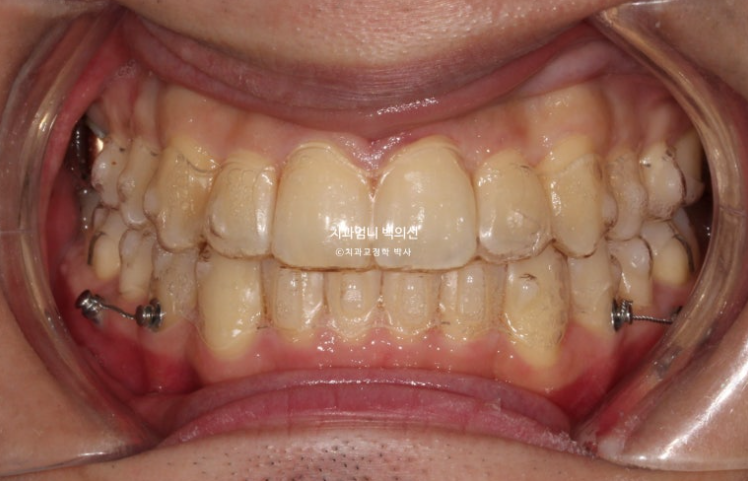
Because the patient lived in a province far away, they visited once every three months, and there were also periods when the aligner change interval became longer than 7 days.
So it took 1 year and 11 months, longer than expected, to wear all 79 aligners.
This is the appearance after wearing all 79 aligners over 1 year and 11 months, from October 2022 to September 2024.
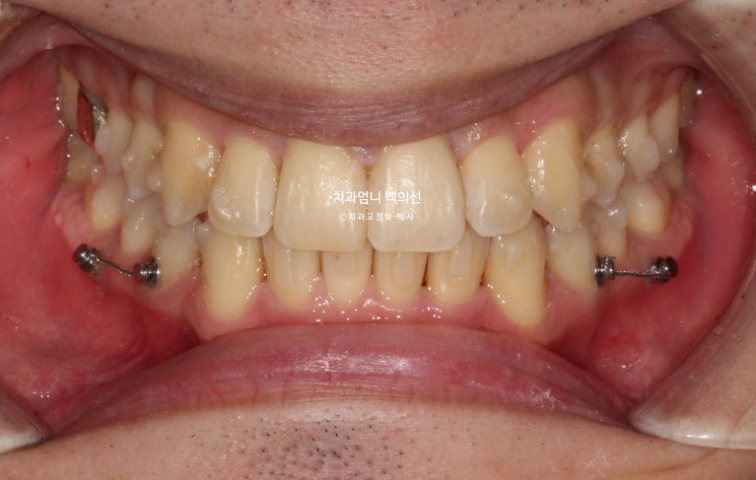
24.09
The front teeth midline discrepancy has improved a lot, but it is not yet perfectly aligned.
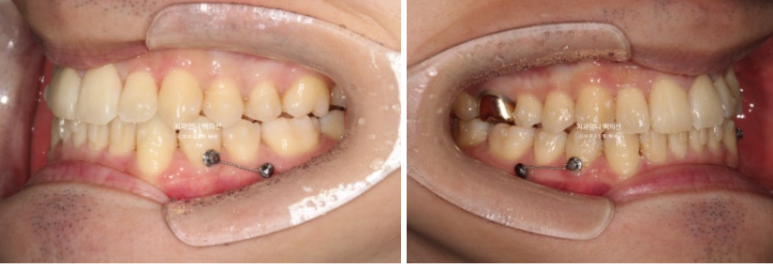
24.09
The molar occlusion itself has improved to Class I, but a gap is visible between the upper and lower teeth.
To further improve the occlusion and midline, we proceeded with remaking additional aligners.
From October 2024 to March 2025, the patient wore elastics and completed six months of additional aligner treatment, finishing all treatment.
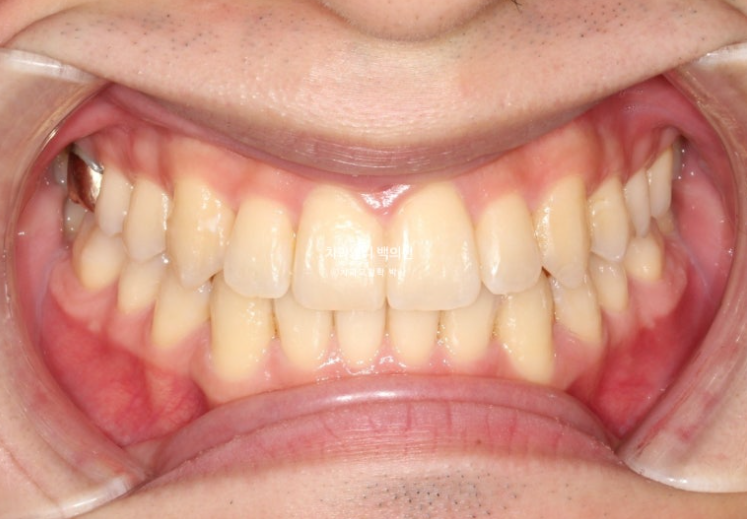
25.03
After treatment, the midline is perfectly aligned.
Here, let me briefly explain the rumor that Invisalign orthodontic treatment ends with poor occlusion.
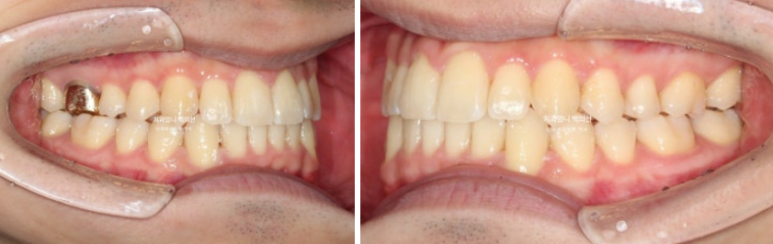
25.03
Under the premise that Class I occlusion has finally been achieved (excluding situations where the occlusion is a mess to begin with), a slight separation of the upper and lower molars occurs, as shown in the photo.
This is explained in a SCI paper.
Let me summarize it in an easy-to-understand way.
Unlike wire braces, where the appliance is attached only to the sides of the teeth, Invisalign covers the chewing surface, that is, the occlusal surface.
Because the upper and lower aligners together have a certain thickness, there is inevitably a part of the appliance that is bitten on the occlusal surface, and because of this, the molars are unintentionally intruded by about 0.9 mm.
The force of biting acts as an intrusive force that pushes the teeth toward the direction of the bone.
This phenomenon is more noticeable in people with a strong bite.
Because the cause of posterior intrusion is the appliance being bitten on, if you stop wearing the aligners after Invisalign treatment, the molars that had been intruded because of the appliance naturally return to their original physiological position and come down slightly.
In other words, posterior occlusion stabilizes, and the molars that did not touch well start to make better contact.
This usually takes about two weeks.
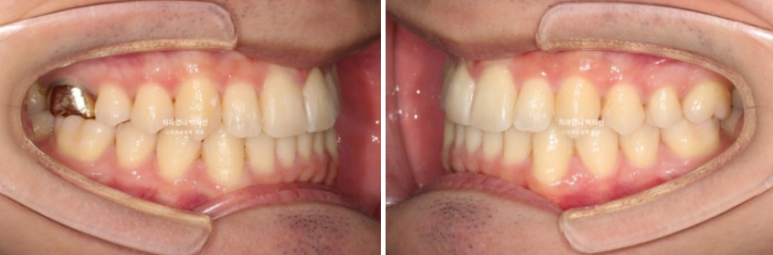
After 2 weeks
If, for two weeks, the molar part of the final Invisalign aligner is cut off and it is worn only while sleeping, a change like the one in the photo appears.
A tight and even occlusion naturally forms on the molars.
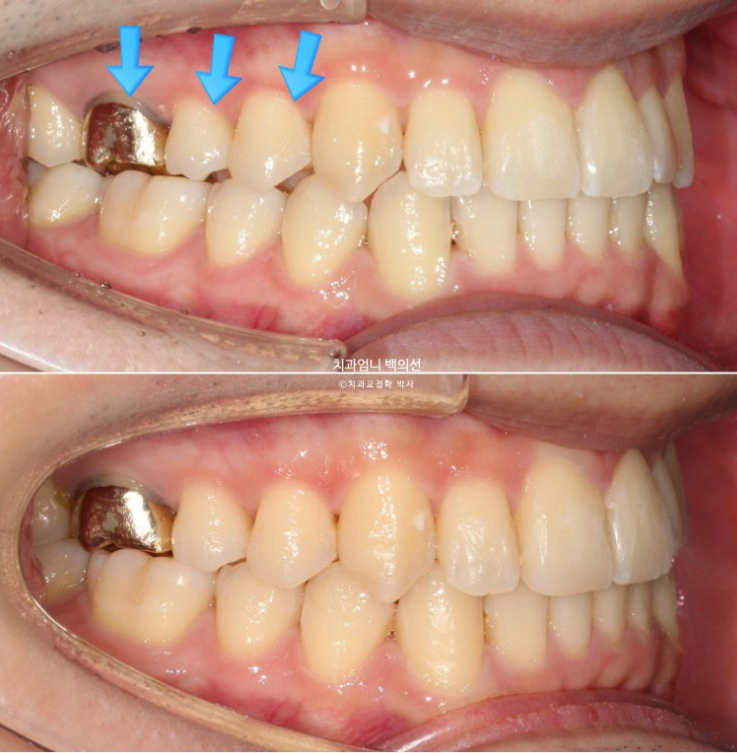
After 2 weeks
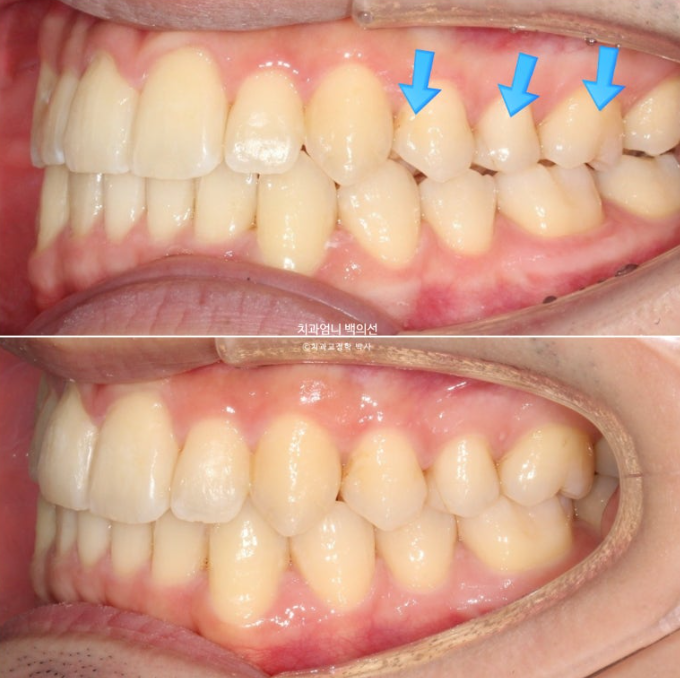
After 2 weeks
You can think of the blue arrow area as the state where the molar occlusion is 0.9 mm open immediately after finishing treatment, as described in the paper.
The photo below shows the molars making good contact after two weeks of occlusal stabilization.
In particular, the patient wanted a Vivera removable retainer after orthodontic treatment, but for Vivera fabrication, occlusal stabilization of the molars must come first.
It would not be appropriate to fabricate Vivera while the molars are still open, right?
If a Thermoformed retainer were to be made, the story would be a little different.
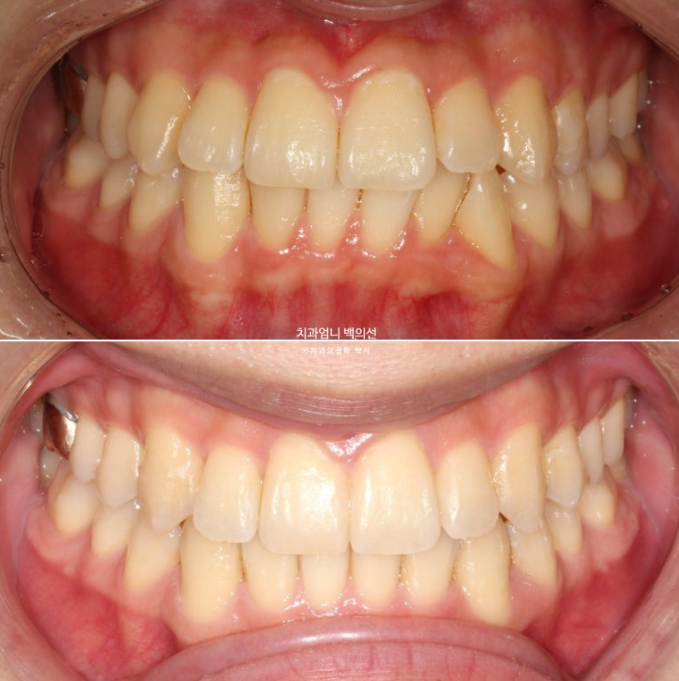
2022.10~2025.03
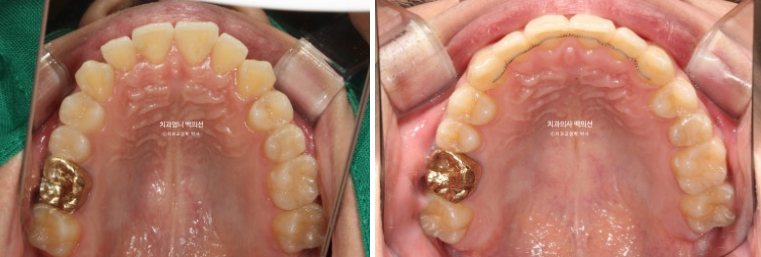
2022.10~2025.03
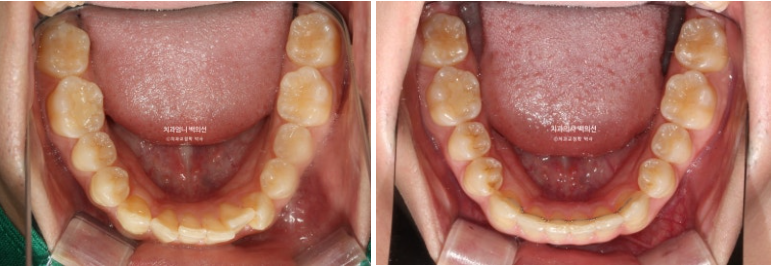
2022.10~2025.03
No matter how much you wear a Vivera retainer, a wire retainer is essential.
What changes are there in the facial profile?
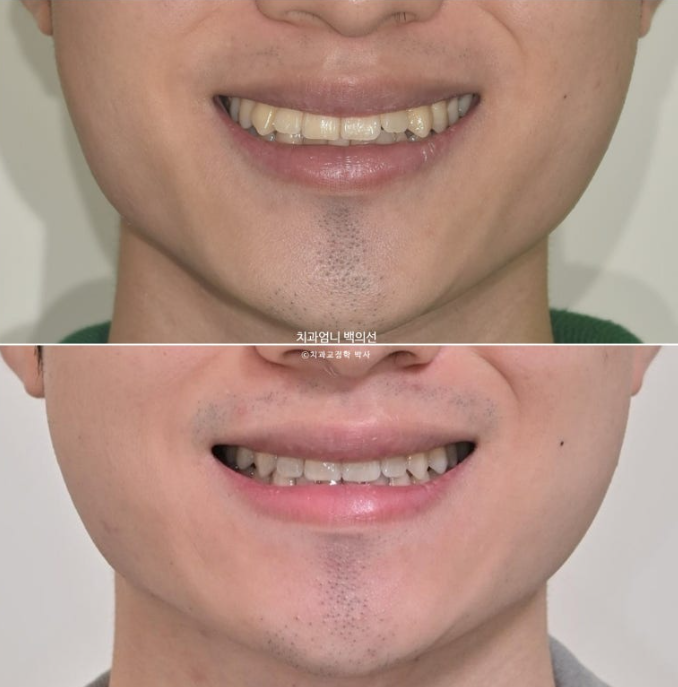
2022.10~2025.03
The protruding front teeth and canines have improved, and the smile line has become well organized.
As the inclination of the front teeth and the midline improved, the asymmetrical appearance was also resolved.
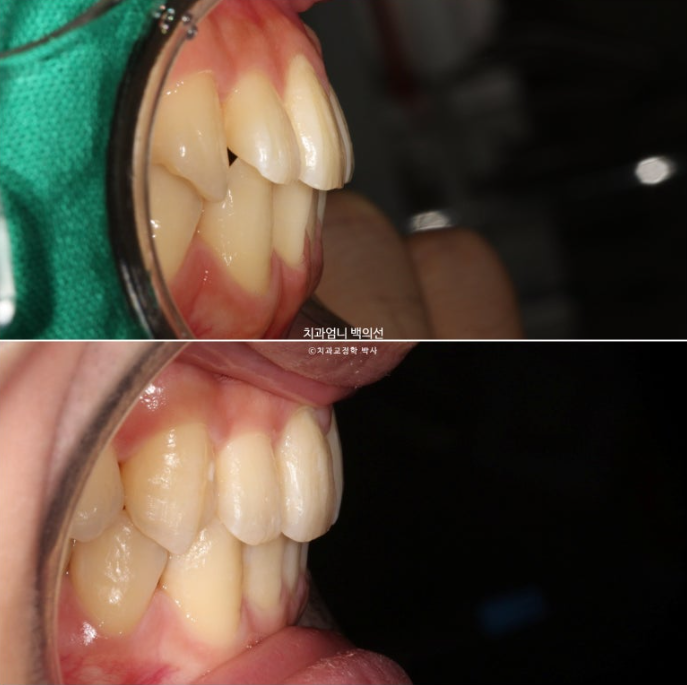
2022.10~2025.03
The protrusion of the front teeth has improved.
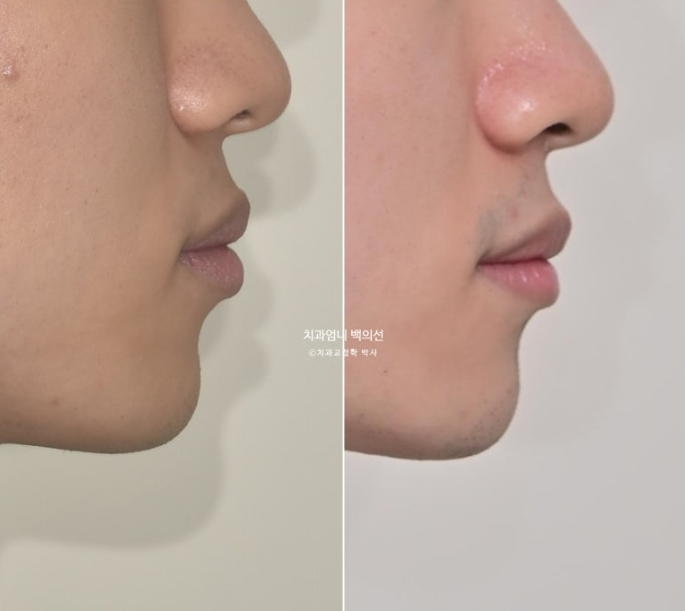
2022.10~2025.03
The front teeth moved back by 2 mm, but the upper lip did not change, and the lower lip moved back slightly.
Changes in the lower lip are predictable and linear relative to the amount of retraction of the lower front teeth, but the upper lip is less so. If I were to explain that, the story would become long again, so I will cover it another time.
The patient is currently wearing Vivera retainers, and after completing orthodontic treatment, also received Botox treatment to improve the habit of clenching the teeth.
I hope this post is helpful for those preparing for Invisalign orthodontic treatment.