Hello.
Over the years, I have introduced various processes for finishing cases with missing teeth through orthodontics without implants.
However, if two teeth are consecutively missing in one quadrant, such as in a dentition with four missing teeth, it is better to place at least one implant.
Otherwise, with two missing teeth, you cannot avoid the centerline shifting and the front teeth moving too far backward, resulting in protrusive teeth.
23.08~25.06
If the front teeth move too far backward and become protrusive teeth, it is not just aesthetically unappealing; in some cases, the lower jaw is pushed backward, which can worsen the temporomandibular joint.
Today, I will show how retreatment, especially reverse correction, is carried out in such cases.
This patient visited in August 2023 for retreatment.
23.08
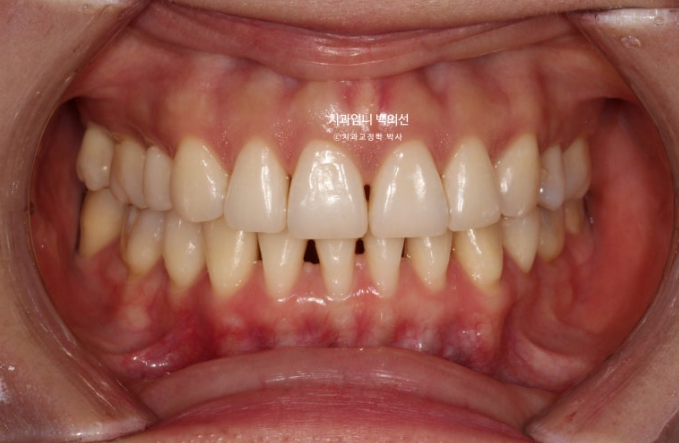
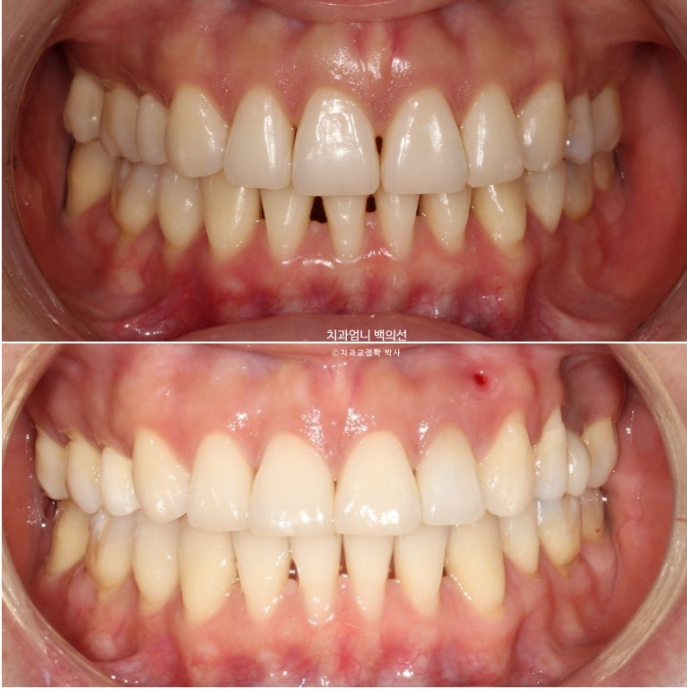
Black triangles and a mismatch in the centerline are visible.
The gums are relatively thin, so gingival recession is also visible in the premolar area.
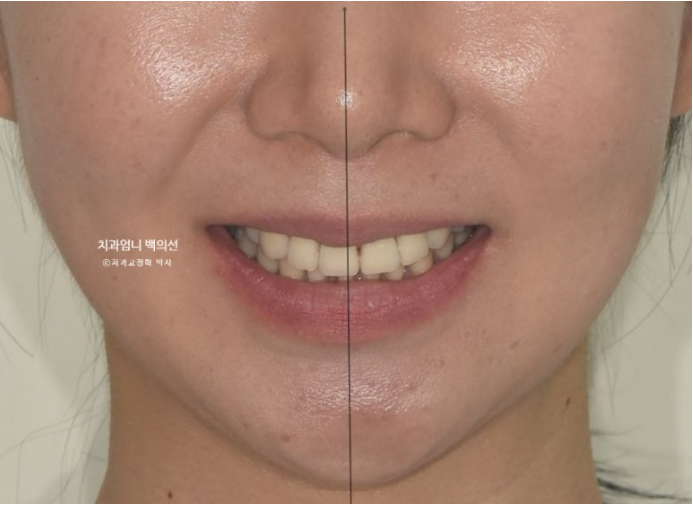
Compared with the face, the maxillary front teeth centerline is shifted to the left.
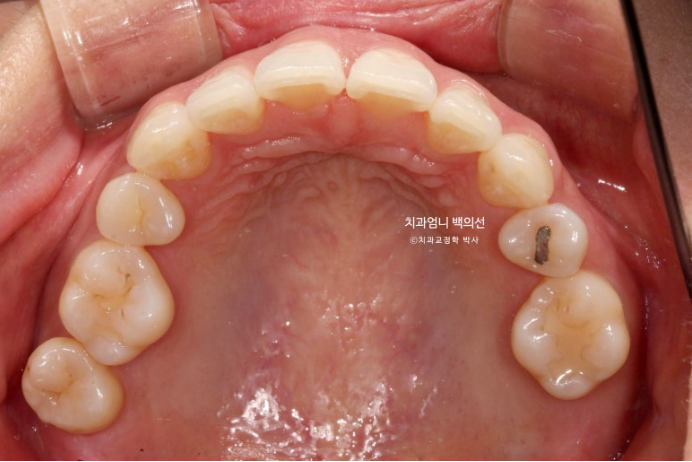
The cause was the difference in the number of teeth on the left and right sides.
Because of extraction orthodontic treatment done long ago, four premolars are missing, and in addition, one left first molar is also missing.
That means there are two missing teeth only on the left side of the upper jaw.
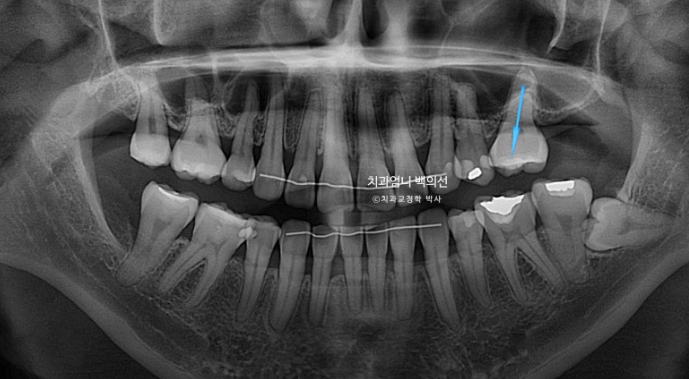
23.08
On the X-ray, you can see that the second premolar has tipped toward the left upper first premolar area, causing the space to disappear.
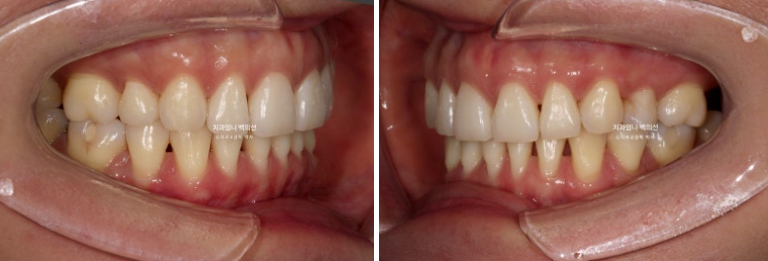
The molar occlusion relationship is Class II.
The decision to proceed with reverse correction must be made carefully. Many people come in for retreatment consultations to improve protrusive teeth or lip profile after extraction orthodontics.
But in reality, cases in which reverse correction is recommended to the patient are very rare.
This is because we must keep in mind the possibility that as the teeth move forward again, the gums may recede.
23.08
However, this case is different from cases where reverse correction is needed purely for aesthetic reasons such as protrusive teeth or lip profile.
Because the previous orthodontic treatment caused excessive retraction of the upper teeth, the lower jaw was clearly pushed backward. This not only severely harms facial appearance but can also strain the temporomandibular joint, so it is better to improve the jaw position even if reverse correction is needed.
To restore the upper front teeth centerline and improve the balance of tooth numbers and occlusion, we decided to reopen the space for one missing molar through orthodontics and place an implant.
Because the patient’s gums are thin, treatment must be done carefully to prevent gum recession and to keep the black triangles from getting larger.
We chose Clippy-C orthodontics and started treatment.
There was more work to do on the upper dentition than the lower one, so the appliance was attached to the upper teeth first and treatment was started there.
The lower appliance should be attached as late as possible to reduce discomfort and lessen the gum burden caused by retreatment.
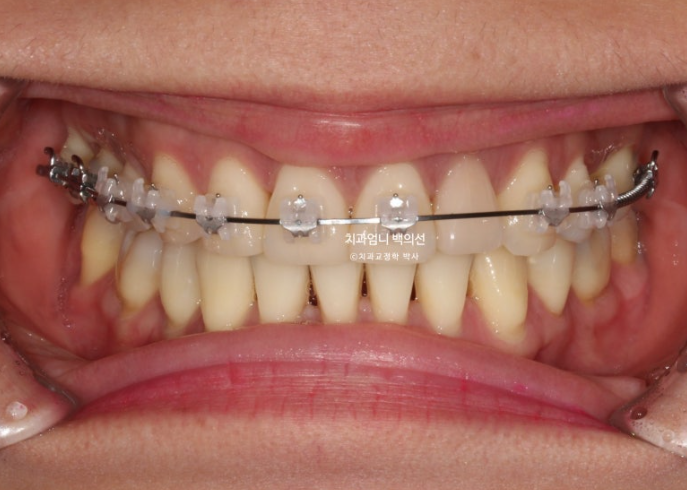
24.04
This is what it looked like 6 months after treatment began.
Treatment is being carried out with appliances attached only to the upper teeth.
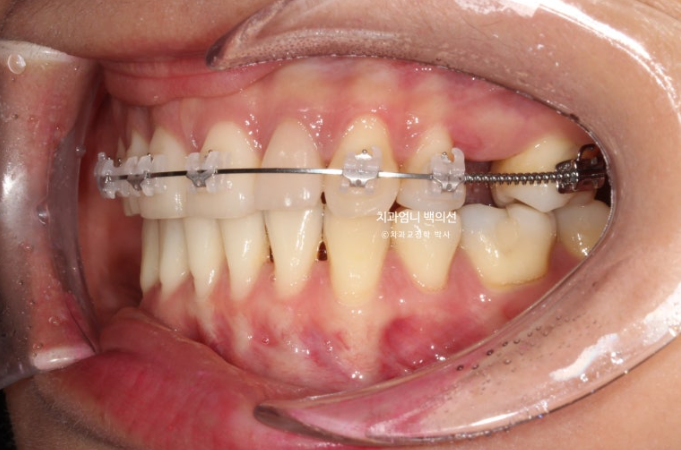
While recovering the molar space.
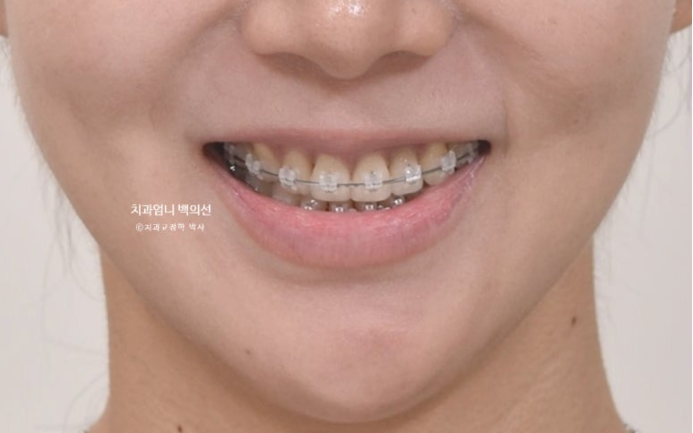
24.08
The upper teeth centerline matched the nose, philtrum, and face after 1 year of treatment.
From that point on, the Clippy-C appliance was also attached to the lower teeth and alignment was started.
At 1 year and 3 months after treatment began, sufficient space had finally been secured for the missing molar, and the implant was placed.
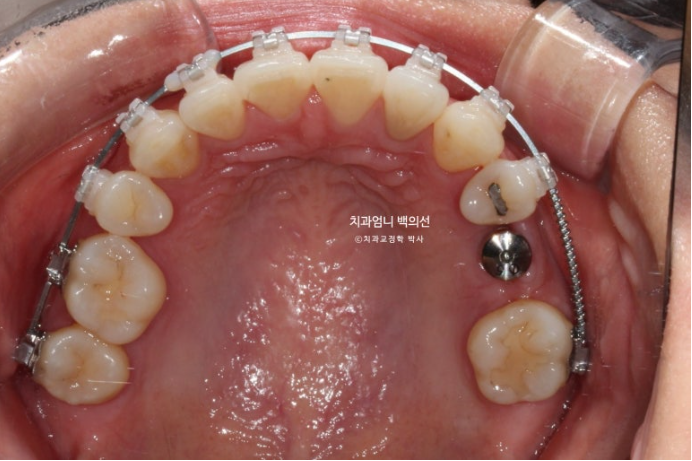
24.11
After the occlusion was stabilized and the finishing process was completed, retreatment was finally finished in June 2025.
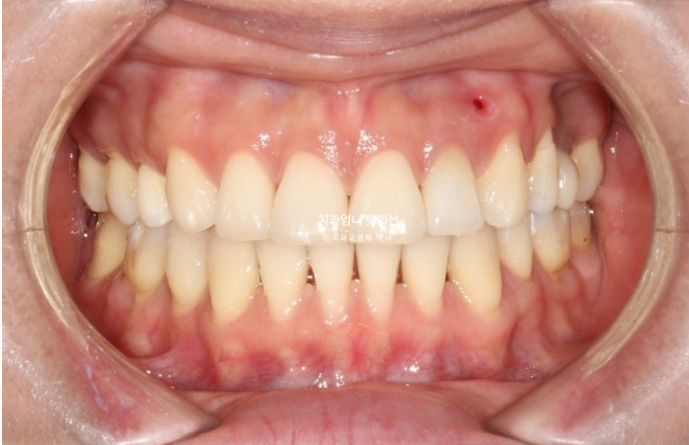
25.06
The total treatment period was 1 year and 10 months.
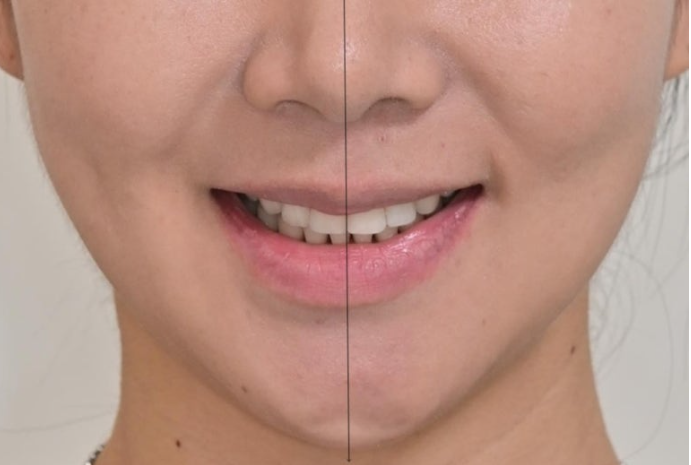
25.06
Now the centerline of the front teeth matches the nose and philtrum exactly.
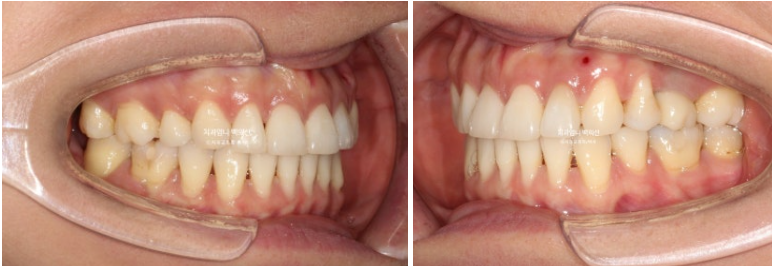
The bilateral molar occlusion relationship, which had been Class II, finally became Class I.
23.08~25.06
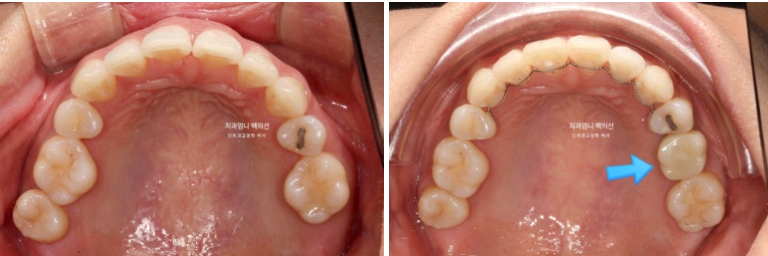
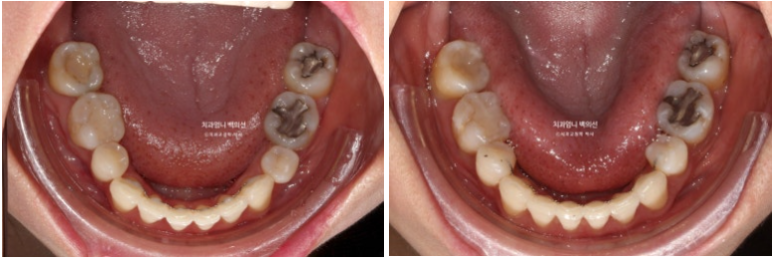
After the implant indicated by the blue arrow was placed, the number of teeth on the left and right sides became balanced. As a result, the centerline was improved, the molar occlusion relationship became Class I, and the protrusive teeth caused by the backward-leaning front teeth were also corrected.
23.08~25.06
23.08~25.06
A small amount of interproximal reduction was performed to reduce the size of the existing black triangles.
Now let’s look at the facial comparison.
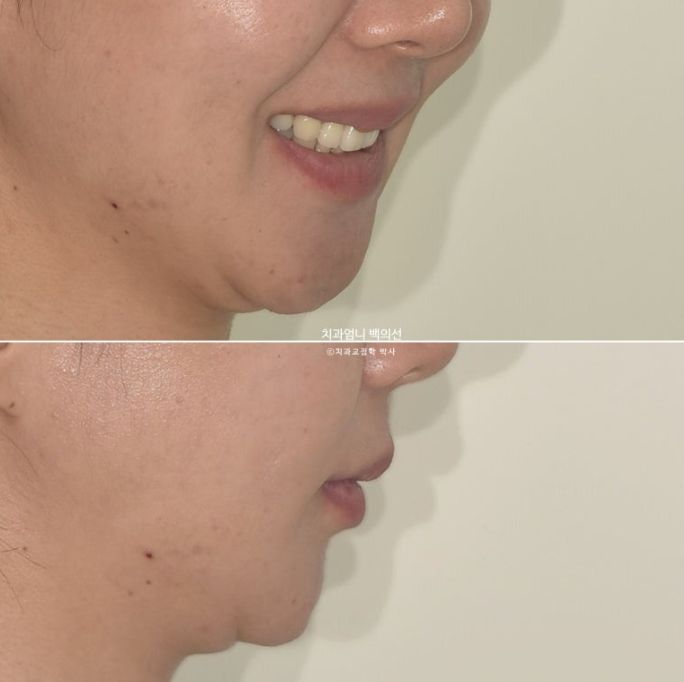
23.08~25.06
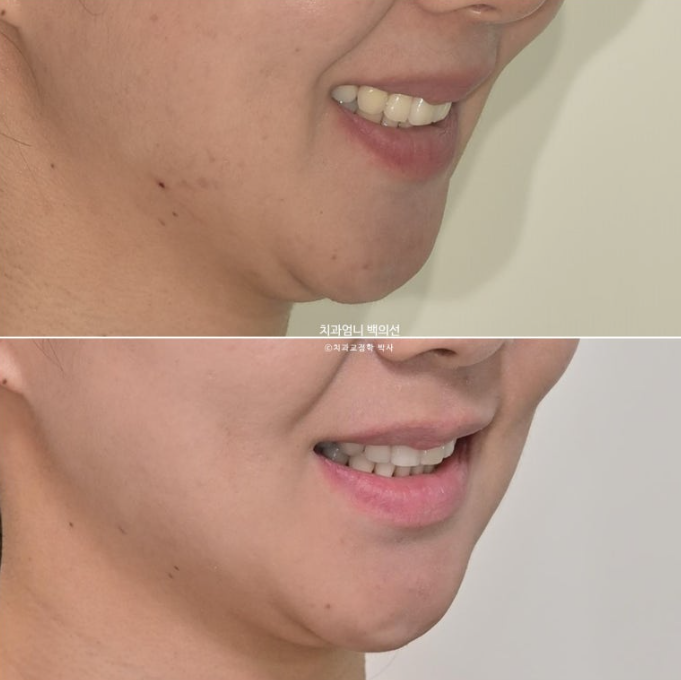
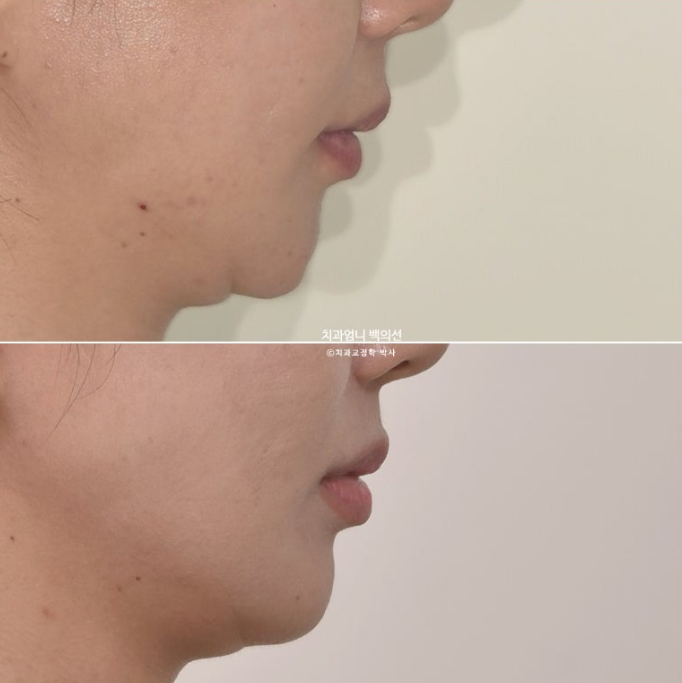
There is a clear improvement in the angle of the upper front teeth, which had been protrusive, and as the lower jaw that had been pushed backward moved forward again, the facial appearance improved.
23.08~25.06
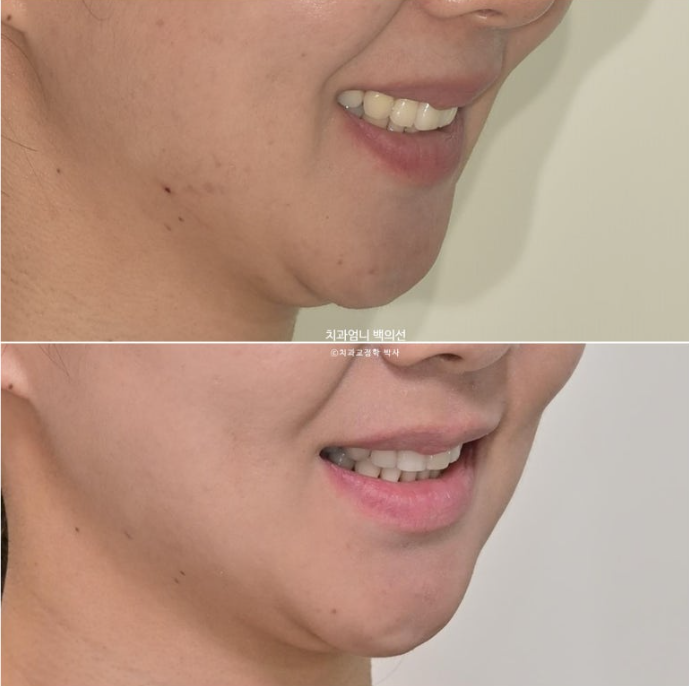
The change in the lower jaw position is even more clearly visible in the side view.
The protrusive front teeth were improved to normal through reverse correction, so when biting down, the lower jaw that had been pushed backward now closes comfortably.
The part that had looked like a recessed chin because the lower jaw was pushed back was also improved.
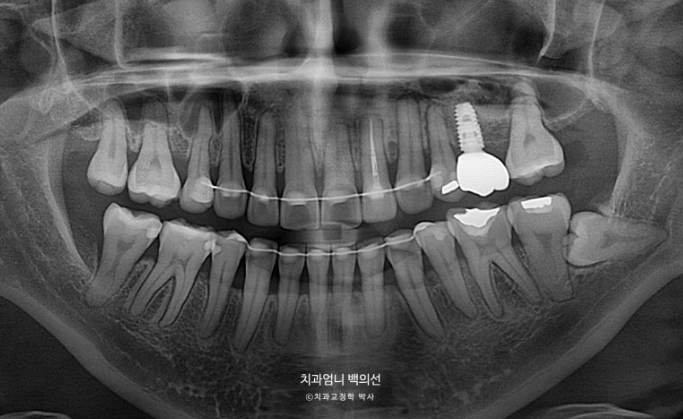
During the 1 year and 8 months of retreatment, there was no additional root resorption, and root angulation improved compared with the beginning.
Retreatment, especially reverse correction, must be approached carefully.
However, if improvement is needed not only for aesthetics but also functionally and in terms of temporomandibular joint health, careful treatment can produce good results without side effects.
I hope this post is helpful for those considering reverse correction.