Hello.
This is Invisalign Dental Clinic.
Today, at Invisalign Dental Clinic, I’d like to talk about cases where Invisalign is not recommended.
A lot of people wonder how far Invisalign treatment can be used.
In most cases where orthodontic treatment is possible, such as extraction orthodontics, protrusion correction, and orthodontic treatment for children, Invisalign treatment is available.
However, from experience, there are also cases where Invisalign orthodontic treatment would be difficult, and where it may be better to proceed with wire braces rather than Invisalign.
I’ll introduce those cases today.
When the teeth are short
If the teeth are short, Invisalign is not recommended.
In this case, wire braces are recommended.
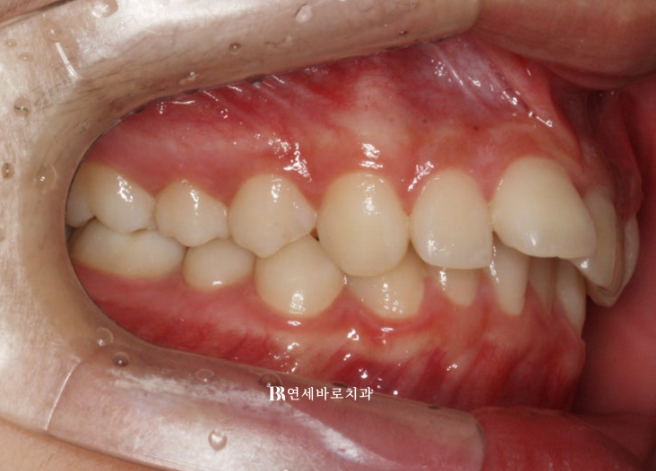
This type of tooth has an average tooth length.
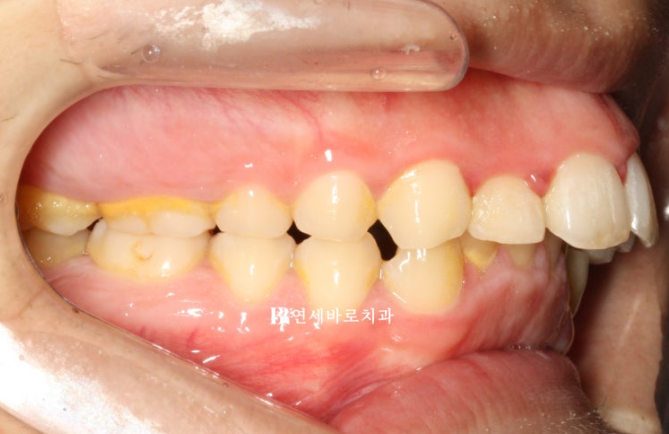
This type of tooth is a short tooth.
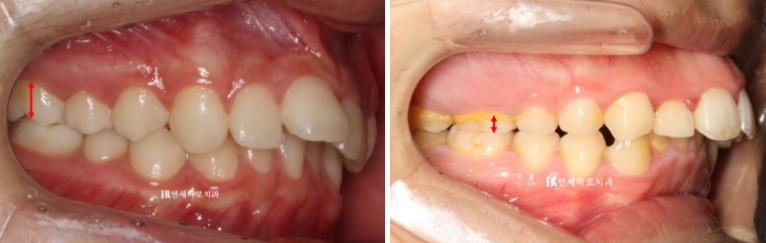
Comparison photo of a person with an appropriate tooth length and a person with short teeth
If the teeth are short, treatment with bracket orthodontics such as Clippy C may not be a major problem, but if Invisalign is used, progress does not go well.
This is not only true for Invisalign; it applies to all clear aligners.
For Invisalign, the transparent tray needs to cover the teeth as much as possible in order to transmit force effectively. But if the teeth are short, there is almost nowhere for the tray to grip the teeth, so force is not transmitted well.
If there are attachments, it is somewhat better, but because it is not an easy orthodontic case, in more complicated treatments it takes much longer and is less favorable compared with Clippy C wire braces.
So in these cases, since Clippy C wire braces are advantageous for the patient in terms of both cost and treatment period, we recommend wire braces.
Then what if the teeth are long instead?
Invisalign orthodontic treatment goes very well.
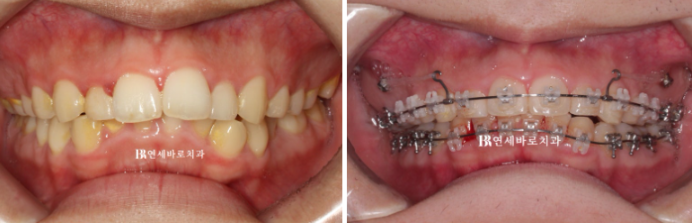
If the molars are not short but only the front teeth are short, there is a way.
You can perform gum contouring to increase the tooth length, then order Invisalign.
However, because gum contouring is not possible for molars, Invisalign is not recommended.
This patient also initially wanted Invisalign, but we recommended Clippy C wire braces.
Now let me show you another person.
This patient also wanted Invisalign treatment.
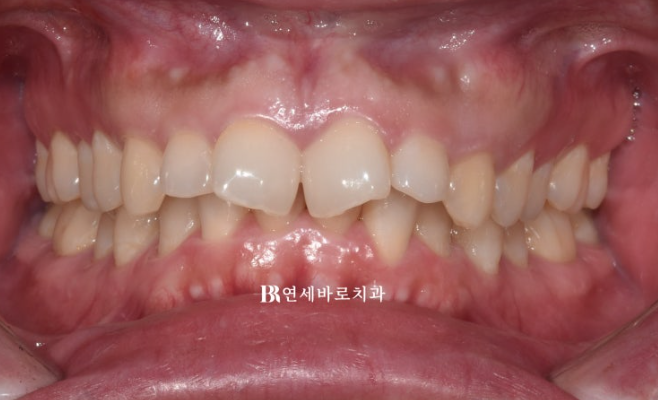
The front teeth are short to a similar degree as the previous patient.
However, the molars are of normal length.
In this case, there is a way.
First, perform gum contouring, increase the length of the front teeth, restore them to a normal length, then take a scan for Invisalign treatment and prepare the aligners.
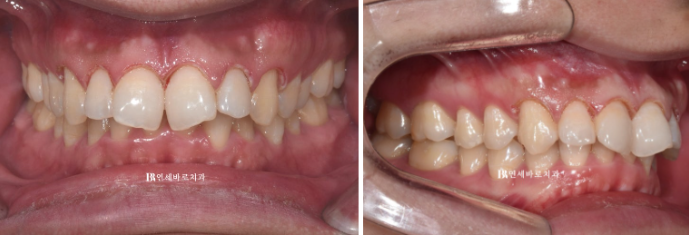
Immediately after gum contouring
I have introduced cases where Invisalign is not recommended.
Rather than extraction orthodontics or protrusion correction, I think the case where Invisalign is not recommended is when the teeth are short, regardless of the type of malocclusion.