Hello,
This is Apgujeong Orthodontic Clinic.
Let me introduce Invisalign orthodontic treatment.
The straight line connecting the canines or molars on both sides is called the occlusal plane.
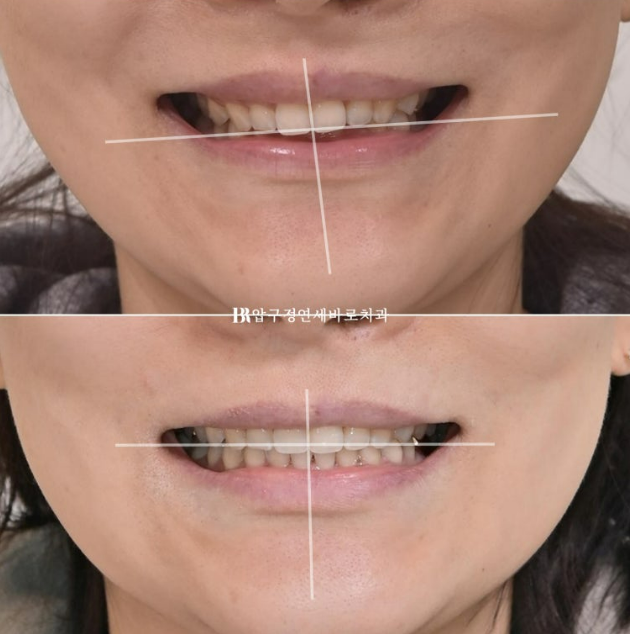
When this occlusal plane is tilted, it is called canting, and orthodontic correction is needed to raise the side that has dropped.
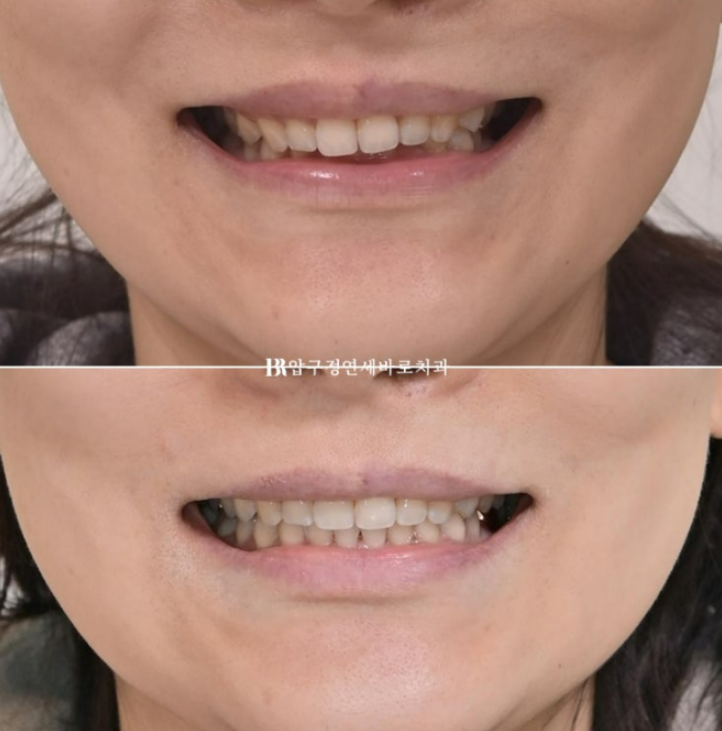
24.01~24.12
Today, I will show you how Invisalign can correct a tilted occlusal plane together with the axis of the front teeth.
In addition, it would be good to see how a sunken lower lip finds its place again when severe overbite is improved.
One more thing: I will also explain the limitations of orthodontic treatment when implants are present.
This patient visited in January 2024 for orthodontic treatment.
They had already undergone bracket-and-wire orthodontic treatment before, and this was re-treatment to correct several issues.
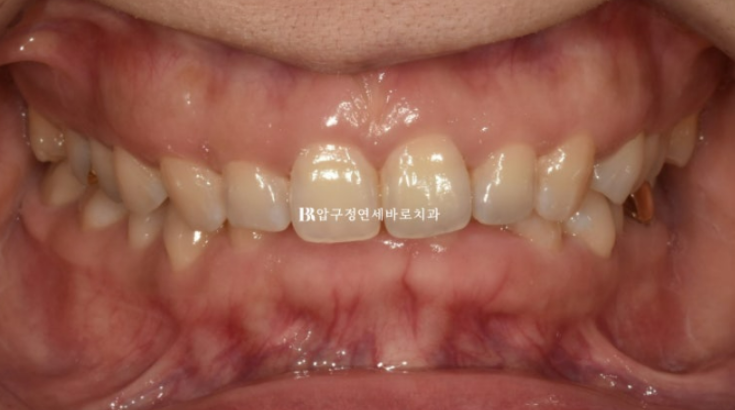
24.01
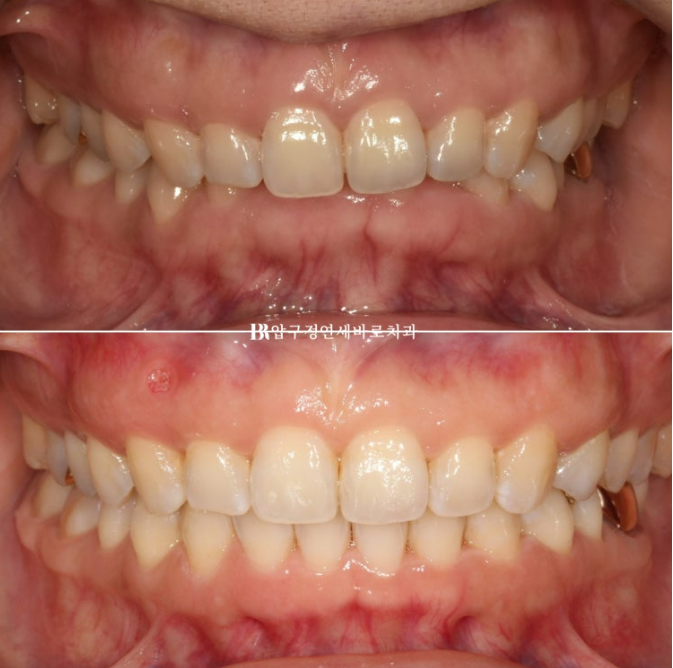
The occlusal plane is tilted.
When the plane is tilted like this, the front teeth are often tilted along with it.
The upper teeth cover the lower teeth so much that the lower teeth are not visible at all, which is a severe overbite.
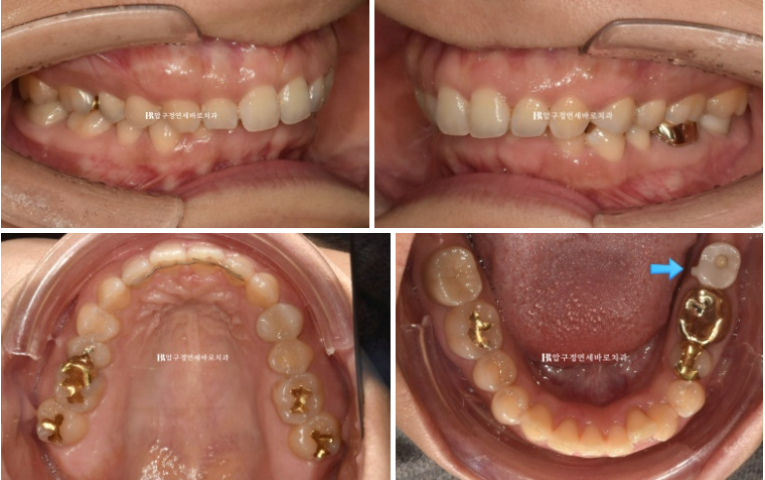
24.01
As a trace of previous orthodontic treatment, a wire retainer is attached to the upper front teeth.
Why is the wire retainer broken into several pieces?
Because of the overbite.
If treatment is finished while an overbite remains, the wire retainer will touch the lower teeth, causing discomfort, repeated detachment, and other problems.
An overbite becomes a major obstacle to recurrence prevention and maintenance after orthodontic treatment.
It is best to address it.
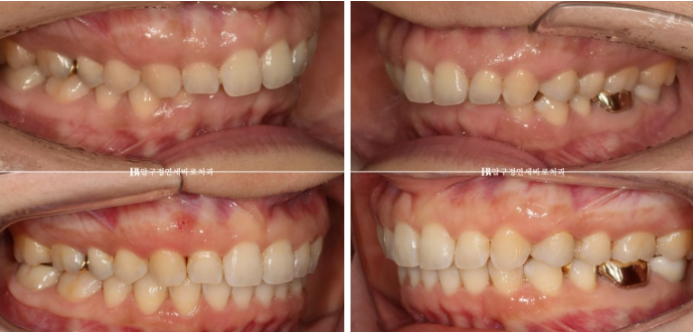
The blue arrow indicates the implant.
On the side with the implant, movement of the molars is limited, including the implant tooth.
Therefore, there are limits to correcting the bite on the side with the implant.
If the molar bite is not symmetrical on both sides, this can also affect the front dental midline, and treatment may be finished with the upper and lower midlines not aligned.
With that in mind, we proceeded with orthodontic treatment, and Invisalign was chosen.
To correct the canting, a mini-screw was placed on one side and rubber bands were attached.
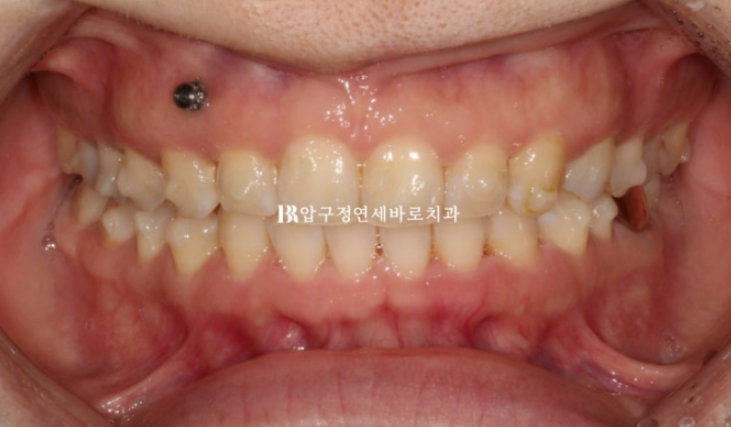
24.07
This is the condition after wearing all of the appliances from February to July 2024 for five months.
Because cooperation with the appliances was good, the overbite was completely improved with the first set.
Not only that, but the tilt of the front teeth and the tilt of the occlusal plane were also completely corrected.
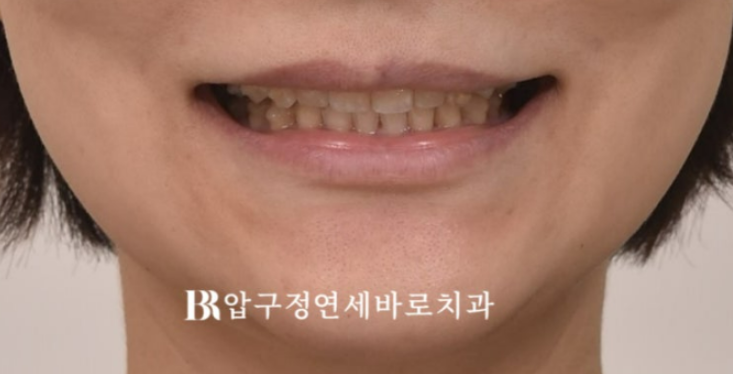
24.07
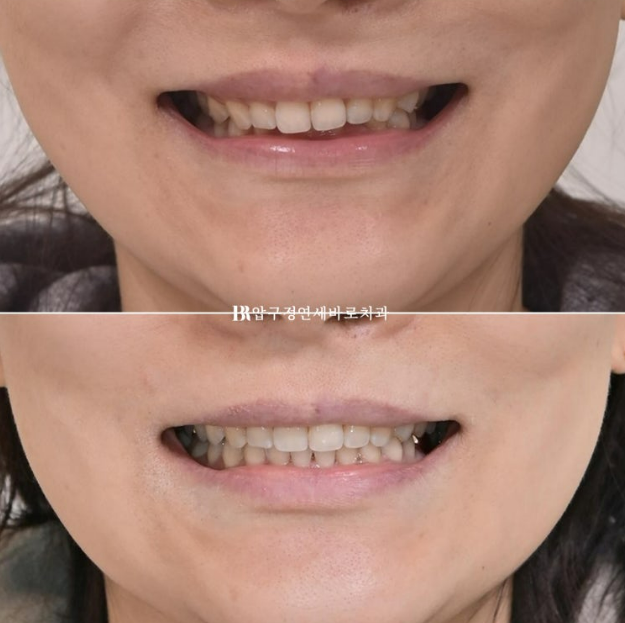
The improvement in canting can be confirmed once more from the facial photo.
It took five months to improve the canting.
Here, there is one important point to mention.
When straightening the tilted axis of the front teeth, attachments on the front teeth are essential.
This patient also had attachments placed on the four upper front teeth.
Many patients say, “I’d like it if there were no attachments on the front teeth.”
Although it may seem like attachments on the front teeth would be noticeable, as you can see in the photo, front-tooth attachments are actually not very visible.
Rather, canine attachments are the most noticeable.
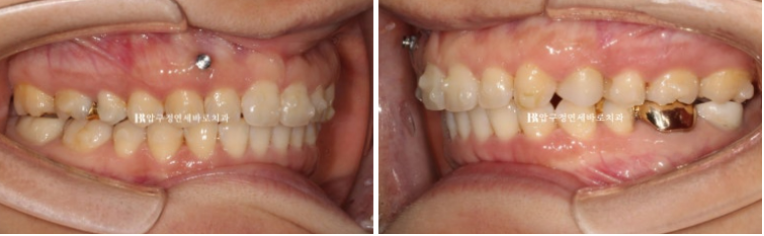
24.07
The left-side bite is still disappointing because the implant limits tooth movement.
Because of the implant, the midline could not be aligned perfectly, but we proceeded with additional appliance fabrication to improve it further.
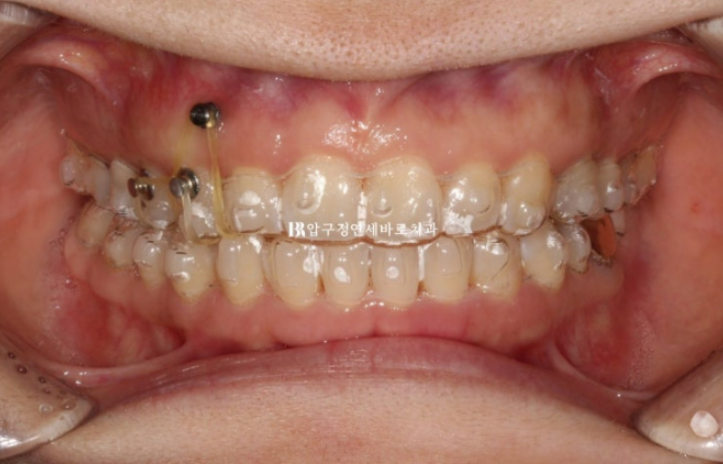
24.08
From August to December 2024, additional appliances were worn for four months.
To improve the midline, rubber bands were also added on the right side.
And finally, in December, treatment was completed after 11 months.
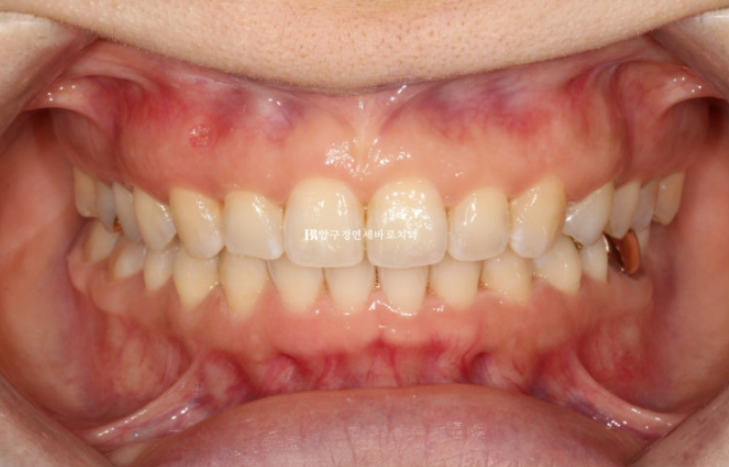
24.12
The tooth axis, occlusal plane, and overbite are all normal, and the midline is still a little disappointing.
Given the limited molar movement due to the implant, this is probably the best possible result.
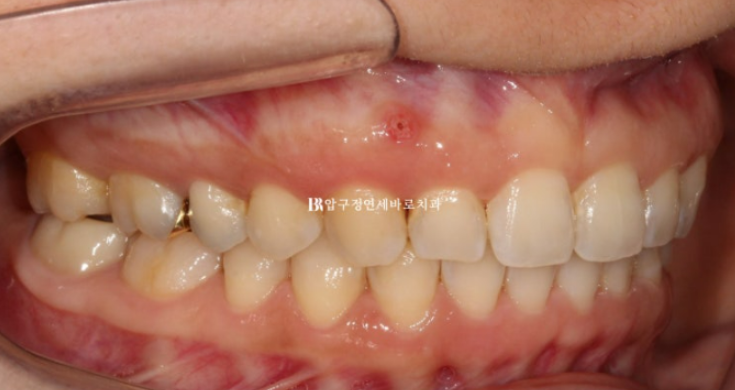
24.12
Many of you may wonder what happens to the area where a mini-screw is removed after orthodontic treatment.
As shown in the photo, it fills in with tissue immediately after removal.
There is no hole left behind.
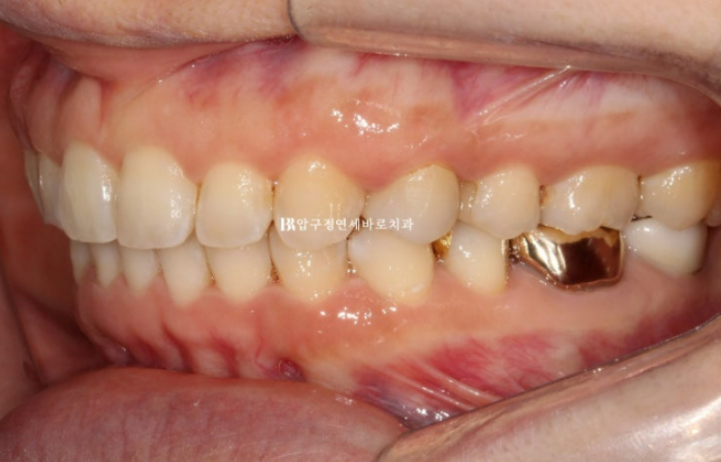
24.12
The left-side bite with the implant was also further improved with the additional appliance.
The bite fits properly, of course.
If the bite is not good, we do not finish orthodontic treatment.
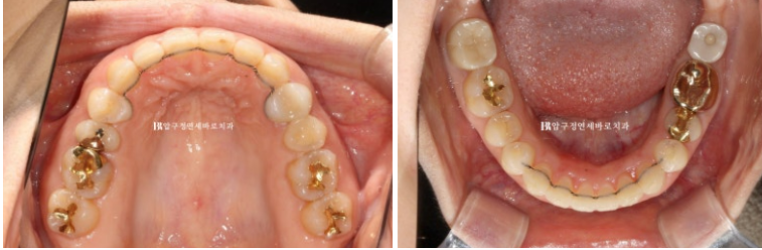
24.12
In most cases, unless it is an extraction case involving premolars, the wire retainer is attached only from canine to canine.
However, even in non-extraction orthodontic treatment, the wire retainer needs to be extended to the premolars to prevent recurrence of the overbite.
For the removable retainer as well, a hard Vivera retainer that covers the occlusal surfaces was made to prevent canting from recurring.
The patient said they were happy that the overbite had been relieved compared with before, and that the wire retainer finally felt comfortable.
Let’s compare before and after.
The total treatment period was 11 months, and one remake was done.
24.01~24.12
24.01~24.12
24.01~24.12
24.01~24.12
In just 11 months, the occlusal plane and tooth axis were completely improved.
To prevent recurrence in the future, the design and type of retainer need to be considered carefully.
24.01~24.12
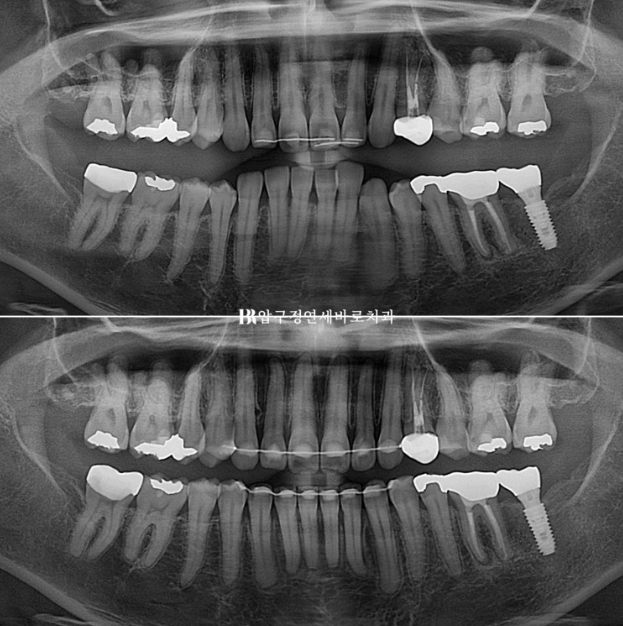
On the panoramic image, you can see that the lower front teeth, which were protruding at the initial visit, have been intruded considerably.
24.01~24.12
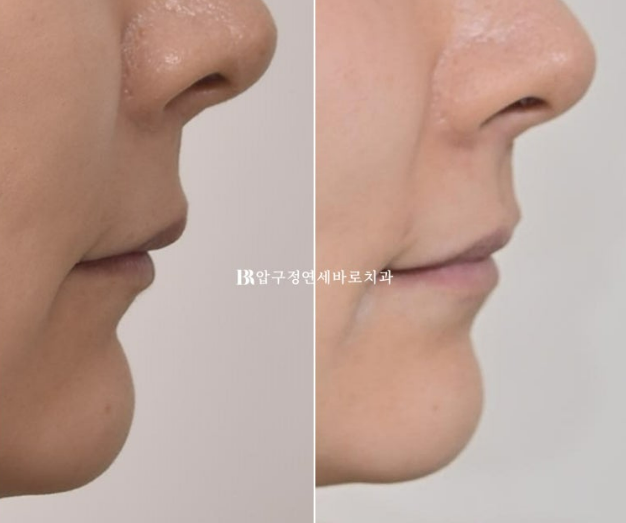
Because the lower front teeth, which were hidden by the upper teeth when the overbite was present, were tucked in, the lower lip also regained its volume after orthodontic treatment.
Canting correction, which raises one side of the dentition to correct the occlusal plane, is one of the orthodontic treatments that can be done well with Invisalign.
Retreatment should be approached carefully.
Thank you for reading this long post.