After receiving an implant consultation,
the question we hear most often is this:
"So, how long will it take?"
When people hear an answer involving several months,
most of them are taken aback.
They are unsure whether they will have to keep visiting the dentist throughout those months,
or whether they will have to stay without a tooth.
I will organize the entire process by stage.

──────
1st stage. Diagnosis and planning | 1 visit
A panoramic X-ray and CT scan are taken.
This is the process of checking how much bone remains beneath the gums that are visible to the eye,
and where the nerve canal passes.
At this stage, the implant position, direction, and number are determined.
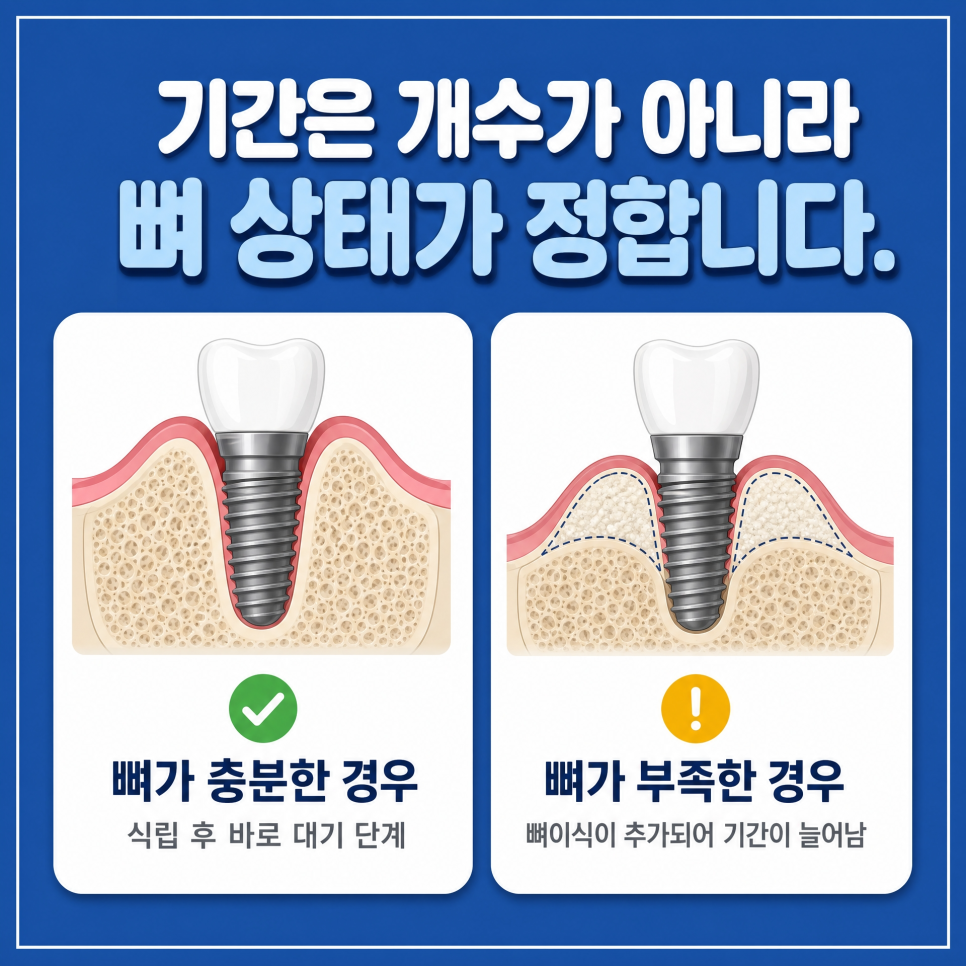
If the examination shows that there is not enough bone,
bone grafting is added to the plan,
and the treatment period is extended accordingly.
──────
2nd stage. Extraction and gum healing | 4–8 weeks, if necessary
This applies when any remaining teeth need to be extracted.
The extraction site usually needs one or two months to heal before an implant can be placed.
Depending on the condition, extraction and implant placement may be performed on the same day.
──────
3rd stage. Implant placement | The day of surgery
The gums are opened and the fixture is placed into the bone.
If only a small number are placed, the procedure takes approximately 30 minutes to one hour;
when the entire set is placed, it takes longer.
For those having several implants placed at once,
or for those with significant dental anxiety,
conscious sedation may also be considered at this stage.

──────
4th stage. Waiting for osseointegration | 2–6 months
This is the longest stage.
It is the period during which the implanted fixture bonds with the bone,
and because the body heals at its own pace, it is difficult to shorten this period.
The lower jaw generally takes less time, while the upper jaw tends to take longer.
If bone grafting was performed at the same time,
or if you have diabetes,
more time may be needed.
You do not have to visit the dentist throughout this entire period.
There will only be a few visits to monitor your progress,
and the area that appears to have a missing tooth is fitted with a temporary tooth.

──────
5th stage. Fabrication and placement of the prosthesis | 3–5 weeks
Once it has been confirmed that the fixture has bonded with the bone,
the tooth that will be placed on top of it is made.
The process of taking impressions, having the prosthesis fabricated at a dental laboratory,
and checking the fit in the mouth is repeated.
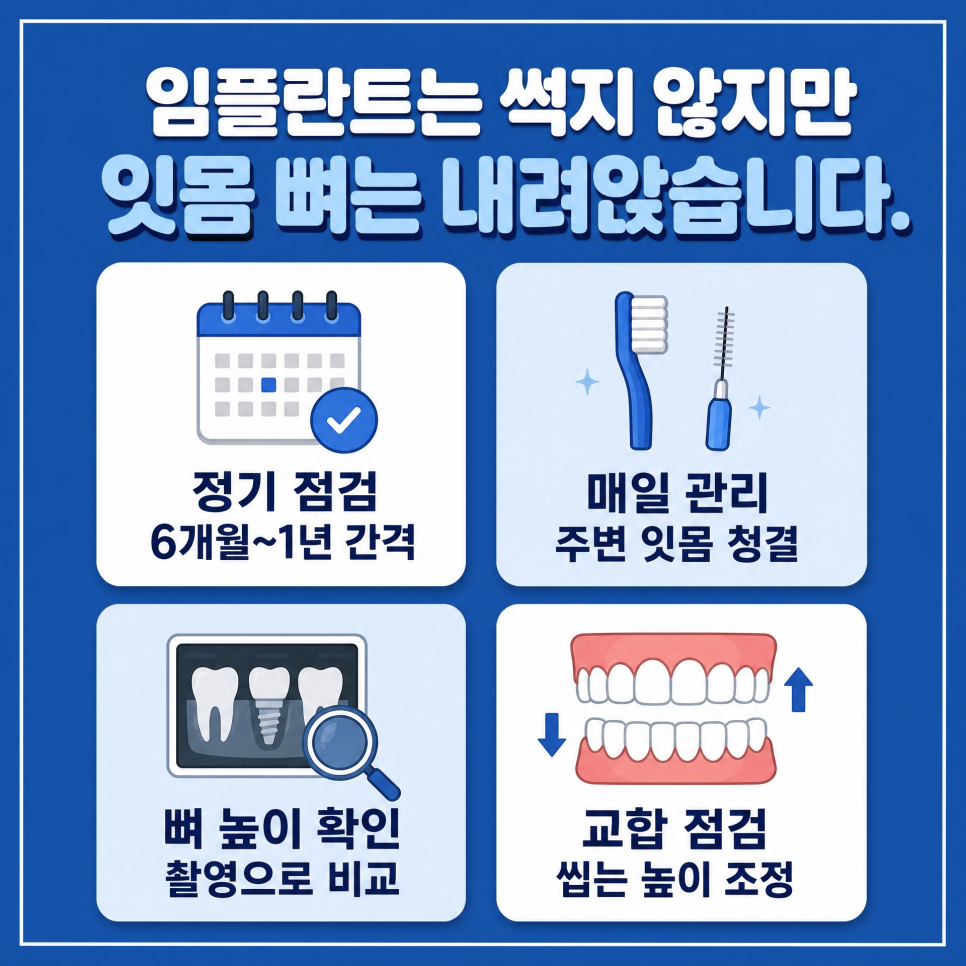
Because this stage involves adjusting the biting height, it is not completed in one visit; you will usually need to visit two or three times.
──────
6th stage. Regular checkups | Ongoing thereafter
This is not the end.
Implants are used for a much longer period
than the time it takes to place them.
Unlike natural teeth, they do not decay, but they can become loose if the gum bone recedes.
That is why their condition is checked at intervals of six months to one year.
──────
So, how long does the entire process take?
For a simple case, approximately three months;
if extraction or bone grafting is involved,
you should expect anywhere from six months to one year.
The factor that determines the treatment period is the condition of the bone, rather than the number of implants.
Even when placing a single implant,
a site with sufficient bone and a site with insufficient bone
will have completely different schedules.
That is why it is difficult to give an exact time frame before reviewing the CT scan.
──────
Directions
Official YouTube channel of the chief director
https://www.youtube.com/@implant_dr.yichoi
Official Instagram
https://www.instagram.com/plandent.seoul_official/
The periods above are general guidelines and may vary depending on your oral condition and overall health.
Occlusal problems, fixture loosening or loss, nerve damage, inflammation, and other complications may occur after the procedure.