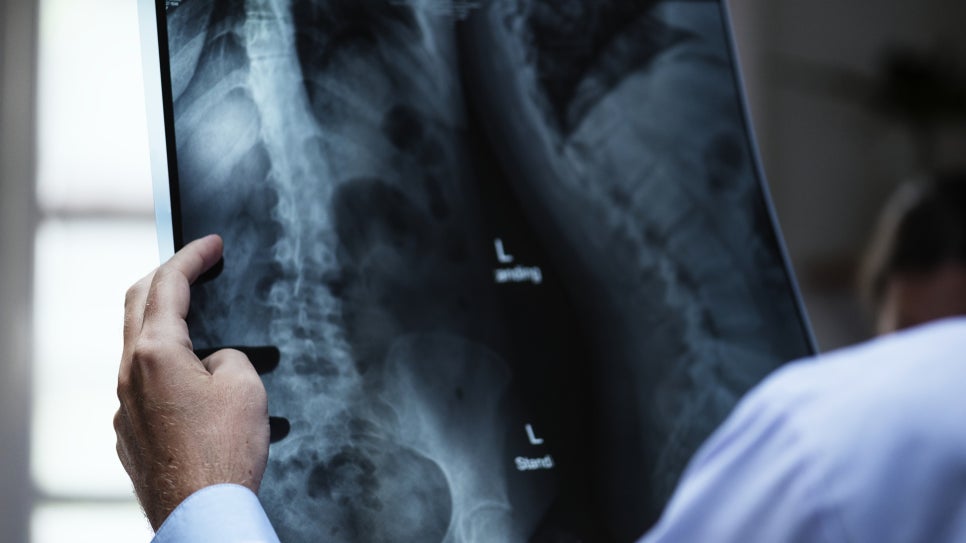
Our bodies have about 200 bones of various sizes. They are firmly connected to one another by muscles and tendons, forming the skeleton. Bones are important structures that protect vital organs inside the body, produce blood, and make movement possible.
A fracture refers to a bone breaking due to external force and means that the continuity of the bone is completely or incompletely interrupted. Fractures can be classified according to the condition of the injured area, such as an open fracture in which the bone protrudes outside the skin, or a comminuted fracture with multiple fracture lines.
Most organs (for example, the lungs, brain, and heart) heal after injury with scar tissue that is different from their original shape, but bones heal into their original bone tissue even after a fracture. However, for a fracture to heal, the fracture site must be properly fixed, and sufficient blood supply and appropriate stimulation must be provided.
◆ Causes and Symptoms
-
Causes
When a bone cannot withstand external force applied to it, it breaks. Such external forces include falls, car accidents, and drops from a height, and the type of fracture varies depending on the nature of the force.
-
Symptoms
When a bone breaks, severe pain occurs, and the main symptoms are as follows.
· Pain and tenderness: Pain occurs due to swelling at the fracture site, muscle spasm, and damage to the periosteum, and it worsens when the fracture site is pressed and becomes more severe when moving.
· Loss of normal function: The fractured area moves abnormally, and nearby joints hurt, making movement impossible.
· Deformity caused by the fracture: The shape of the arm or leg changes.
· Swelling: Fluid and blood seep into the injured area, causing the arm or leg to swell.
· In addition, sensory impairment, muscle spasm, and paralysis may occur.
◆ Diagnosis
If you visit a hospital with the above symptoms, the doctor will examine you based on the patient's symptoms and then take plain X-rays, and perform special tests such as computed tomography if necessary.
-
Medical history taking (interview)
The overall circumstances at the time of injury, when the symptoms began and how severe they are, past medical history, general health status, and other related details are checked. In particular, the height of the fall and the speed of the vehicle at the time of impact are asked about in detail. This is because, in general, the magnitude of the external force that caused the fracture is proportional to the degree of bone injury.
-
Physical examination
Pain and tenderness, functional impairment, deformity, and abnormal movement at the suspected fracture site are checked, and in particular, whether there is damage to blood vessels or nerves is evaluated.
-
Plain X-ray examination
This is the most important and basic test for diagnosing fractures. To accurately determine the type of fracture, images are taken from multiple angles, and the joints above and below the injured area should be included to check for associated injuries. In children, for an accurate diagnosis, not only the injured area but also the opposite side should be imaged for comparison.
-
Computed tomography (CT) scan
A CT scan may be performed when a fracture is difficult to diagnose on plain X-rays or when the type of fracture needs to be clearly identified. CT is an imaging technique designed to view cross-sections of the human body, and three-dimensional computed tomography can provide three-dimensional images that are like seeing the fracture directly, greatly helping in the diagnosis and treatment of fractures.
So far, I have explained bone fractures.
In the next installment, we will look at the treatment and complications of bone fractures.
Source: Korea Disease Control and Prevention Agency National Health Information Portal