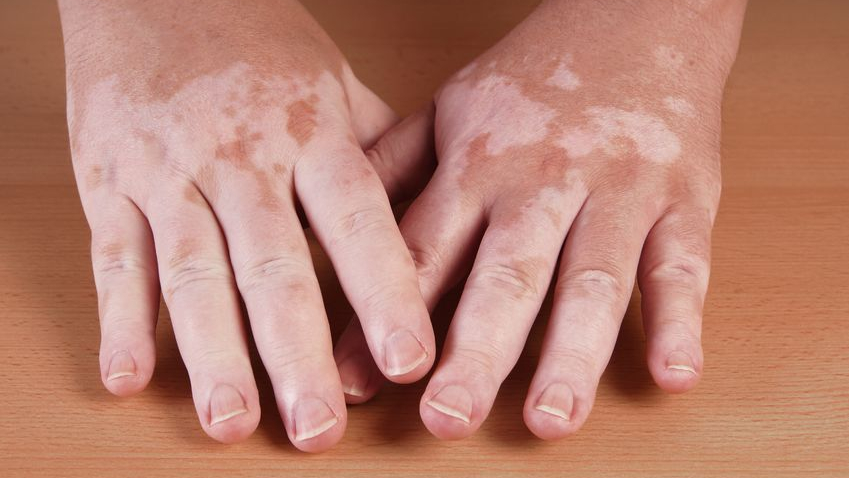
Vitiligo is a skin condition in which the skin loses its color due to a deficiency of melanocytes, resulting in depigmented white patches on the skin, and sometimes the hair also turns white. It is also commonly called 백납. It occurs in about 1% of the population and is most commonly seen between the ages of 10 and 30. There are no differences in occurrence by race or region.
Cause
If the melanocytes normally present in the epidermis of the skin die or cannot produce melanin, the skin turns white. The exact cause of vitiligo has not yet been identified. The main proposed causes are melanocyte apoptosis due to oxidative stress such as ultraviolet light and melanocyte destruction due to autoimmune mechanisms.
About 10–20% of patients appear to have a family history of vitiligo, suggesting that genetic factors also play some role.
Symptoms
Vitiligo presents as white depigmented patches of various sizes, round or irregular in shape. Sometimes the borders of the white patches may appear darker instead. Aside from the appearance of white patches, there are few subjective symptoms, and in very rare cases the affected area may itch or feel prickly. Depending on its form, vitiligo can be classified into localized type, in which one or several white patches develop in one area; segmental type, in which it appears in a band along one side of the body; and generalized type, in which it spreads widely throughout the body. There is also an acrofacial type, which mainly develops on the face and the ends of the hands and feet. Recently, it is sometimes simply divided into segmental and non-segmental mixed types.
Segmental vitiligo occurs locally in part of the body along a skin segment and may increase in size for about 1–2 years, but in most cases it remains in the form it first appeared and does not spread further. In generalized vitiligo, the course varies greatly: it may remain unchanged for several years and then suddenly spread after a number of years.
Vitiligo often develops white hair (leukotrichia), and in some cases hair depigmentation is the first symptom. Vitiligo is a cosmetic issue and is generally not related to internal medical conditions and is not contagious. However, because autoimmune diseases such as thyroid disorders may rarely be associated, it is necessary to confirm this through blood tests.
Diagnosis
Vitiligo is usually easy to diagnose through visual observation. However, there are many other conditions that can cause white patches on the skin besides vitiligo, so it is important not to diagnose yourself or receive incorrect treatment, and instead to see a dermatologist.
In the early stages, it can be difficult to differentiate, so it should be distinguished from other diseases through a Wood's lamp examination or a skin biopsy. In addition, because eye abnormalities, inner ear abnormalities, thyroid disease, and anemia may rarely be associated, blood tests and other examinations may be performed to check for these.
So far, I have explained vitiligo up to the diagnosis stage.
In the next part, we will look at the treatment of vitiligo.
Source: Korea Disease Control and Prevention Agency, National Health Information Portal