- How to Check for Airway Obstruction
Airway obstruction does not happen often, but it can be fatal if immediate treatment is not given.
Airway obstruction caused by a foreign body can be divided into mild and severe cases. If a patient shows signs of airway obstruction, such as holding their throat with their hand, being unable to make a coughing sound, showing cyanosis, or being unable to speak or breathe, quickly ask, "Is something stuck in your throat?" or "Is your throat blocked?" If the patient cannot speak and only nods, judge it to be a severe airway obstruction and provide immediate treatment. In the case of mild airway obstruction, where the patient can speak or breathe, encourage coughing so that the patient can expel the foreign body on their own.
- How to Treat Airway Obstruction
When a choking incident caused by food occurs, ask someone else to call 119 and immediately attempt to remove the obstruction using the following methods.
- When the patient is conscious
If the patient is conscious and cannot cough, perform the abdominal thrust method (Heimlich maneuver) as follows.
· Stand or sit the patient up, stand behind them, wrap your arms around their waist, and make a fist with one hand.
· Place the thumb side of the clenched fist in the middle of the patient’s abdomen, between the navel and the lower part of the breastbone.
· Cover the fist with the other hand and pull inward and upward with a quick abdominal thrust. Do not press on the upper abdomen.
· If the foreign body is removed, or if the patient starts breathing or coughing, stop the abdominal thrusts and watch to see whether the patient can breathe freely again. Even during the procedure, stop if the patient loses consciousness.
· After the blocked foreign body comes out and consciousness returns, the patient should visit a medical institution because there is a possibility of internal organ damage.
- When the patient is unconscious
If the patient becomes unconscious, lay the patient down and perform cardiopulmonary resuscitation as follows.
· Lay the patient flat on the floor and ask someone to call 119.
· Kneel beside the patient and perform 30 chest compressions.
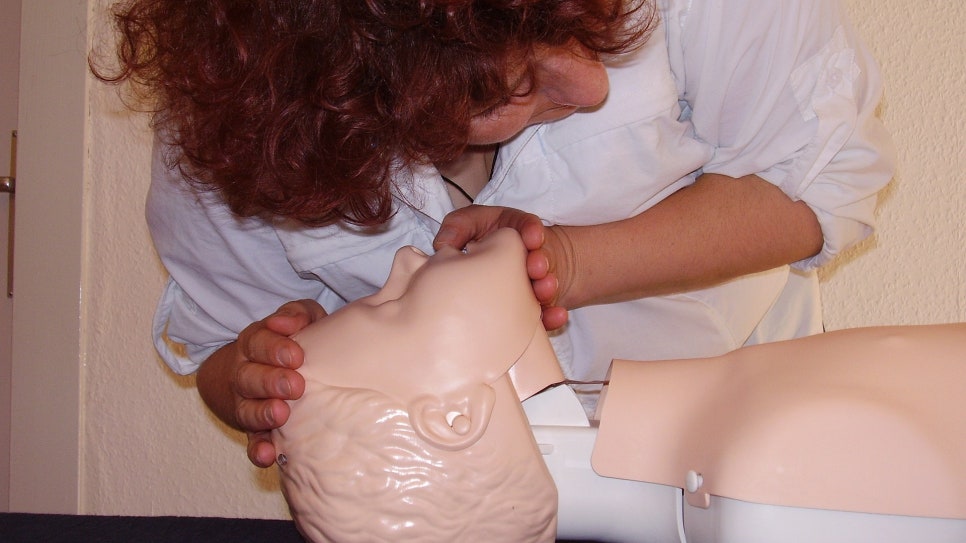
· Before giving rescue breaths, check the patient’s mouth and remove any visible foreign body. If no foreign body is visible, give 2 rescue breaths.
· Repeat 30 chest compressions and 2 rescue breaths, and check the patient’s mouth before giving rescue breaths to remove any foreign body.
· Continue cardiopulmonary resuscitation until the 119 emergency team arrives.
- Infant Airway Obstruction
For infants under 1 year old, perform the following method.
· First, support the child on the rescuer’s arm with the face facing downward. At this time, make sure the child’s face is lower than the chest.
· Pat the child’s back 5 times in a row with the palm of your hand.
· Then turn the child forward again and compress the center point just below the line connecting the nipples with two fingers 5 times.
· Repeat until the foreign body comes out, and remove it if it is identified.
- Precautions
Do not sweep inside the mouth with your fingers before the foreign body has been visually confirmed.
If the foreign body is not clearly visible, it is likely located deep inside and difficult to remove. If handled incorrectly at this point, it may be pushed even deeper. Therefore, it is best to remove it with your fingers only when the foreign body has been visually confirmed.
So far, I have explained the management of airway obstruction caused by a foreign body.
In the next section, we will learn about arrhythmia.
Source: Korea Centers for Disease Control and Prevention, National Health Information Portal