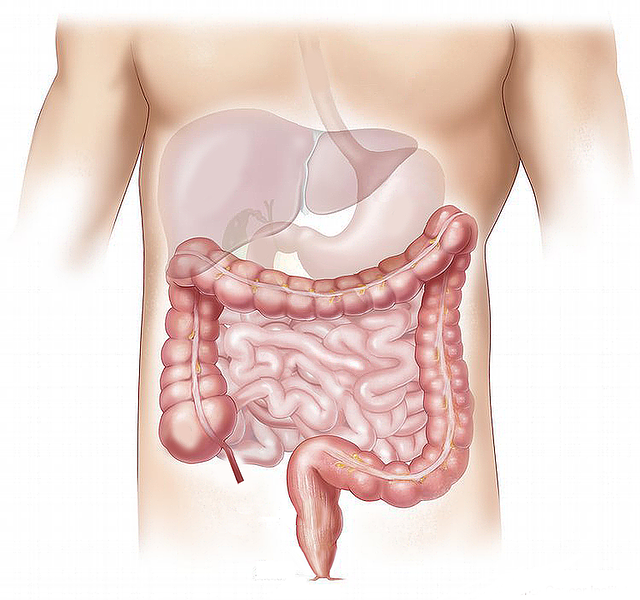
< What Is Colorectal Cancer? >
- Colorectal cancer refers to malignant tumors that develop in the colon and rectum. Depending on where they occur, cancer in the colon is called colon cancer, and cancer in the rectum is called rectal cancer; together, they are collectively called colorectal cancer or colon and rectal cancer. Since most of the large intestine is the colon, the term large intestine is sometimes used in context to mean only the colon.
< Types of Colorectal Cancer >
-
Most colorectal cancers are adenocarcinomas that arise from glandular cells in the colonic mucosa, and they are known to develop from benign adenomatous polyps. A polyp refers to a mass that protrudes like a lump because the tissue of the gastrointestinal mucosa has partially overgrown excessively, and an adenoma is a tumor formed by the proliferation of glandular cells. About 5–15% of all colorectal cancers occur due to genetic factors.
-
In addition to adenocarcinoma, lymphoma, neuroendocrine tumors, and leiomyosarcoma can also arise primarily, meaning they can occur on their own rather than as a result of another disease. Lymphoma of the colon accounts for less than 1% of all malignant tumors of the digestive tract and 10–20% of digestive tract lymphomas. It commonly develops in the ileocecal region, which is the beginning of the large intestine, and its symptoms are the same as those of adenocarcinoma; it is sometimes discovered as a mass in the lower right abdomen.
-
Neuroendocrine tumors are slow-growing tumors that arise from neuroendocrine cells in the gastrointestinal tract, pancreas, ovaries, lungs, and other organs. They mainly occur in the appendix and rectum, and most do not cause symptoms. Cases in which they metastasize or become malignant and cause carcinoid syndrome are extremely rare.
-
A very rare malignant tumor called Kaposi sarcoma can also occur in the colon. This sarcoma is caused by a herpesvirus. It most commonly appears on the skin, but it can occur in any organ except the brain, and it is frequently found in patients with acquired immunodeficiency syndrome. In the colon or rectum, it appears as red patches, nodules, or polyps.
< Risk Factors That Cause Colorectal Cancer >
-
Patients aged 50 or older
-
Diet - Dietary habits have long been known as the environmental factor that has the greatest influence on the development of colorectal cancer. It has been confirmed that continuing to eat foods high in animal fat and saturated fat, or enjoying red meat such as pork and beef, processed meats such as sausages, ham, and bacon, increases the risk of developing colorectal cancer. In addition, low-fiber diets and refined, low-residue diets—foods that are low in fiber and are digested and absorbed quickly, leaving little behind in the intestines—also increase the likelihood of colorectal cancer.
-
Lack of exercise - According to studies conducted recently, mainly in the West where the incidence of colorectal cancer is high, occupations with heavy labor are associated with a relatively lower risk of colon cancer, and physical activity during leisure time as well as during work hours lowers the risk of colon cancer. Physical activity and exercise promote intestinal peristalsis, reducing the time stool spends passing through the intestines, and thereby reducing the time carcinogens in the stool are in contact with the intestinal mucosa, which suppresses the carcinogenic process.
-
Obesity - Being overweight is known to increase the risk of colorectal cancer by about 1.5 to 3.7 times, and an increase in waist circumference is also one of the risk factors.
-
Alcohol consumption - As diets in Korea have recently become more Westernized, the incidence of colorectal cancer is rising, just as it has in developed countries in Europe and the United States. Foreign studies have reported both that heavy drinking increases the risk of colorectal cancer and that it does not. More research is needed, but many scholars suspect that heavy drinking may increase the risk of colorectal cancer.
-
Genetic factors - It has been found that 5% of colorectal cancers are clearly caused by heredity, and an additional 5–15% are known to be related to genetic predisposition. Unlike colorectal cancer caused by environmental factors, colorectal cancer caused by genetic factors often has a clear cause. Also, because people are born with defective genes, a common feature is that colorectal cancer develops at a relatively young age, and because gene function is not limited to the colon, many other organs also show abnormal findings. Among hereditary conditions, the representative one related to colorectal cancer is hereditary polyposis syndrome. This is a general term for diseases in which multiple polyps develop in the colon, and it includes familial adenomatous polyposis, juvenile polyposis, Peutz-Jeghers syndrome, Cowden syndrome, MUTYH-associated polyposis, Muir-Torre syndrome, and Turcot syndrome.
-
Adenomatous polyps - Although polyps are benign tumors, those classified histologically as adenomatous polyps can progress to tumors, that is, colorectal cancer.
-
Inflammatory bowel disease - Inflammatory bowel disease can be broadly divided into colitis and Crohn’s disease. Inflammatory bowel disease is a condition in which inflammation occurs in the intestines chronically (for more than 6 months). If you have such a condition, the risk of developing colorectal cancer can rise by 4 to 20 times, so regular colonoscopy examinations are necessary.
Source - Korea Disease Control and Prevention Agency, National Health Information Portal