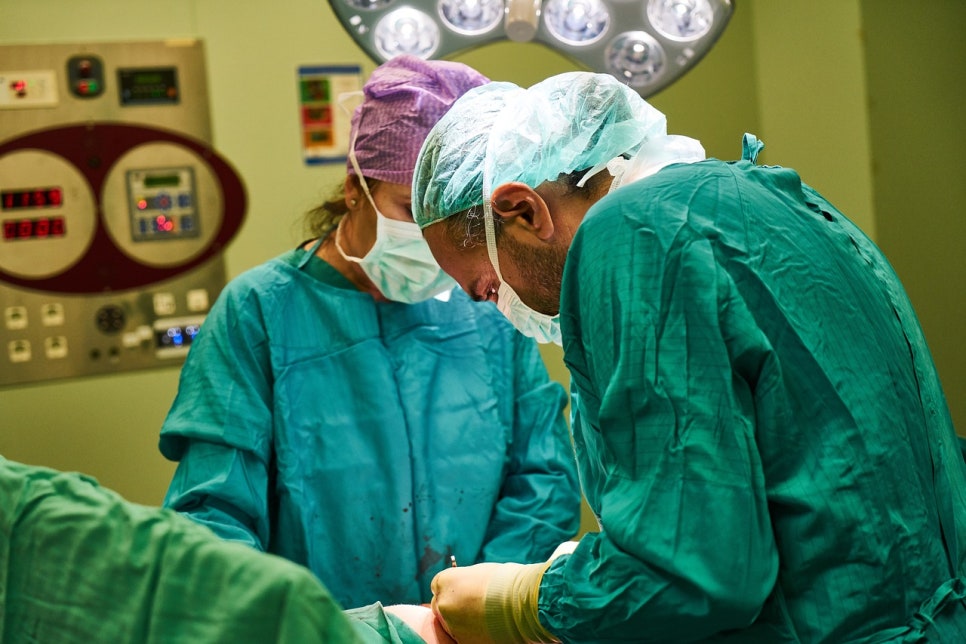
<< Treatment Methods for Colorectal Cancer 1. Surgical Treatment >>
-
The most fundamental treatment for colorectal cancer is surgery. The proper surgical principle for colorectal cancer is to remove the colon with sufficient margins on both the distal and proximal sides of the tumor, centered on the tumor, and also to extensively remove the lymph nodes. In the case of colorectal cancer, surgery can also be performed through laparoscopy without opening the abdomen. Laparoscopic surgery refers to a method of surgery performed through small openings (incisions) for inserting a laparoscopic camera and laparoscopic surgical instruments, unlike open surgery, which requires a large incision. Because the incision is small and there is less damage to nearby organs during surgery, postoperative pain is less and recovery is faster, allowing a quicker return to daily life. The hospitalization period is shorter, which is also an economic advantage.
-
Endoscopic resection: Early colorectal cancer can be treated with endoscopic resection alone if all conditions are met, such as good differentiation of cancer cells, no invasion of blood vessels or lymphatic vessels, and confinement to only the mucosa or part of the submucosal tissue. If a careful review of the removed tissue shows that the depth of cancer invasion is greater, the cell differentiation is poor, or there are findings of invasion into blood vessels or lymphatic vessels, secondary open surgery or laparoscopic surgery may be needed to extensively remove the colon.
-
Surgical method for cancer in the colon: For cancers located in the cecum, ascending colon, and proximal transverse colon (the part closer to the entrance of the colon), a right hemicolectomy is performed, removing part of the small intestine and part of the transverse colon as well. After resection, an ileocolic anastomosis is performed to connect the ileum at the end of the small intestine with the cut end of the transverse colon. Anastomosis is also called a connection procedure and refers to surgery that joins organs inside the body.
<< Treatment Methods for Colorectal Cancer 2. Chemotherapy >>
-
Chemotherapy is a treatment method that uses anticancer drugs to treat cancer by injection or oral administration. Depending on the situation, a single drug may be used, or multiple drugs may be combined at the same time. Because anticancer drugs are delivered throughout the body, this is a systemic treatment that is effective not only for cancer in the colon but also for cancer that has spread to the liver or lungs.
-
Types of anticancer drugs used to treat colorectal cancer: Fluoropyrimidine-based drugs such as 5-fluorouracil, UFT, and capecitabine, as well as irinotecan and oxaliplatin, are widely used and have shown effectiveness in colorectal cancer. In addition, bevacizumab (brand name Avastin) and cetuximab, targeted therapies developed in the mid-2000s, became covered by health insurance as first-line treatments for recurrent or metastatic cancer from March 2014 and are being used more and more.
-
Targeted therapies used to treat colorectal cancer: In addition to the bevacizumab and cetuximab mentioned above, regorafenib was approved and began being marketed in Korea in 2013 as a targeted therapy used for colorectal cancer. Aflibercept also received domestic marketing approval in 2013, but it has not yet been marketed. When targeted therapies are administered together with anticancer chemotherapy, they have been shown to slow disease progression and, in some cases, extend survival compared with anticancer chemotherapy alone. They have also shown an effect of extending survival when administered alone in metastatic colorectal cancer that has become resistant after chemotherapy.
-
Immunotherapy used to treat colorectal cancer: Recently, anti-PD-1 immunotherapies have shown excellent antitumor effects in several cancer types. Among anti-PD-1 immunotherapies, pembrolizumab was administered to patients with metastatic colorectal cancer with deficient DNA mismatch repair who had progressed on standard treatment, and a response rate of 40% was obtained. The results showing that this antitumor effect was sustained were published in the prestigious medical journal the New England Journal of Medicine.
-
Duration of chemotherapy: When the cancer has been completely removed (some cases of stage 2, stage 3, and stage 4), adjuvant chemotherapy is administered for 6 months to reduce the chance of recurrence. If surgery is not possible or if some cancer remains after surgery, the duration of chemotherapy cannot be predetermined. The treatment period varies depending on the response to the anticancer drugs, the severity of side effects, the patient's health status, and other factors, so it may end early or continue for more than a year.
<< Treatment Methods for Colorectal Cancer 3. Radiation Therapy >>
-
Radiation therapy is a local treatment method and is commonly used as adjuvant treatment before or after surgery for advanced rectal cancer with a high risk of recurrence, that is, cancer at stage 2 or 3. However, even in stage 4 disease, if the distant metastasis is resectable, adjuvant radiation therapy may be performed, and it may also be carried out after local resection in stage 1 cancer to prevent recurrence.
-
Duration of radiation therapy: Radiation therapy is received on an outpatient basis for about 10 to 20 minutes a day, 5 times a week from Monday to Friday. The treatment period is usually around 6 weeks for preoperative or postoperative adjuvant treatment, and 7 to 8 weeks for primary treatment without surgery or for recurrent cancer. In some cases, it may be as short as 2 to 4 weeks, but this is exceptional.
Source: Korea Disease Control and Prevention Agency National Health Information Portal / National Cancer Information Center