Hello. I am Shin Seung-hwan, the director of Yonsei U-Line Dental Clinic Garak Branch, located in Garak-dong, Songpa-gu.
Today, I would like to talk about how teeth grinding can affect changes in facial shape.


Do you ever feel that your face is getting larger as you age?
Of course, you may gain weight as you get older,
or your face may look that way because your skin has become saggy,
but surprisingly, the habit of grinding or clenching your teeth can also cause changes in facial shape.


When people hear about teeth grinding, many say, “But I don’t grind my teeth.”
However, teeth grinding does not necessarily mean
only grinding your teeth while making a screeching sound.
Quietly clenching your teeth can have the same effect.


If the jaw muscles remain tense
even at night, when we should be resting,
the muscles may eventually develop and change the shape of the face.

If the habit of clenching your teeth continues, the jaw muscles gradually become larger,
which can eventually make your jaw look square.
Of course, some people naturally have a larger bone structure,
but in many cases, the jaw muscles become enlarged because of daily habits.
In particular, people who chew a lot of gum or enjoy tough foods
such as squid or beef jerky may develop their jaw muscles more easily.
The problems caused by teeth grinding are not limited to the shape of the jaw.



In your 20s, the surface of your teeth may be strong enough
that you do not notice any particular discomfort,
but as you age, the constant pressure placed on your teeth
can cause significant wear and eventually lead to chips or cracks.

That is why, in your 30s and 40s, you may suddenly feel
a sharp, tingling pain when chewing.
When people visit the dentist with these symptoms,
their teeth are often already cracked or chipped.

Teeth grinding does not occur only at night;
it can also happen during the day.
For example, former baseball player Park Chan-ho reportedly had a habit of clenching his teeth
while exerting force when throwing the ball,
which caused considerable tooth wear.

That is why he reportedly wore a device during his playing career
to protect his teeth during the day as well.
In this way, there may be moments when you unconsciously clench your teeth tightly.


For example, in movies or television dramas, there are scenes in which a woman in labor bites down on a towel or belt.
This can also be viewed as a protective measure intended to reduce
the force placed on the teeth.


There is also a simple way to check at home.
If you examine the inside of your tongue or cheek,
you may find bumpy marks where your teeth come into contact.
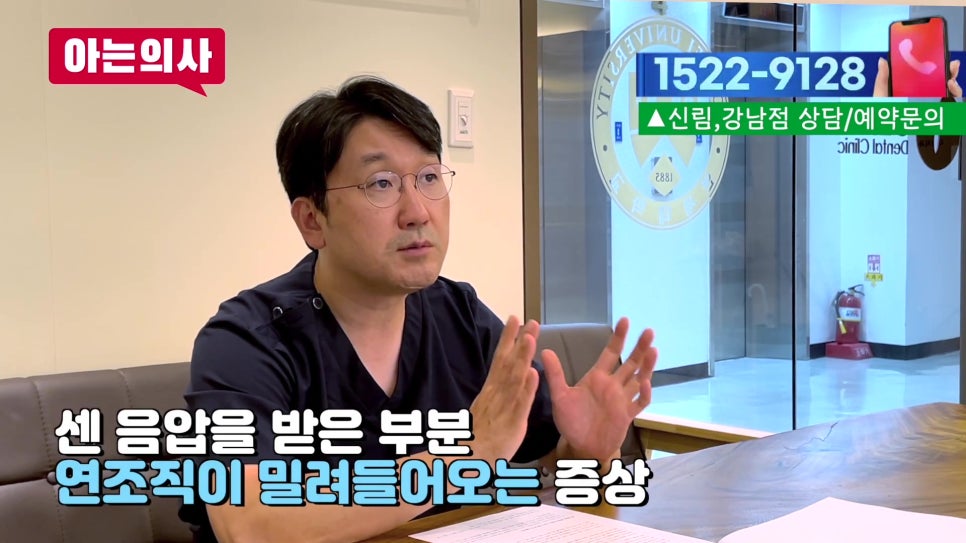
These occur when tissue is pushed inward
by continuous, strong pressure.



If you have marks like these, there is a strong possibility
that you unconsciously clench your teeth.
If teeth grinding continues for a long time, it can cause problems not only with tooth wear
but also with the jaw joint.


In severe cases, you may feel as though your jaw is slipping out of place,
or experience increased pain when chewing hard foods.
That is why teeth grinding should not simply be left untreated;
it is worth having it checked at least once.


There are roughly two treatment options to consider.
The first is to reduce the muscles with Botox injections
when the jaw muscles have become excessively developed.
However, rather than being a fundamental solution,
this can be considered a supportive treatment to relieve tension in the jaw muscles.

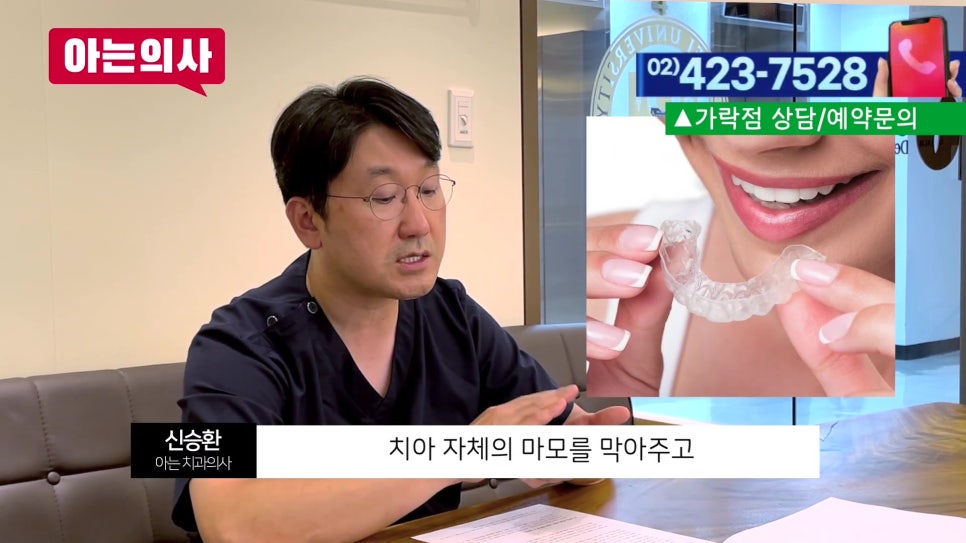

The second is to wear a device to prevent teeth grinding.
Wearing it especially at night can help prevent tooth wear
and reduce tension in the jaw muscles,
so it is recommended as a fundamental treatment option.
If you feel that your face is getting larger,
or your teeth seem more sensitive than before, consider whether you may be grinding your teeth
and it would be a good idea to have a dental examination.
For healthy teeth and jaws, it may also help to pay attention to whether you have a habit
of clenching your teeth tightly in your everyday life.