Hello. I am Kang Dong-ho, the director of the Sillim branch of 연세유라인치과의원, located near Exit 7 of Sillim Station in Sillim-dong, Gwanak-gu.

You may have heard people say, “If you do not floss, you will get cavities.”
But what exactly does that mean?
We brush our teeth every day, right?
We diligently brush the upper and lower surfaces, the sides, and even the chewing surfaces with a toothbrush.



However, teeth are three-dimensional structures rather than simple flat surfaces, so there are limits to the areas a toothbrush can clean.
Generally, only three surfaces can be brushed: the cheek side, the tongue side, and the chewing surface.
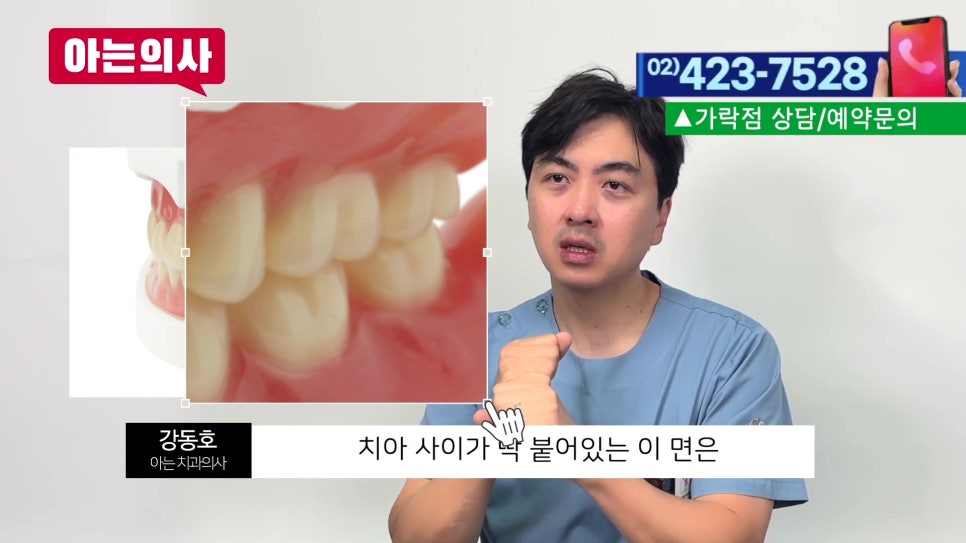

The problem area is between the teeth, known as the “interproximal surface.” The toothbrush bristles do not reach this area well.
In addition, in young people with healthy gums, the gums fill the spaces between the teeth effectively, so food does not tend to get stuck easily.


For this reason, people may not worry much about cavities, but this area is actually extremely important.
Tooth shapes vary from person to person.
Some people have molars with a rounded shape, while others have molars that are somewhat angular.


When rounded molars meet, a slightly open gap can form between them.
Food debris and plaque can easily become trapped in this space.
In such cases, the structure can be considered more susceptible to cavities developing between the teeth.


Children and people in their teens and twenties are especially in a period when their teeth are more vulnerable to cavities.
If plaque trapped between the teeth is left unattended, cavities can develop quickly.
That is why pediatric dentists place such strong emphasis on flossing.
Similarly, we tell adults that they should make flossing a regular habit at least through their twenties.


In fact, one of the most common types of cavities among people in their twenties is an “interproximal cavity.”
There are the chewing-surface cavities we commonly think of, but quite a few people also receive treatment for cavities that begin between the teeth.


However, many people think of floss as merely an aid to use when food gets stuck.
In fact, using floss once every day before bed is highly effective for preventing cavities.



Why specifically at night? The mouth becomes dry at night.
As saliva production decreases, the mouth’s ability to neutralize acidity also declines.
Cavities develop because of acids. The less saliva there is, the longer the teeth are exposed to acid, which can eventually lead to cavities.


That is why it is important to keep the mouth as clean as possible before going to bed.
For middle-aged and older adults whose gums have receded somewhat, the spaces between the teeth become wider. In addition to floss, they should also use an “interdental brush.”


In particular, after the age of 60, root-surface cavities, or “root caries,” occur frequently.
The decrease in saliva production that comes with age also plays a role.


In such cases, floss alone is not enough. You should use an interdental brush to clean by rubbing between the areas around the tooth roots as well.
Floss should not simply be inserted up and down like a toothpick. Instead, you should rub it as if you are cleaning the surfaces.


To sum up, one reason cavities develop is bacteria and plaque on the interproximal surfaces between the teeth, an area that is easy to overlook.
To prevent this, regardless of age, it is important to develop the habit of carefully cleaning even the hard-to-reach areas by using floss or an interdental brush.


With these care habits, you can reduce not only cavities but also gum disease and bad breath.
Remember that if you establish good habits from a young age, you may be able to avoid more extensive dental treatment later on.