Hello. I’m Shin Seung-hwan, chief director of Yonsei U-Line Dental Clinic, Garak Market Station Branch, located near Exit 4 of Garak Market Station in Garak-dong, Songpa-gu.
Many people experience discomfort because their jaw makes a noise or because their jaw hurts.
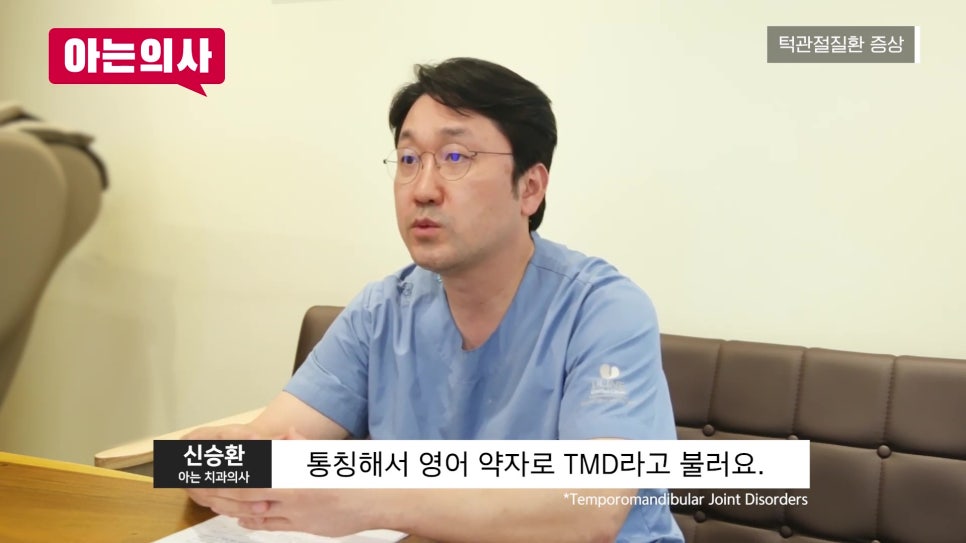
People often use various terms such as temporomandibular joint disorder, jaw disc, or TMJ disorder, but the accurate collective term is temporomandibular joint disorder.
We also call it TMD, the English abbreviation.
Simply put, it refers to the entire condition in which discomfort develops in the jaw joint.
In most cases, it starts with a clicking sound in the jaw.
You know the ‘click’ sound that happens when you press firmly on a finger joint?
In a similar way, a light sound begins to occur in the jaw.
As time passes, it may progress from just making a sound to also causing pain when opening the mouth wide, or even to a situation where the mouth hardly opens at all.
Sometimes the jaw dislocates while opening the mouth and does not go back in easily.
The reason someone who had no special symptoms suddenly develops jaw pain and discomfort is often that the jaw joint was subjected all at once to excessive movement beyond its range of motion.
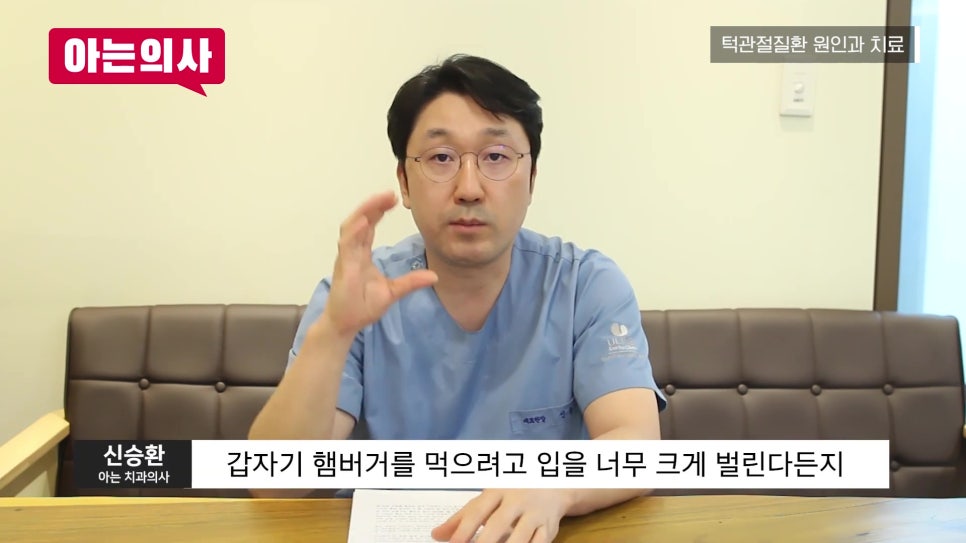
For example, this can happen when you open your mouth too wide to take a big bite of a hamburger,
or when you yawn very widely,
or when you sing forcefully and open your mouth too much.
The muscles and ligaments around the joint have a set range, and if they suddenly move beyond it, they can get strained and cause pain.
It is similar to the mechanism that causes pain when you sprain your wrist or ankle.
The problem is that, unlike other joints, it cannot be immobilized with a cast.
We have to speak, eat food, and breathe, so we cannot completely fix the jaw in place.
That is why basic care that can be done at home is important.
First, please avoid actions that open the jaw wide.
When yawning, support your jaw with your hand to reduce the range, and repeatedly touching or shaking it because it hurts is also not good. The habit of resting your chin on your hand, or postures in which you lean your jaw to only one side, are also very bad for the jaw joint, so they should be avoided.
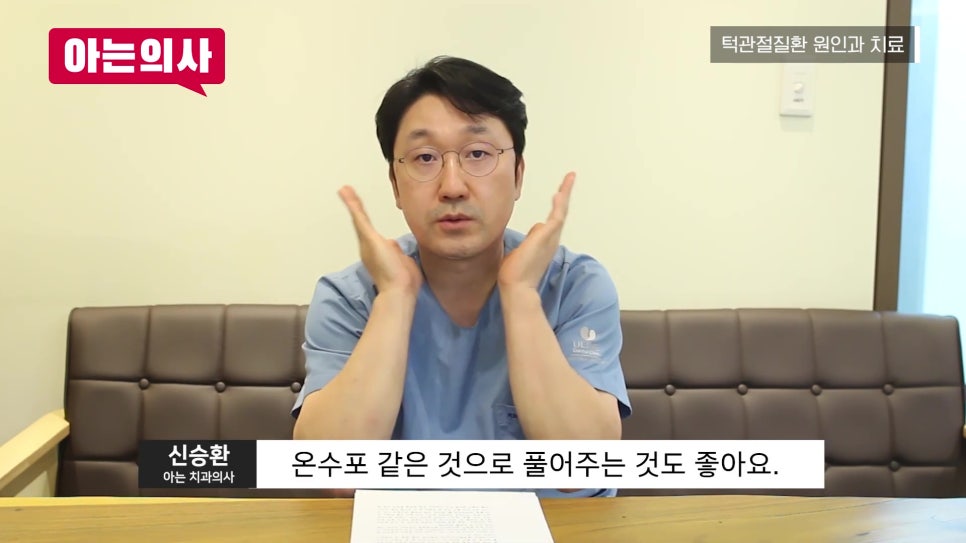
When eating, it is better to focus on soft foods rather than chewy or hard foods.
Warm compresses or hot packs can also help.
It is fortunate if these basic measures are enough to ease the symptoms, but if the pain is severe or lasts for a long time, it is better to get a prescription from a dental clinic.
Taking painkillers or muscle relaxants for about 1 to 2 weeks may also lead to significant improvement in the early stages.
However, if this still does not solve the problem and the discomfort continues, there is a high possibility that it is not just a simple temporary pain, but a stage where it is progressing into a full-blown temporomandibular joint disorder.
In that case, more active treatment is needed.
A representative treatment is a device called a splint.
Many people know it as a ‘teeth grinding appliance,’ right?
There are several types,
but collectively, they are called splints.
Wearing the device while sleeping helps stabilize jaw movement and relax tense muscles.
Another important treatment is occlusal therapy.
Jaw joint symptoms often occur when the bite is unbalanced,
when there is a habit of using only one side of the jaw,
or when missing teeth have disrupted the bite.
In such cases, occlusal therapy may also be performed together to help restore natural jaw movement by subtly adjusting the height and shape of the teeth.
In conclusion, a temporomandibular joint disorder is not necessarily a major illness just because there is a sound, but if left untreated, it can lead to pain and functional limitations.
In many cases, proper management in the early stage is enough to improve the condition, and if needed, it can be managed stably with a splint or occlusal therapy.
This has been Yonsei U-Line Dental Clinic near Garak Market Station in Garak-dong, Songpa-gu.