Garak Market Station Dentist – A Complete Overview of Toothache Causes | Why Your Teeth Hurt When Chewing or Eating Cold Foods
Hello, I’m Shin Seung-hwan, the chief director of Yonsei U-Line Dental Clinic, Garak Market Station Branch, a dentist located in Garak-dong, Songpa-gu.
Today, I’ll整理 the most common reason patients visit the dentist:
toothache.
Symptoms such as “It hurts when I chew,” “My teeth feel sensitive when I eat something sweet,” and “I get a sharp sensation when I drink cold water” are things most people have experienced at least once.
Because the causes differ depending on the symptoms, knowing what each symptom may indicate can help you avoid missing the right time for treatment.
- The Most Common Reason for Visiting the Dentist Is “Pain”
Most patients visit the clinic because of discomfort such as the following:
-
Pain when chewing food
-
A sharp, sensitive feeling when eating sweet foods
-
Tooth sensitivity to cold foods such as ice cream
-
Pain even when eating hot foods
-
Sensitive or bleeding gums when brushing
Because each of these symptoms may have a slightly different cause, let’s look at them one by one.

- Tooth Sensitivity to Cold or Sweet Foods: The Cause May Be “Cavities”
The most common cause is a cavity (dental caries).
The surface of a tooth is protected by hard tissues called enamel and dentin, which shield the nerve from external stimuli.
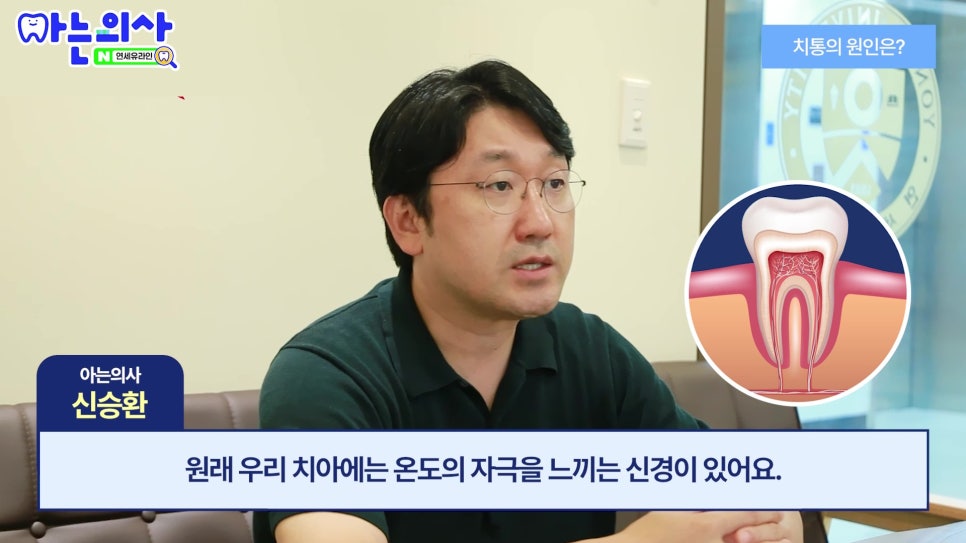
However, when this protective layer is damaged or eroded by a cavity, the nerve inside the tooth (the pulp) becomes more sensitive to changes in temperature.
Teeth naturally contain nerves that detect temperature. When an excessively cold or hot stimulus is applied, they send a pain signal to protect themselves.
Because the distance to the nerve becomes shorter in areas where the tooth has been lost to decay, the stimulus is transmitted more quickly and strongly, which is felt as pain.
- What Is “Periodontitis”?
A condition in which the dental nerve (pulp) becomes inflamed is called pulpitis.
Periodontitis can broadly be divided into two patterns.
✔ Temporary periodontitis
-
A sharp sensation occurs when cold water or ice is applied, but quickly disappears within 1–3 seconds
-
It often improves when the cavity is treated appropriately
✔ Persistent periodontitis
-
The sharp sensation is deep and lasts for a long time, and the pain does not subside easily
-
More active treatment, including root canal treatment, may be necessary
- Pain: When You Can Monitor It vs. When Treatment Is Needed
Not every toothache means that immediate treatment is necessary.
Situations that can be monitored
-
When excessive, momentary pressure is placed on a tooth while chewing hard food
-
When temporary sensitivity develops after external trauma, such as falling or bumping the tooth
In these situations, changes in the pain can be monitored for several days, or as long as one to two months.
However, if the pain gradually worsens, a dental examination is necessary.
Situations that require treatment
-
A cavity that is visibly darkly discolored or damaged → cavity treatment such as resin or an inlay
-
Pain when tapping the tooth, or recurring pain whenever you chew
-
A tooth that used to be sensitive only to cold foods but now also hurts with hot foods
The last situation in particular may be a sign that pulpitis has progressed considerably, and root canal treatment may need to be considered.
At the dental clinic, the treatment plan is determined after checking whether inflammation has spread outside the tooth root through percussion tests, temperature sensitivity tests, and, when necessary, X-rays.
- If Several Molars Hurt Even Though the Teeth Look Fine: Consider “Sinusitis”
In some cases, the teeth themselves have no particular problem, yet several upper molars feel uncomfortable at the same time when chewing.
In such cases, the dentist will ask whether you have recently had a severe cold or have chronic sinusitis.
This is because the roots of the upper molars are located very close to the maxillary sinus, a space within the sinuses.
When inflammation develops inside the maxillary sinus due to a cold or sinusitis, it can irritate the roots of adjacent teeth and cause a strange sensation or pain when chewing.
These cases are characterized by the following:
If there is no abnormality in the teeth themselves, treatment by an ear, nose, and throat specialist—such as treatment for sinusitis, rhinitis, or maxillary sinusitis—may take priority over dental treatment.
- How to Respond If You Have a Toothache
| Symptom | Possible cause | Response |
|---|
| Brief sensitivity to cold that quickly subsides | Temporary pulp irritation | Monitor the symptoms or receive cavity treatment |
| Persistent sensitivity to cold and sweet foods | Cavity, early pulpitis | Cavity treatment is needed |
| Pain when chewing + pain with hot foods | Advanced pulpitis | Consider root canal treatment |
| Pain when the tooth is tapped | Advanced pulpitis; possible spread of inflammation | A detailed examination, including X-rays, is needed |
| Several upper molars feel uncomfortable at the same time | Possible sinusitis or maxillary sinusitis | Consider receiving care from an ear, nose, and throat specialist as well |
In Closing
Toothache does not simply end with “it hurts.” The cause and treatment approach can differ depending on the nature of the pain.
In particular, if the pain repeatedly occurs when chewing beyond brief sensitivity to cold foods, or if there is pain when the tooth is tapped, this may be a sign that pulpitis is progressing. We recommend that you do not put off seeing a dentist.