
How to Care for Facial Dead Skin

These days, during seasonal transitions like this, many people are struggling with dead skin buildup. However, if you simply rub off the white flakes that appear on the face and body, it can actually lead to secondary problems such as dry skin.
�
In skin care, exfoliation helps healthy skin regeneration and is effective in maintaining and promoting the cell turnover cycle. It also helps improve the skin through the removal of dead skin cells and cell regeneration, and it helps keep the skin healthy by normalizing the keratinization process.
�
Why does dead skin form?

Human skin goes through a turnover process in which dead cells shed and new cells are created every 28 days. However, external environmental factors, irregular sleep, eating habits, stress, and other causes can disrupt the turnover process, preventing dead skin from being removed properly.
�
When the body's metabolic activity decreases for various reasons, the cycle of shedding skin layers and regenerating new cells does not occur normally, causing the skin to become rough and dead skin to form.
�
Do you really need to remove facial dead skin?
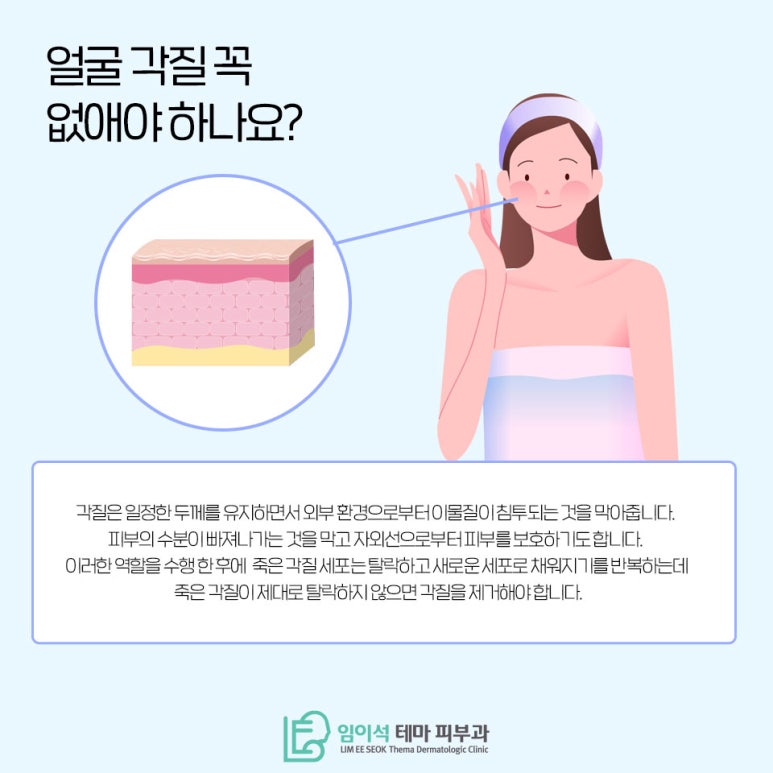
Dead skin maintains a certain thickness and helps prevent foreign substances from penetrating from the outside environment. It also helps prevent moisture from escaping the skin and protects it from ultraviolet rays. After carrying out these roles, dead skin cells repeatedly shed and are replaced by new cells. If dead skin does not shed properly, it should be removed.
�
For people whose shedding and regeneration of dead skin occur normally, exfoliation is not necessarily required. But if a dead skin layer continues to remain on the skin, it can cause problems such as skin aging, skin disease, itching, and wrinkles, so it should be removed.
�
Precautions for facial dead skin care

Exfoliating every day is not good for the skin. Rubbing the face with a washcloth or similar item can cause skin trouble and damage, so careful care is important. Also, using scrub products too often to remove dead skin can irritate the skin and cause skin trouble or dryness, so frequent use of scrubs should also be avoided.
Exfoliation should also be different depending on skin type

Because the causes of dead skin differ by skin type, it is best to use different exfoliation methods, frequencies, and products.
Dry skin: In the case of dry skin, dead skin forms because the skin lacks moisture and sebum, so it is best to gently remove it after applying a moisturizing cream. As for products, it is best to use gentle, non-granular gel-type or wash-off exfoliating products. Exfoliating too often can make the skin even drier, so doing it about once every two weeks is recommended. After removal, use moisturizing products such as cream and essence to balance the skin's oil and moisture levels.
�
Oily skin: Oily skin, which produces plenty of sebum and accumulates a thick layer of dead skin, should be exfoliated regularly. Once or twice a week is appropriate, and using scrub products that help open pores is recommended. However, frequent use of scrub products can damage the skin, so it is good to use a scrub product once a week and a gommage type product the other time, which is applied to the skin and then peeled off by hand. Opening the pores sufficiently with a steam towel to soften the skin before exfoliating is even more effective, and after exfoliation, you can provide moisture by using a moisturizer that does not contain oil.
�
Sensitive skin: Sensitive skin can develop skin trouble from even minor irritation, so once or twice a month is appropriate. It is best to avoid actions that may irritate the skin as much as possible, and when exfoliating, it is best to remove dead skin lightly with a lotion or cream type product.
�
Normal skin: This skin type has a well-balanced oil and moisture level and sheds dead skin smoothly, so exfoliation is not really necessary. However, during seasonal transitions or in spring and autumn, normal skin can also develop dead skin, so doing it once or twice a week is recommended. When exfoliating, use a product with very few granules and gently rub it off, and use moisture packs and similar products to balance the skin's oil and moisture levels to prevent dryness and sensitivity.
�
Facial dead skin Q&A

Q1. Is it true that if you keep removing dead skin, it will appear more often and in greater amounts??
A1. Normal dead skin sheds invisibly and is naturally replenished. Dead skin is necessary for skin protection. When dead skin is removed, our body makes it again, but that does not mean it produces more of it.
�
Q2. Why does dead skin occur more in dry weather than in summer??
A2. The moisture content of the skin's stratum corneum is about 13%, but when the weather becomes dry, that level drops below 10%, and sebum secretion also decreases, causing moisture inside the skin to evaporate more easily. As a result, dead skin does not shed properly, and more dead skin forms and skin damage occurs more frequently in dry weather seasons such as seasonal transitions, spring, autumn, and winter than in summer.
�
Q3. Does dead skin cause skin diseases??
A3. Dead skin itself does not cause skin trouble. However, dead skin layers that do not shed in time disrupt the skin's oil and moisture balance and block moisture replenishment within the skin, which leads to skin trouble. Even normal skin can turn into dry skin if dead skin is not properly removed, because it prevents the skin from receiving proper nourishment and moisture.
�
When skin becomes dry and dead skin forms, many people spray mist or use lip balm, lotion, or cream to press down the white, flaky dead skin. But this is only a temporary fix. If the underlying problem is not resolved, dead skin will continue to bother us. Also, no matter how good a dead skin care method may be, it may not suit everyone because each person has different constitution and environment, so checking your skin condition through a consultation with a specialist and receiving professional care is also one option.